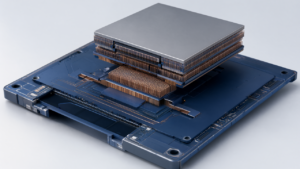
Key Findings: Hybrid Copper Bonding for HBM4E Achieves Thinner Packages and Enhanced Thermal Performance
Samsung has announced its latest research findings on next-generation HBM4E (High Bandwidth Memory 4 Enhanced) packaging strategies. The study reveals that Hybrid Copper Bonding (HCB) technology can achieve both superior thermal characteristics and physical miniaturization compared to traditional Thermo-Compression Bonding (TCB). This represents a significant advancement in memory technology for the AI and high-performance computing sectors.
Technical & Product Details
- Advantages of Hybrid Copper Bonding (HCB): HCB is a technology that directly bonds copper-to-copper, eliminating the need for solder bumps and underfill materials. This not only allows for a substantial reduction in joint thickness but also creates direct copper paths with high thermal conductivity, resulting in superior heat transfer.
- Elimination of Underfill Materials: In conventional TCB processes, underfill materials were essential to ensure the reliability of microbumps. HCB removes this requirement, offering greater material selection flexibility, process simplification, and reduced thermal resistance.
- Reduced Hot Spot Junction Temperature: Research demonstrated that HCB effectively reduces junction temperatures at hot spots within HBM stacks. This directly contributes to the stable operation and extended lifespan of memory chips.
- Over 15% Reduction in Package Stack Height: The elimination of underfill materials and thinner bonding enable a reduction of over 15% in the overall package stack height compared to conventional TCB-based designs. This miniaturization allows for the stacking of more memory dies in a limited space, contributing to higher system density.
Background & Industry Context
With the increasing demand from AI and data centers, HBM has become key to maximizing the performance of GPUs and NPUs. However, the higher stacking density and increased speeds of HBM create significant challenges related to thermal management and physical package size constraints. Samsung’s HCB technology offers an innovative solution to these challenges, paving the way for the mass production of next-generation HBM.
Strategic Significance & Outlook
The introduction of HCB technology in HBM4E will directly contribute to enhancing the performance of AI accelerators, enabling faster and more efficient AI processing. The reduction in package thickness allows for the integration of more HBM stacks into a single chip package, further boosting the computational power of future AI processors. This Samsung technology is poised to establish new standards in high-bandwidth memory evolution and accelerate innovation across the semiconductor industry.
Source: https://www.sammyfans.com/2026/06/25/samsung-finds-thinner-cooler-path-for-hbm4e-ai-memory/
Get our weekly technology intelligence — free
Receive an infographic that lets you judge at a glance whether each field’s analysis report is worth reading.
Subscribe Free — Weekly Tech Intelligence
By subscribing, you’ll receive Troy-Technical’s weekly technology intelligence newsletter.
- Your email and selected fields are used only to deliver the newsletter.
- We never share your information with third parties.
- You can unsubscribe anytime via the link in each email.
See our Privacy Policy for details.
Takes about a minute · Unsubscribe anytime