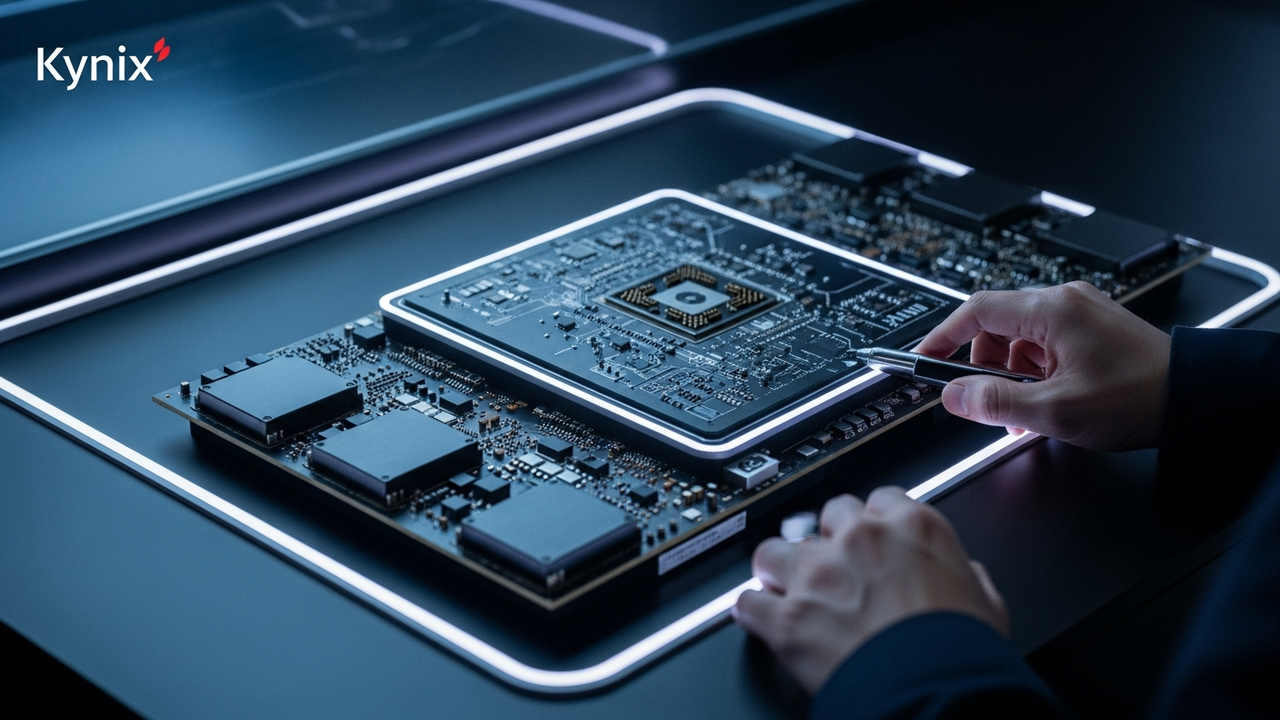
Key Findings: HBM4 Hybrid Copper Bonding Achieves Over 20% Thermal Performance Improvement
According to Kynix’s analysis, Hybrid Copper Bonding (HCB) technology for HBM4 (High Bandwidth Memory 4) has been confirmed to improve thermal performance by over 20% compared to traditional microbump architectures. This innovation is crucial for processors to maintain stable clock speeds in the high-load environments demanded by AI workloads.
Technical & Product Details
- Elimination of Solder Bumps and Underfill: HCB removes the need for solder bumps and underfill materials, which were essential in conventional HBM stacking. This results in thinner interconnects and eliminates a primary source of thermal resistance.
- Direct Copper-to-Copper Connection: HCB establishes highly efficient thermal conduction paths by directly bonding copper layers. Copper’s high thermal conductivity ensures that heat within the HBM stack is dissipated more rapidly and uniformly.
- Over 20% Reduction in Thermal Resistance: HCB significantly reduces thermal resistance by over 20% compared to conventional techniques. This improvement is paramount for effectively suppressing internal temperatures of HBM modules and preventing performance degradation (thermal throttling) due to overheating.
- Maintaining Clock Speeds Under AI Loads: In AI and High-Performance Computing (HPC) applications, continuous HBM access generates high thermal loads. The superior heat dissipation provided by HCB helps processors maintain their rated clock speeds under such conditions, maximizing the efficiency and throughput of AI computations.
Background & Industry Context
The rapid growth of the AI and HPC sectors strongly demands enhanced performance from HBM, which is integrated into GPUs and Application-Specific Integrated Circuits (ASICs). However, the increasing stacking density of HBM dramatically raises thermal density, making thermal management the biggest bottleneck for performance improvement. HCB is widely anticipated in the industry as a technology that fundamentally solves this thermal challenge.
Strategic Significance & Outlook
The adoption of HCB technology for HBM4 will accelerate the development of next-generation AI accelerators and contribute to the realization of more powerful and energy-efficient data centers. The dramatic reduction in thermal resistance will open new avenues for further increasing HBM stack counts and expanding data bandwidth. Kynix believes this technology will become an indispensable element in supporting the computing power of the AI era and establishing a new standard for semiconductor packaging technology.
Source: #
Get our weekly technology intelligence — free
Receive an infographic that lets you judge at a glance whether each field’s analysis report is worth reading.
Subscribe Free — Weekly Tech Intelligence
By subscribing, you’ll receive Troy-Technical’s weekly technology intelligence newsletter.
- Your email and selected fields are used only to deliver the newsletter.
- We never share your information with third parties.
- You can unsubscribe anytime via the link in each email.
See our Privacy Policy for details.
Takes about a minute · Unsubscribe anytime