Key Findings
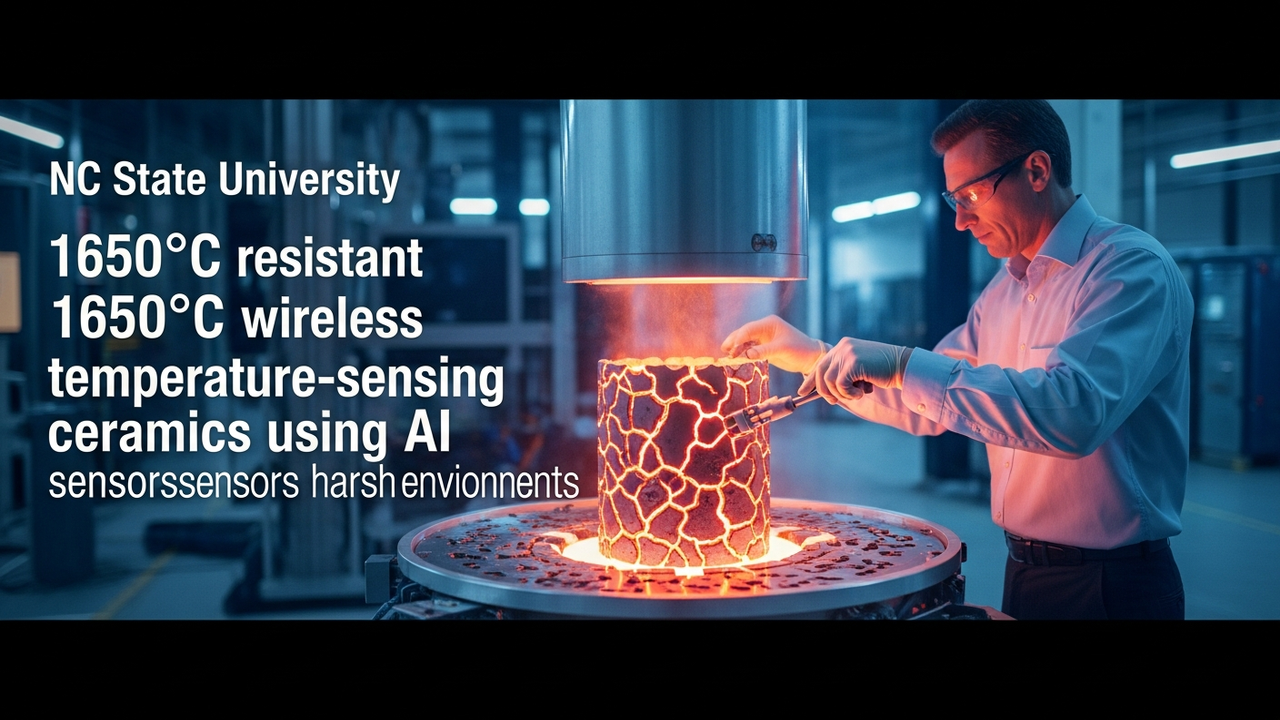
Researchers in the Department of Mechanical and Aerospace Engineering at NC State University have developed a groundbreaking metasurface-patterned ceramic sensor capable of wireless temperature sensing in extreme high-temperature environments, specifically up to 1,650°C. This innovation was made possible by integrating artificial intelligence (AI) throughout the entire design and optimization process. This breakthrough sets a new standard for real-time monitoring technologies in demanding applications such as aerospace, energy generation, and high-performance manufacturing.
Technical / Clinical Details
The developed ceramic sensor features nanoscale-designed metasurface patterns, which enable it to emit and modulate specific radio frequency (RF) signals. The research team employed advanced AI models to optimize the material composition, microstructure, and manufacturing processes. AI played a central role in analyzing vast datasets of material performance and manufacturing conditions to identify the most efficient and robust sensor designs.
This sensor measures temperature non-contact, effectively bypassing the degradation and failure issues that conventional contact-based sensors face in high-temperature environments. Specifically, it estimates material temperature with extremely high precision by analyzing frequency shifts and amplitude changes in the RF signals. This technology is particularly effective for data acquisition in environments inaccessible to humans, such as combustion chambers, turbine engines, nuclear power plants, and high-temperature chemical reactors.
Background & Context
Precise monitoring in harsh environments remains a significant challenge for modern industries. In high-temperature settings, conventional electronics and sensors quickly fail or have severely shortened lifespans. Consequently, there is a strong demand for reliable, real-time data acquisition to optimize aircraft engine efficiency, enhance the safety of new nuclear reactors, and improve quality control in advanced manufacturing processes. The research from NC State addresses these needs, exemplifying how the convergence of AI and materials science can drive transformative innovations.
In the United States, investment in advanced materials research is accelerating, driven by goals to strengthen national defense, energy security, and industrial competitiveness. This achievement demonstrates AI’s capacity to accelerate the material development cycle and create materials with previously unattainable performance. Industry demand for such high-temperature, wireless sensors is growing, with significant interest expected from aerospace companies and major energy players globally.
Strategic Significance & Outlook
Moving forward, the research team plans to further validate the long-term stability and reliability of this metasurface sensor and assess its suitability for various industrial applications. AI models will also be leveraged to scale up manufacturing processes and reduce costs, accelerating the path to commercialization. In the future, the scope of application could expand to multifunctional sensors capable of simultaneously measuring multiple physical quantities, such as pressure, strain, and gas concentration, in addition to temperature. This technology is poised to be a crucial element in building highly efficient and safe next-generation industrial systems.
Source: https://news.ncsu.edu/2026/07/making-the-most-of-multifunctional-materials/
Get our weekly technology intelligence — free
Receive an infographic that lets you judge at a glance whether each field’s analysis report is worth reading.
Subscribe Free — Weekly Tech Intelligence
By subscribing, you’ll receive Troy-Technical’s weekly technology intelligence newsletter.
- Your email and selected fields are used only to deliver the newsletter.
- We never share your information with third parties.
- You can unsubscribe anytime via the link in each email.
See our Privacy Policy for details.
Takes about a minute · Unsubscribe anytime