Key Findings
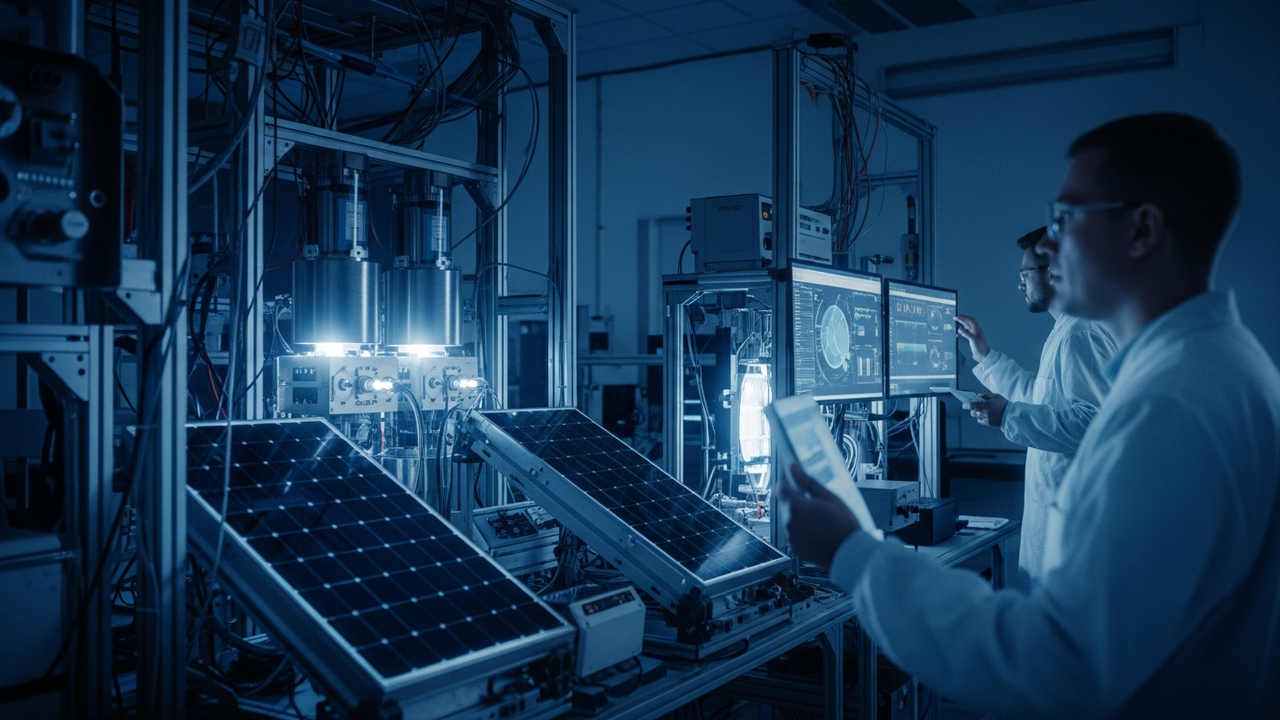
A team of German researchers has achieved a groundbreaking 31.3% efficiency in a system that directly converts sunlight into hydrogen fuel. This remarkable advancement significantly boosts the economic feasibility and practical applicability of green hydrogen production compared to conventional processes, marking a crucial step towards commercial-scale clean hydrogen generation.
Technical Details
The innovative system was developed by a team at the Fraunhofer Institute for Solar Energy Systems (Fraunhofer ISE). They ingeniously combined highly efficient solar cells with Proton Exchange Membrane (PEM) electrolysis technology to maximize the direct conversion efficiency of solar energy into hydrogen. While traditional green hydrogen production typically involves a two-stage process (solar power generation followed by electrolysis), this new method directly feeds the electricity generated by the solar cells into the electrolyzer. By facilitating a direct photoelectrochemical reaction for hydrogen generation, the system minimizes energy conversion losses. This 31.3% efficiency represents a world-leading benchmark at the research level, demonstrating a substantial improvement over previous direct solar-to-hydrogen technologies.
Background & Context
Green hydrogen, produced using renewable energy, emits no CO2 during its generation and is highly anticipated for its role in industrial decarbonization, mobility, and energy storage across various sectors. However, its production cost and efficiency have been major barriers to widespread commercial deployment. Specifically, photoelectrochemical (PEC) systems and integrated PV-electrolyzer systems, which utilize direct sunlight, have faced challenges with lower efficiencies and higher material costs. The German government has designated a national hydrogen strategy and invested heavily in green hydrogen research and development. Fraunhofer ISE’s achievement stands as a concrete success story within these efforts.
Strategic Significance & Outlook
This achievement of 31.3% efficiency will profoundly impact the commercial viability of green hydrogen production. Higher efficiency directly translates to reduced production costs, making green hydrogen more economically competitive against grey hydrogen (derived from natural gas) and blue hydrogen (with carbon capture and storage). Fraunhofer ISE’s technology is also promising in terms of modularity and scalability, with future applications anticipated in large-scale industrial plants and decentralized hydrogen production systems. This breakthrough holds the potential to be a significant accelerator for Germany’s energy self-sufficiency goals and the broader European ambition for net-zero emissions.
Get our weekly technology intelligence — free
Receive an infographic that lets you judge at a glance whether each field’s analysis report is worth reading.
Subscribe Free — Weekly Tech Intelligence
By subscribing, you’ll receive Troy-Technical’s weekly technology intelligence newsletter.
- Your email and selected fields are used only to deliver the newsletter.
- We never share your information with third parties.
- You can unsubscribe anytime via the link in each email.
See our Privacy Policy for details.
Takes about a minute · Unsubscribe anytime

Comments