Key Findings
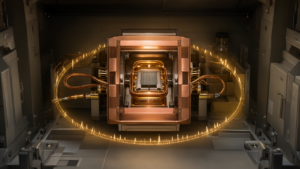
A collaborative research effort between the Duke Quantum Center and IonQ has yielded a significant advance in quantum computing, demonstrating the first fully distributed three-node GHZ (Greenberger-Horne-Zeilinger) state. This pioneering experiment successfully entangled individual atomic qubits located in separate processing nodes, connected exclusively by photonic links. The achievement, which circumvents the need for local two-qubit gates or post-selection, represents a critical milestone for modular quantum computing and provides strong evidence for quantum non-locality in a distributed setting.
Technical / Clinical Details
- Distributed GHZ State Realization: The GHZ state is a highly entangled multi-qubit state, fundamental for various quantum information tasks, including quantum communication and computation. In this study, three distinct quantum processing nodes, each containing atomic qubits, were entangled to form a GHZ state through photon-mediated interactions. This means quantum information could be shared and correlated across physically separated units without direct physical contact between their core processors.
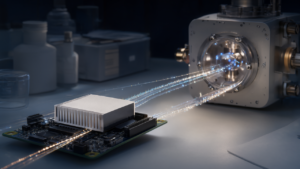
- Role of Photonic Links: A primary challenge in scaling quantum computers lies in connecting physically distant qubits while maintaining coherence. The research team utilized photons as “flying qubits” to establish entanglement over long distances between atomic qubits within each node. Photons are ideal for this purpose due to their low-loss transmission properties and ability to carry quantum information reliably, effectively acting as high-fidelity quantum interconnects.
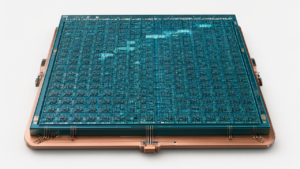
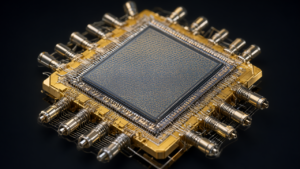
- Implications for Modular Quantum Computing: This breakthrough is a pivotal step toward realizing modular quantum computing architectures. Instead of fabricating an entire large-scale quantum computer on a single chip, which faces immense engineering challenges, this approach allows for the development of smaller, more manageable quantum processing units (QPUs). These QPUs can then be interconnected using photonic links, enabling the creation of much larger and more complex quantum systems with enhanced scalability and fault tolerance.
Background & Context
Current quantum computers often employ a monolithic design, where all qubits are integrated onto a single chip. However, as qubit counts increase, challenges related to control, cooling, and wiring grow exponentially. Modular quantum computing, which involves networking multiple smaller quantum processors, is a promising alternative to overcome these scaling limitations. The work by Duke Quantum Center and IonQ addresses a key technical hurdle in this modular paradigm: the reliable generation of entanglement between spatially separated nodes. This capability is not only crucial for building scalable quantum computers but also lays foundational groundwork for the development of a quantum internet.
Strategic Significance & Outlook
This scientific achievement has profound implications for the future of quantum technology, promising to accelerate the construction of large-scale fault-tolerant quantum computers and the evolution of distributed quantum networks. By enabling robust connections between quantum nodes via photonic links, this technology could eventually lead to global quantum internet infrastructure and “distributed quantum computation,” where multiple quantum computers collaborate to solve problems beyond the capacity of any single machine. This innovation underpins advancements in quantum sensing, quantum communication, and ultimately, the practical realization of general-purpose quantum computers, profoundly influencing future research and technological trajectories.
Source: https://quantumcomputingreport.com/news/
Get our weekly technology intelligence — free
Receive an infographic that lets you judge at a glance whether each field’s analysis report is worth reading.
Subscribe Free — Weekly Tech Intelligence
By subscribing, you’ll receive Troy-Technical’s weekly technology intelligence newsletter.
- Your email and selected fields are used only to deliver the newsletter.
- We never share your information with third parties.
- You can unsubscribe anytime via the link in each email.
See our Privacy Policy for details.
Takes about a minute · Unsubscribe anytime