Background and the Digital Transformation in Pharma
The pharmaceutical industry faces immense pressure to accelerate drug development, reduce manufacturing costs, and ensure product quality amidst increasing demand and complexity. Traditional drug discovery and manufacturing processes are often lengthy, capital-intensive, and prone to unforeseen challenges. Artificial intelligence (AI) and advanced simulation technologies, particularly digital twins, are emerging as powerful tools to address these bottlenecks, transforming the entire pharmaceutical value chain from R&D to commercial production.
Digital twin technology, which creates virtual replicas of physical systems or processes, enables real-time monitoring, simulation, and optimization, thereby offering unprecedented opportunities for efficiency gains and risk reduction in complex manufacturing environments.
Roche and NVIDIA’s AI Factory: Pioneering Digital Twins in GLP-1 Manufacturing
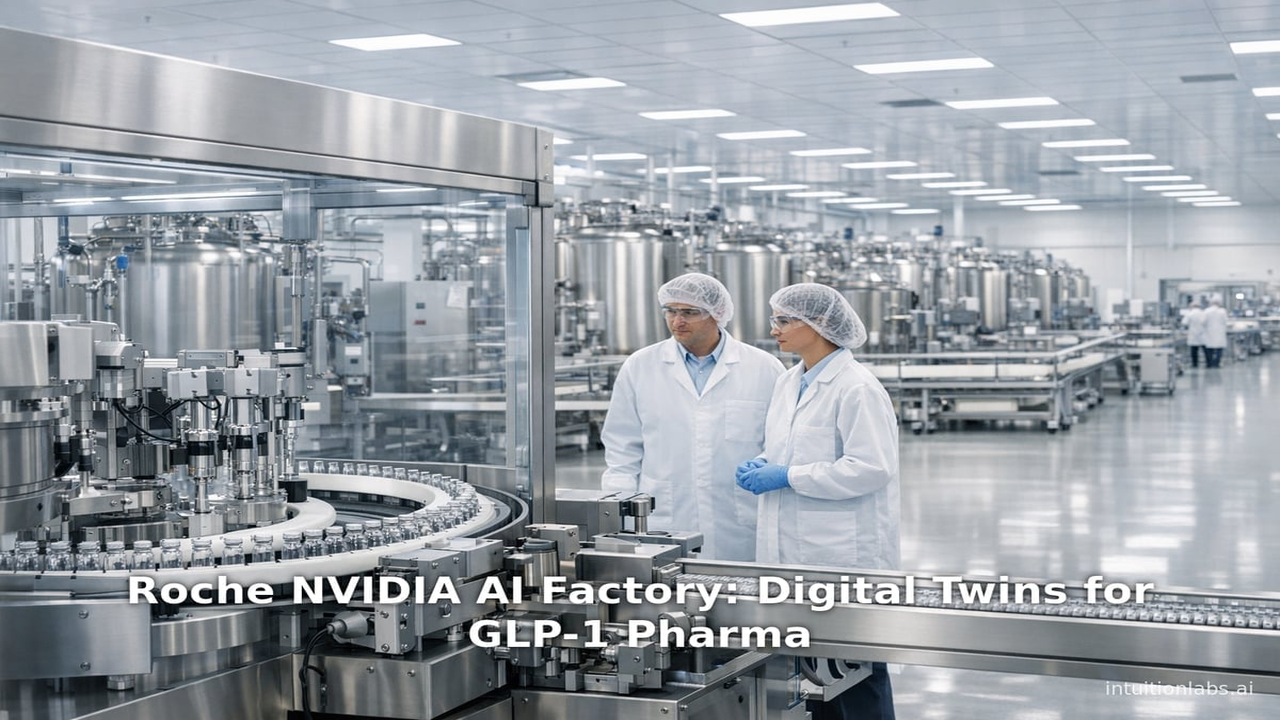
Pharmaceutical giant Roche has announced a groundbreaking partnership with NVIDIA to establish a state-of-the-art AI factory, powered by over 3,500 GPUs. This ambitious initiative will deploy NVIDIA’s Omniverse digital twin platform to optimize the operations of an upcoming GLP-1 (Glucagon-like peptide-1) manufacturing facility. This move marks a significant technological leap, positioning AI and simulation as central pillars alongside traditional chemistry and biology in drug development.
The deployment of digital twins aims to:
- Simulate Entire Production Lines: Replicate the entire manufacturing process in a virtual environment, encompassing complex chemical reactions, robotic automation, material flow, and potential equipment faults. This holistic simulation allows for comprehensive testing and validation before physical implementation.
- Optimize Performance: By analyzing vast amounts of real-time and simulated data, engineers can identify bottlenecks, predict potential failures, and fine-tune process parameters. This optimization can lead to substantial improvements in throughput, yield, and overall operational efficiency.
- Prevent Costly Rework: Virtual prototyping and scenario planning enable the identification and resolution of design flaws or operational inefficiencies in the digital realm. This proactive approach significantly reduces the need for expensive physical rework, shortening design and validation lead times.
Industry analysts anticipate that widespread adoption of digital twins in pharma manufacturing could lead to a 25–40% increase in plant capacity and a 15–20% reduction in design and validation lead times, translating into accelerated market access for critical therapeutics.
Technical Significance and Future Outlook
This collaboration is technically profound, as it leverages cutting-edge AI and high-performance computing to create a living, breathing digital replica of a complex biopharmaceutical plant. The ability to simulate intricate chemical and biological processes, coupled with physical robotics, provides an unparalleled testbed for innovation. It’s a move from reactive problem-solving to proactive, predictive optimization.
Looking ahead, Roche is exploring ‘agentic research workflows,’ where AI agents could autonomously design and conduct experiments. This vision includes the potential for closed-loop robotics labs, where AI models generate hypotheses, program robots to execute experiments, interpret results, and iterate on designs without human intervention. Such advancements could dramatically accelerate the pace of drug discovery and development, making the creation of new therapeutics more efficient and predictable than ever before.
This initiative sets a new benchmark for digital transformation in the pharmaceutical industry, demonstrating how AI can redefine manufacturing efficiency, quality, and innovation, ultimately benefitting patients worldwide through faster access to vital medicines.
Source: https://intuitionlabs.ai/articles/roche-nvidia-ai-factory-glp-1-digital-twins