Background
Carbon Fiber (CF) has long been recognized as an indispensable strategic material in a wide range of high-tech industries, including aerospace, automotive, wind energy, and sports equipment, owing to its unparalleled strength-to-weight ratio and stiffness. However, traditional carbon fiber manufacturing processes, primarily involving high-temperature thermal treatment of polyacrylonitrile (PAN) precursors, are energy-intensive and incur high production costs. Furthermore, the difficulty in recycling end-of-life carbon fiber composite materials has posed a significant sustainability challenge, prompting the industry to seek more environmentally friendly solutions.
Key Findings / Results
To address these challenges and transition towards a more sustainable and economically viable manufacturing ecosystem, the carbon fiber industry is accelerating several innovative initiatives:
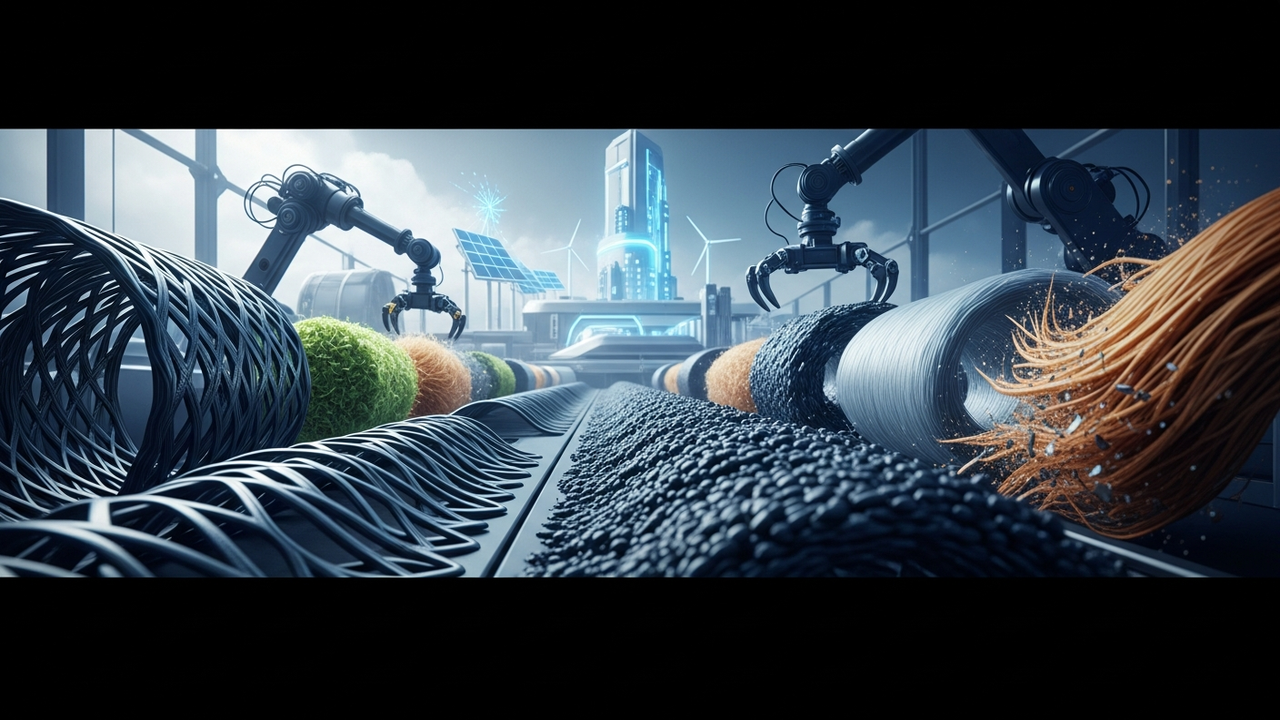
- Development of Recycled Carbon Fiber (rCF): Technologies for efficiently recovering carbon fibers from end-of-life composites and reusing them while maintaining their original mechanical properties are rapidly advancing. Methods such as pyrolysis, solvolysis, and fluidized bed reactors are under extensive research, with aerospace-grade rCF beginning to emerge.
- Exploration of Alternative Precursors: Efforts are underway to develop low-cost, biomass-derived alternative precursor materials, such as lignin and pitch, to replace the expensive and energy-intensive PAN. This aims to reduce carbon fiber manufacturing costs and lower the environmental footprint.
- Establishment of Low-Carbon Manufacturing Routes: The entire manufacturing process is being decarbonized through initiatives such as improving energy efficiency in carbon fiber production, developing new carbonization technologies that reduce CO2 emissions, and incorporating renewable energy sources.
These collective efforts are redefining carbon fiber not merely as a high-performance material but as a ‘sustainable high-performance material’ that considers its environmental impact across its entire lifecycle.
Technical Significance & Outlook
These advancements in the carbon fiber industry are poised to significantly impact a wide range of industrial sectors. The proliferation of recycled carbon fiber will promote material cost reduction and circular resource utilization, further accelerating the adoption of CFRPs in aerospace and automotive applications. Manufacturing from alternative precursors is expected to make carbon fiber more affordable, enabling its deployment in new applications where cost was previously a barrier. Furthermore, the decarbonization of manufacturing processes will contribute to companies’ sustainability goals and enhance the environmental value of their products. Moving forward, as these technologies mature and become integrated into global supply chains, carbon fiber is anticipated to strengthen its role in providing sustainable and high-performance solutions across broader industries. This evolution underscores the critical role of materials science and engineering in building a sustainable future.
Source: https://jotaintl.com/about-us/academy/carbon-fiber-history/








Comments