
CoWoS Bottleneck Alleviates, HBM Presents New Challenges
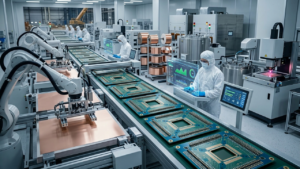
For several years, the TSMC CoWoS (Chip-on-Wafer-on-Substrate) advanced packaging capacity had been the primary bottleneck in the production of NVIDIA’s high-performance AI accelerators. However, due to significant capital investments by TSMC, the tightness in CoWoS supply is gradually easing. Reports indicate that TSMC is expanding CoWoS capacity to approximately 35,000 wafers per month by the end of 2026, with potential to reach 120,000 to 140,000 wafers per month by late 2026 or 2027. While this is positive news for AI chip supply, as CoWoS constraints ease, a new and more severe bottleneck has emerged: the supply shortage of High Bandwidth Memory (HBM).
Current State and Constraints of HBM Supply
NVIDIA’s next-generation GPUs, such as the Blackwell Ultra (B300) and Rubin, which are designed for high-performance AI accelerators, require vast quantities of HBM, specifically HBM3E and HBM4. However, HBM production consumes significantly more wafer capacity than conventional DRAM. Furthermore, only three manufacturers globally—SK Hynix, Samsung, and Micron—are capable of mass-producing HBM. This limited number of suppliers, coupled with high manufacturing costs and complex production processes, has made HBM supply the new dominant constraint in the AI accelerator market. Demand continues to far outstrip supply, forcing hyperscalers, including NVIDIA, to enter into long-term agreements with memory manufacturers to secure stable HBM supply.
Market Impact and Future Outlook
The HBM supply shortage directly limits the ultimate shipment volumes of AI accelerators, impacting the pace of AI infrastructure build-out. This poses a significant challenge not only for AI chip providers like NVIDIA but also for cloud companies deploying AI services. In the long term, memory manufacturers must accelerate HBM production capacity expansion, a process that requires substantial capital investment and time. Continuous improvements in HBM manufacturing technology, particularly in stacking techniques and thermal management, will also be essential. While the market welcomes the easing of CoWoS supply, it must now confront the new reality of HBM scarcity through collaborative efforts and innovation across the entire supply chain. This approach is necessary to enable the continued widespread adoption and advancement of AI technology.
Source: https://247wallst.com/investing/2026/05/21/nvidia-could-10x-its-sales-one-bottleneck-is-stopping-it/







Comments