Background
The rapid expansion of the electric vehicle (EV) market underscores the increasing criticality of battery safety and performance. Carbon Fiber Reinforced Polymer (CFRP) battery enclosures are crucial components for both weight reduction and enhanced safety in EVs. However, designing these enclosures to withstand side-pole impacts in extreme cold conditions, such as -40°C, presents significant challenges due to the brittle behavior of materials at low temperatures, demanding sophisticated simulations and rigorous validation. Traditional design processes for such complex scenarios typically necessitate hundreds of finite element (FE) simulations across a vast array of design parameters—including material composition, layer thickness, and geometry—to identify optimal structures. This conventional approach is highly demanding of both time and computational resources. Furthermore, stricter safety standards, such as China’s GB 38031-2025, are imposing new and more stringent requirements on battery enclosure design, highlighting the need for a more efficient and agile development cycle for materials with complex behaviors like CFRP.
Key Findings
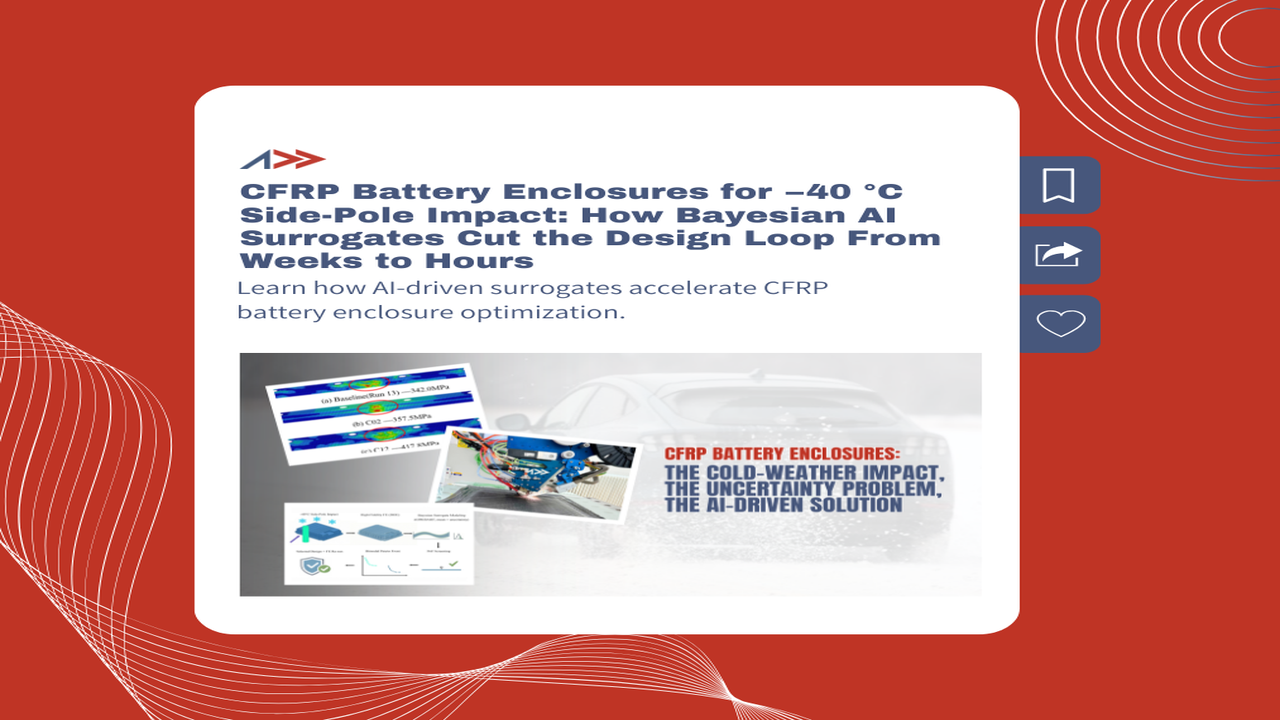
A new open-access study by Addcomposite marks a significant breakthrough by dramatically accelerating the design cycle for CFRP battery enclosures through the innovative application of Bayesian AI surrogate models. The research successfully mapped the extensive design space for CFRP battery casings in extreme cold side-pole impact scenarios, fully adhering to China’s stringent safety standard GB 38031-2025. Remarkably, this was achieved using a mere 50 crash simulations to train the AI model, fundamentally eliminating the need for hundreds of costly FE crash simulations and demonstrating the potential to cut the design process from weeks to mere hours.
The Bayesian AI surrogate model employed is a sophisticated statistical machine learning technique capable of approximating complex non-linear responses across a wide design space from a small, carefully selected set of FE simulation results. Crucially, this probability-based model can also quantify prediction uncertainties, providing engineers with robust insights. By efficiently learning these complex behaviors, the AI empowers engineers to rapidly explore diverse design options and optimize the critical balance between performance and safety. This capability to accurately predict the behavior of composite materials under extreme cold is paramount for enhancing EV battery safety.
This design optimization approach, leveraging Bayesian AI surrogate models, holds the transformative potential to overhaul the entire development process for high-performance composite products, extending beyond CFRP battery enclosures. In the future, AI is expected to be seamlessly integrated across various stages of the product lifecycle, encompassing material design, manufacturing process optimization, and quality control. This integration promises significantly reduced development times and costs, offering companies a powerful tool to bring innovative products to market more rapidly, meet stringent market competition, and comply with evolving regulatory requirements. Its broader impacts are poised to extend beyond the automotive industry to critical sectors such as aerospace, wind energy, and other fields heavily reliant on composite materials.







Comments