Key Findings
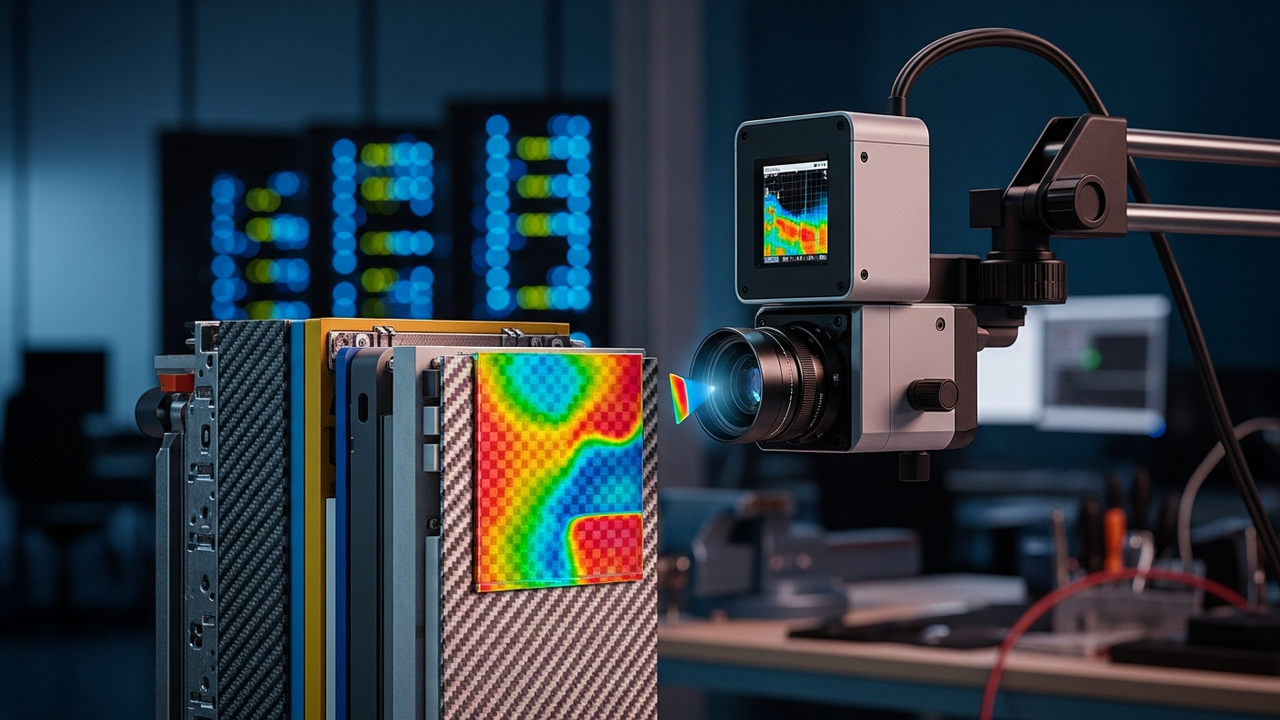
Recent research on the thermal response mechanisms and quantitative characterization of defects in multi-material power equipment has yielded new insights for non-destructive testing technologies through finite element simulations using COMSOL Multiphysics and experimental validation. The study established a 3D transient heat transfer model for air voids and foreign inclusion defects present in Carbon Fiber Reinforced Polymer (CFRP) and epoxy resin matrices, quantitatively demonstrating that thermal diffusivity is the primary factor governing the evolution of defect signals. Notably, it was revealed that CFRP exhibits rapid heat propagation and an early transient response, whereas epoxy resin generates delayed and slowly increasing thermal signals.
Technical & Clinical Details
This research combined infrared thermography with numerical simulations to detect and evaluate internal defects (such as air voids and foreign inclusions) in dissimilar materials like CFRP and epoxy resin used in power equipment. COMSOL Multiphysics simulations enabled detailed modeling of heat transfer behavior across various defect types, sizes, and depths, allowing for theoretical predictions of thermal responses. Experiments involved heating samples with embedded defects using a pulse thermal source and monitoring temperature changes with an infrared camera, confirming a high correlation with simulation results. The findings showed that defects within CFRP layers rapidly influence surface temperature due to high thermal diffusivity, generating early detectable thermal signals. Conversely, defects in epoxy resin, with its lower thermal diffusivity, exhibit slower heat propagation and delayed signal appearance. This quantitative characterization of material-specific thermal response properties provides fundamental data for more accurately estimating defect depth and type.
Background & Context
In high-performance components used in power equipment, particularly those utilizing composite materials, internal defects can severely compromise structural integrity and safety. Traditional non-destructive testing (NDT) techniques often have limitations in precisely locating, sizing, or identifying defect types. While infrared thermography offers advantages like non-contact and rapid wide-area inspection, understanding how different material properties affect heat transfer was crucial for improving its accuracy. This study aimed to address this challenge and enhance the reliability of defect detection in multi-material composite structures.
Strategic Significance & Outlook
The models and insights developed in this research represent a significant advancement in the field of non-destructive testing for multi-material power equipment, including CFRP and epoxy resins. In the future, integrating these quantitative characterization methods into actual manufacturing lines and maintenance processes is expected to strengthen quality control and reduce failure rates. Furthermore, combining this with AI and machine learning could enable automated defect detection and advanced diagnostics, contributing to improved reliability of power infrastructure. The technology also holds promise for application in other composite-intensive industries such as aerospace, automotive, and renewable energy.








Comments