Key Findings
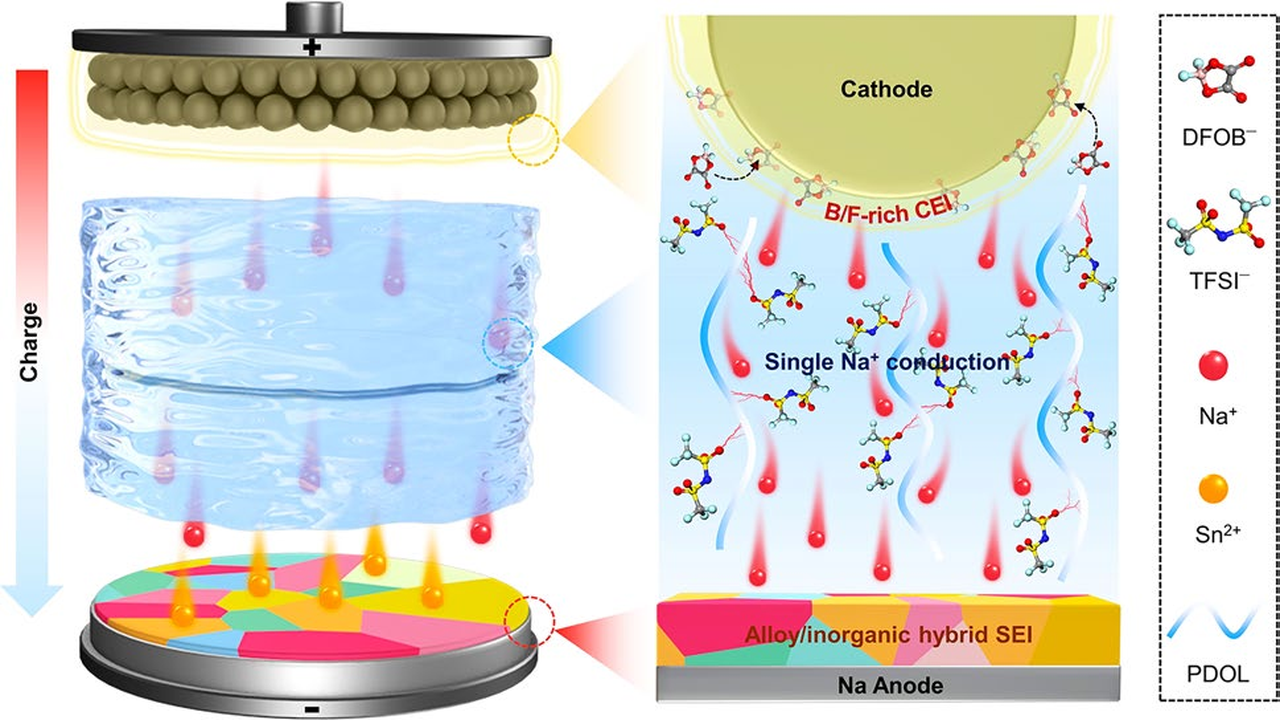
In a groundbreaking development for sodium metal batteries, a quasi-solid-state electrolyte (QSE) system incorporating dual interlocked mediators has been developed. This novel electrolyte significantly improves Na+ ion transport and electrode interfacial chemistry, paving the way for sodium metal batteries that offer both ultrafast charging capabilities and extended cycle life.
Technical / Clinical Details
The developed QSEs feature dual interlocked mediators, specifically a cationic Sn2+ salt and an anionic difluoro(oxalato)borate (DFOB⁻) salt. This unique combination enabled symmetric cells (Li|QSE|Li) to demonstrate remarkable stability for over 6000 hours. Furthermore, full cells (Li||Na3V2(PO4)3) successfully maintained 90% of their capacity for over 2000 cycles at an ultra-fast charging rate of 15C. This represents a significant advancement in addressing the conventional trade-off between charging speed and cycle life in sodium batteries. The QSEs also exhibit high ionic conductivity at room temperature, indicating substantial progress towards practical application.
Background & Context
Sodium-ion batteries are gaining considerable attention as a primary alternative to lithium-ion batteries due to the abundance and low cost of sodium resources. However, similar to lithium-metal batteries, sodium metal batteries have faced challenges related to dendrite formation, impacting both safety and cycle life. The QSEs developed in this study offer an effective solution to these issues, potentially accelerating the adoption of sodium metal batteries, particularly in applications demanding ultrafast charging, such as electric vehicles (EVs) and grid-scale energy storage systems.Strategic Significance & Outlook
The QSEs incorporating dual interlocked mediators have the potential to significantly enhance the performance of sodium metal batteries, making them a competitive option in the next-generation battery market. Future efforts will focus on scaling up this technology, optimizing manufacturing processes, and reducing costs for commercialization. This research is expected to contribute substantially to the diversification of energy storage technologies and the transition towards a sustainable society.