Key Findings
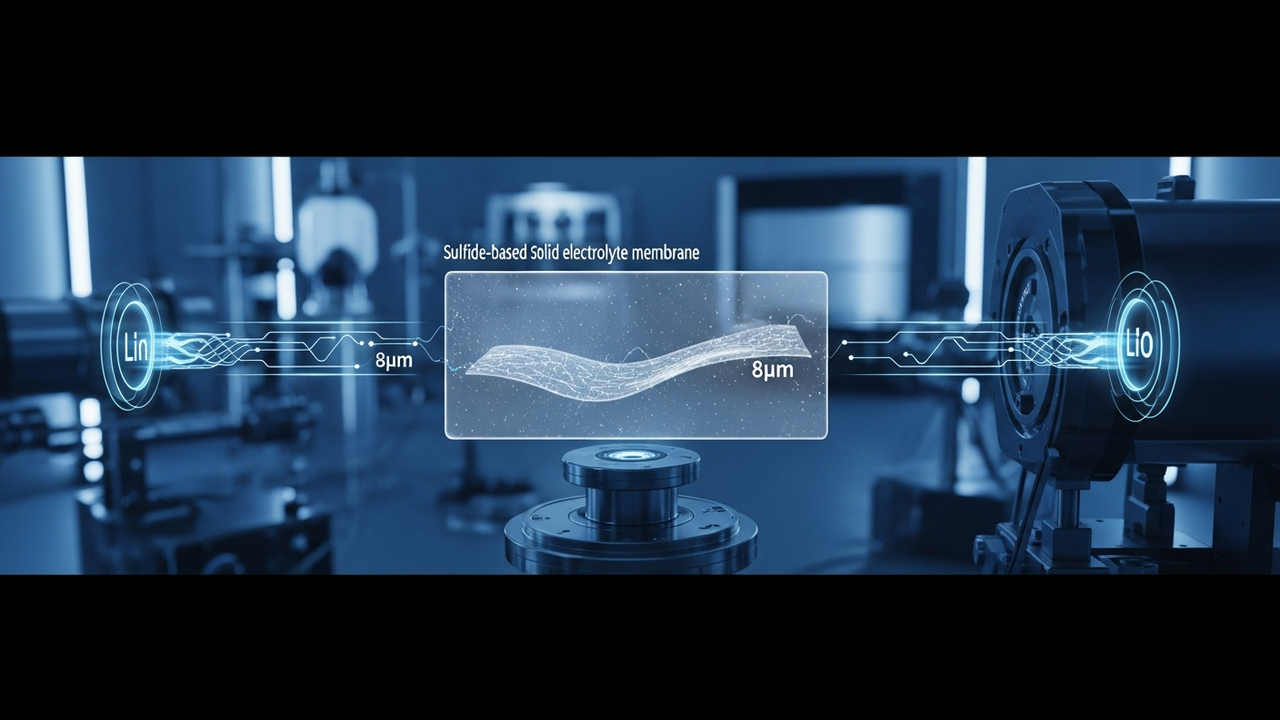
This research highlights the successful fabrication of an ultrathin (8μm-thick) sulfide solid electrolyte film, specifically Li9.88GeP1.96Sb0.04S11.88Cl0.12, using a wet-coating method. The film exhibits outstanding electrochemical performance, achieving a high ionic conductivity of 1.9 mS cm-1 at 25°C. A solid-state lithium battery employing this film with a LiCoO2 cathode demonstrated remarkable stability, maintaining 86.3% capacity retention after 250 cycles at 60°C and a 0.1 C rate.
Technical / Clinical Details
Sulfide solid electrolytes are among the most promising candidates for all-solid-state batteries due to their high room-temperature ionic conductivity and excellent electrochemical stability. The wet-coating method utilized in this study offers a potential pathway for cost-effective manufacturing of uniform, ultrathin electrolyte membranes. The 8μm-thick Li9.88GeP1.96Sb0.04S11.88Cl0.12 film achieved an ionic conductivity of 1.9 mS cm-1 at 25°C, a highly practical value that enables rapid Li+ ion transport. When integrated into an all-solid-state battery with a LiCoO2 cathode and lithium metal anode, the cell recorded an initial reversible capacity of 125.6 mAh g-1 and maintained an impressive 86.3% capacity retention after 250 cycles under 60°C and 0.1 C charge/discharge conditions. This represents a significant advancement towards realizing ultrathin solid electrolytes that are both high in strength and inherently safe.
Background & Context
The increasing demand for electric vehicles (EVs) and portable electronic devices necessitates battery technologies that offer superior safety, higher energy density, and extended lifespan. All-solid-state batteries are anticipated to address the risks of leakage and fire associated with conventional liquid lithium-ion batteries, positioning them as a key next-generation technology. However, challenges related to solid electrolyte manufacturing costs, interfacial resistance, and mechanical strength have been barriers to their widespread commercialization. This research presents a promising strategy for overcoming these challenges by achieving both ultrathin film formation and high cycle stability.
Strategic Significance & Outlook
The development of ultrathin sulfide solid electrolyte films via the wet-coating method holds the potential to simplify manufacturing processes and reduce costs for all-solid-state batteries. Future research will focus on further extending cycle life and scaling up these technologies to larger cell formats, which could accelerate their practical application in EVs and stationary energy storage systems. This achievement represents a critical step towards the realization of high-performance and safe next-generation battery technologies.