Key Findings
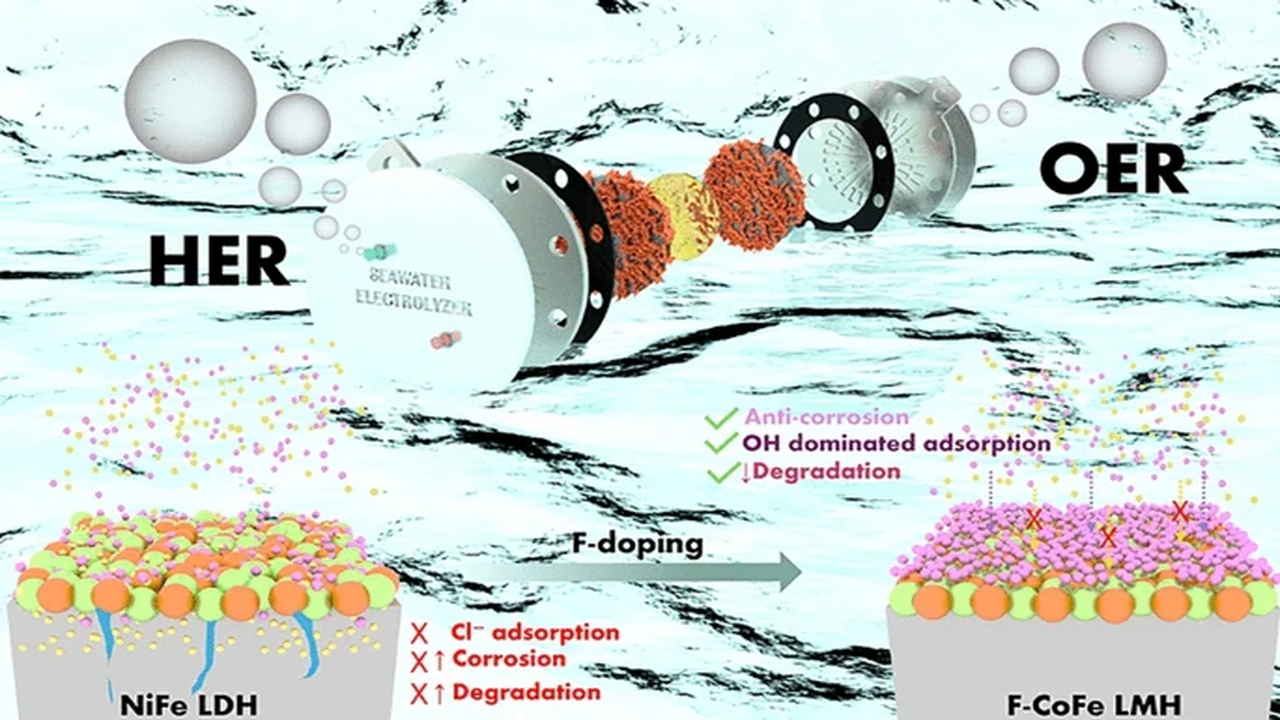
To overcome the critical challenges of slow oxygen evolution reaction (OER) kinetics and severe chlorine corrosion in green hydrogen production via seawater electrolysis, a novel high-polarity fluorine-doped cobalt (Co) and iron (Fe) layered metal hydroxide (F-CoFe LMH-8) catalyst has been developed. This innovative catalyst demonstrates outstanding performance for both the hydrogen evolution reaction (HER) and OER, achieving remarkably low overpotentials of 81.23 mV and 265.5 mV, respectively, at a current density of 10 mA cm⁻².
Technical Details
While seawater electrolysis offers a promising route for green hydrogen production without relying on freshwater resources, its complex ionic composition and corrosive nature due to chloride ions have made it challenging for conventional electrocatalysts to achieve both high efficiency and durability. The research team precisely tuned the electronic structure of cobalt-iron layered metal hydroxides (CoFe LMH) by doping them with fluorine (F) atoms. Given fluorine’s high electronegativity, it optimally modulates the electron density within the CoFe LMH, thereby adjusting the adsorption and dissociation of water molecules at the active sites, as well as the binding energies of oxygen evolution reaction (OER) intermediates (OH*, O*, OOH*). This modification significantly lowers the OER overpotential and accelerates the reaction kinetics. Simultaneously, fluorine doping enhances the hydrophobicity of the catalyst surface, suppressing the adsorption of chloride ions and thus dramatically improving resistance to chlorine corrosion. The F-CoFe LMH-8 functions effectively as a catalyst in bipolar electrolyzers, achieving a current density of 10 mA cm⁻² with exceptionally low overpotentials: 81.23 mV for HER and 265.5 mV for OER. These performance metrics substantially exceed the requirements for industrial-scale seawater electrolysis, rivaling or even surpassing those of existing noble metal catalysts like RuO₂ and IrO₂.
Background and Industry Context
Hydrogen is experiencing surging global demand as a clean energy carrier, essential for storing and transporting renewable energy. Consequently, there is an urgent need for technologies that can produce large quantities of hydrogen affordably and sustainably. Seawater electrolysis stands out as one of the most promising options. However, chloride ions present in seawater pose significant commercialization barriers by causing catalyst degradation and generating undesirable chlorine gas during electrolysis. The findings of this research present an innovative solution to this long-standing problem through the use of inexpensive base metal catalysts, significantly accelerating the practical implementation of green hydrogen production from seawater.
Future Outlook
This high-polarity fluorine-doped F-CoFe LMH-8 catalyst holds immense potential to resolve critical cost and efficiency challenges in green hydrogen production via seawater electrolysis, thereby contributing significantly to the realization of a sustainable energy society. Moving forward, the research team will focus on establishing large-scale production techniques for the catalyst, conducting rigorous long-term stability and durability validation tests, and optimizing engineering for integration into real-world seawater electrolysis systems. The commercialization of this technology is expected to enable hydrogen production independent of freshwater resources, bolster global energy security, and dramatically accelerate the widespread adoption of renewable energy. This represents a crucial breakthrough, strongly supporting the global movement toward a clean hydrogen economy.
Source: https://www.nmlett.org/index.php/nml/article/view/2539