Key Findings
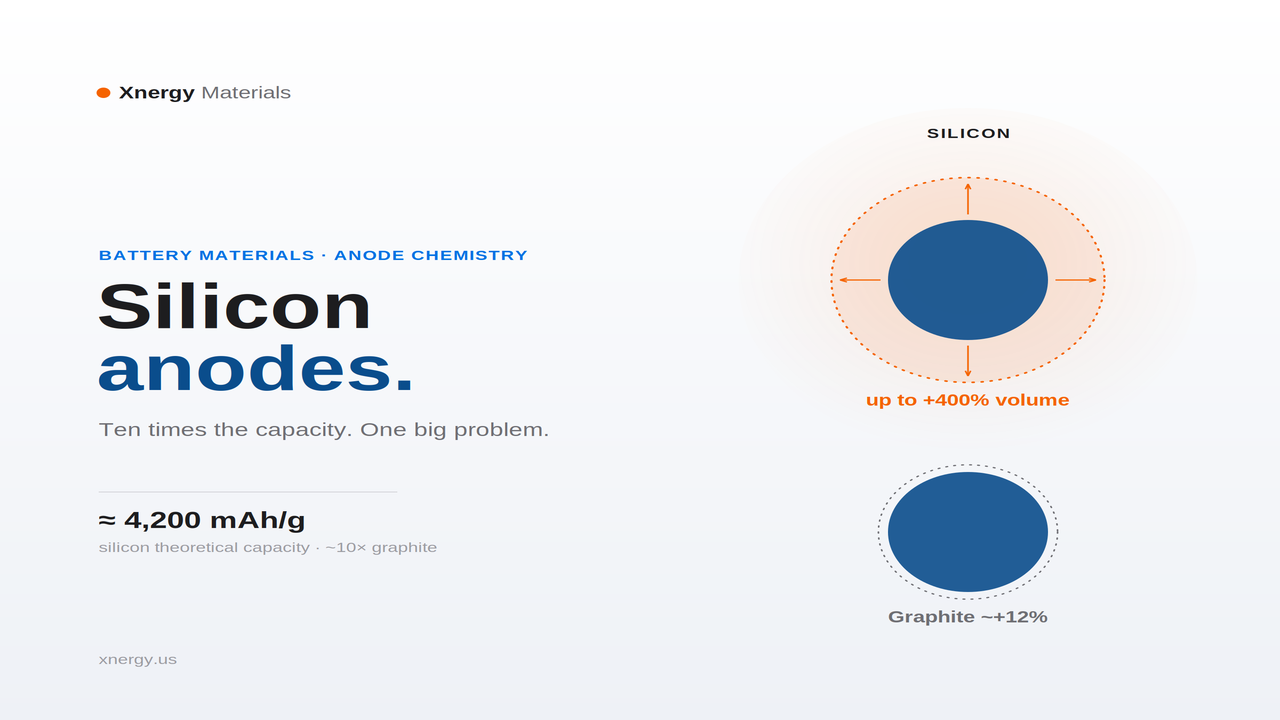
Addressing the most significant challenge for silicon anodes in lithium-ion batteries—the dramatic volume expansion (up to 300%) during charge and discharge cycles and subsequent performance degradation—a suite of innovative solutions has been proposed. These technological approaches encompass structural design of silicon, optimization of composite materials, refinement of electrode binders, and functionalization of electrolytes, all aimed at accelerating the practical deployment of silicon anodes.
Technical Details and Solutions
Silicon anodes hold immense promise due to their high theoretical capacity (up to ~4,200 mAh/g), approximately ten times that of graphite, offering the potential to drastically increase battery energy density. However, volume expansion leads to particle pulverization, destabilization of the solid electrolyte interphase (SEI) layer, and significant degradation of cycle life. Specific solutions to counter these issues include:
- Use of Silicon Oxide (SiOx): Compared to pure silicon, SiOx exhibits attenuated volume expansion, leading to improved cycle stability. While its capacity is lower than pure silicon, it offers a pragmatic balance between practicality and performance.
- Silicon-Carbon Composites (Si-C): Coating or compositing silicon particles with carbonaceous materials (e.g., graphene, carbon nanotubes, amorphous carbon) helps alleviate mechanical stress from volume expansion and maintains conductive pathways. This approach enables the realization of both high capacity and robust cycle stability.
- Construction of Conductive Networks: Uniform dispersion of conductive additives such as carbon nanotubes (CNTs) and carbon black within the electrode creates strong conductive networks around and between silicon particles. This maintains electrical connectivity even as silicon particles expand and contract, preventing performance degradation.
- Utilization of Flexible Binders: Employing flexible polymeric binders like PAA (polyacrylic acid) and SBR (styrene-butadiene rubber) enhances the overall mechanical stability of the electrode, preventing active material particle detachment and electrode disintegration as volume changes occur.
- FEC (Fluoroethylene Carbonate)-Containing Electrolyte Additives: Electrolyte additives like FEC stabilize the formation of the SEI layer in lithium-ion batteries, suppressing parasitic reactions and protecting the electrode surface structure. This significantly contributes to extending cycle life. Research into identifying electrolyte reduction intermediates in lithium metal batteries using techniques like spin trapping also contributes to rational electrolyte design.
Background & Industry Context
The burgeoning electric vehicle (EV) market and the drive for higher performance in portable electronic devices necessitate batteries with greater energy density and extended lifespans. Graphite anodes are approaching their theoretical limits, positioning silicon anodes as the potential next-generation standard. Companies like Sila Nanotechnologies and Group14 Technologies are already scaling up silicon anode material production. Automotive giants like Honda are accelerating silicon anode technology development through significant investments in companies like Nexeon. The U.S. Department of Energy is also funding SiOC anode material development to bolster domestic supply chains.
Strategic Significance & Outlook
The combination of these solutions is expected to enable lithium-ion batteries with silicon anodes to achieve significantly higher energy densities and superior cycle life compared to current graphite-based batteries. The silicon anode battery market is projected to grow at a CAGR of 51.7% from 2026 to 2036, reaching $39.17 billion. The commercialization of this technology will dramatically extend EV ranges, shorten charging times, and improve the performance of portable electronic devices, thereby transforming the entire battery industry. Integrating these advancements with low-cost, high-efficiency manufacturing techniques, such as dry electrode processes, will be key to accelerating the widespread adoption of silicon anodes.









Comments