Background
The relentless expansion and increasing complexity of data are pushing modern computing technologies, particularly electronic-based silicon chips, to their physical limits. Demanding applications like AI’s deep learning models and complex quantum computations necessitate vast computational resources and enormous energy consumption, driving an urgent need for faster, more energy-efficient computing paradigms. Optical computing has long been explored as a promising solution; however, challenges in controlling light-matter interactions and the integration and processing of optical information have hindered its widespread adoption. Monash University’s recent breakthrough addresses these long-standing issues by introducing a novel approach that directly leverages the quantum properties of light via its ‘valley’ degree of freedom, paving the way for practical light-driven chips.
Key Findings
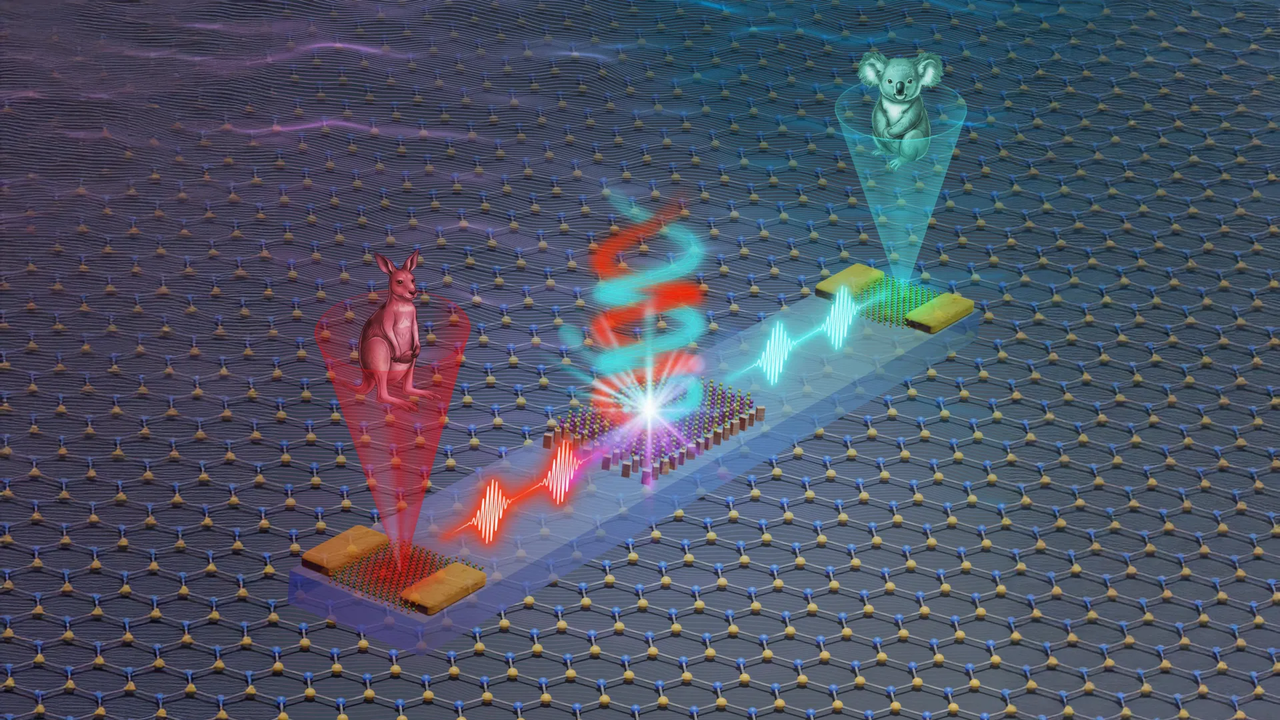
A team of scientists at Monash University has successfully developed a compact chip capable of generating, manipulating, and reading light-based information entirely within a single device. This significant achievement stems from the precise control of light’s ‘valley’ degree of freedom—a unique quantum property—using atomically thin materials and finely tuned nanoscale structures. This breakthrough is anticipated to dramatically accelerate artificial intelligence (AI) and quantum computing while enhancing energy efficiency.
At the heart of this novel chip lies its ability to optically control the ‘valley degree of freedom’ in two-dimensional materials. While conventional semiconductors rely on electron charge or spin for information transfer, the valley degree of freedom represents a new information carrier, linked to electrons residing in specific ‘valleys’ within momentum space. The research team meticulously fabricated nanoscale structures, such as specifically shaped metasurfaces and optical waveguides, onto atomically thin semiconductor materials. This allowed them to efficiently guide and convert photons into desired valley states. As a result, the chip can generate valley information using light, propagate it without loss internally, and ultimately read it out optically. This ‘light-driven valley information processing’ paradigm overcomes the inherent challenges of traditional electronic chips, such as resistive losses and heat generation, paving the way for ultra-fast and ultra-low-power information processing. Specifically, information can be processed at speeds approaching that of light, offering the potential to drastically improve AI learning and inference speeds, and enable more efficient, coherent information transfer between qubits in quantum computing systems. This optical chip holds transformative potential for AI accelerators and quantum computing hardware development. Future efforts will focus on enhancing chip integration and building systems capable of tackling even more complex computational tasks. Should this technology prove scalable for mass production, it could lead to substantial reductions in data center power consumption, significant performance boosts for edge AI devices, and a faster pathway to the commercialization of quantum computing. In the long term, this light-driven valley information processing technology is expected to underpin next-generation supercomputers and unlock entirely new computational frontiers, thereby advancing scientific discovery and societal innovation.
Source: https://www.sciencedaily.com/releases/2026/06/260601025343.htm