Key Findings
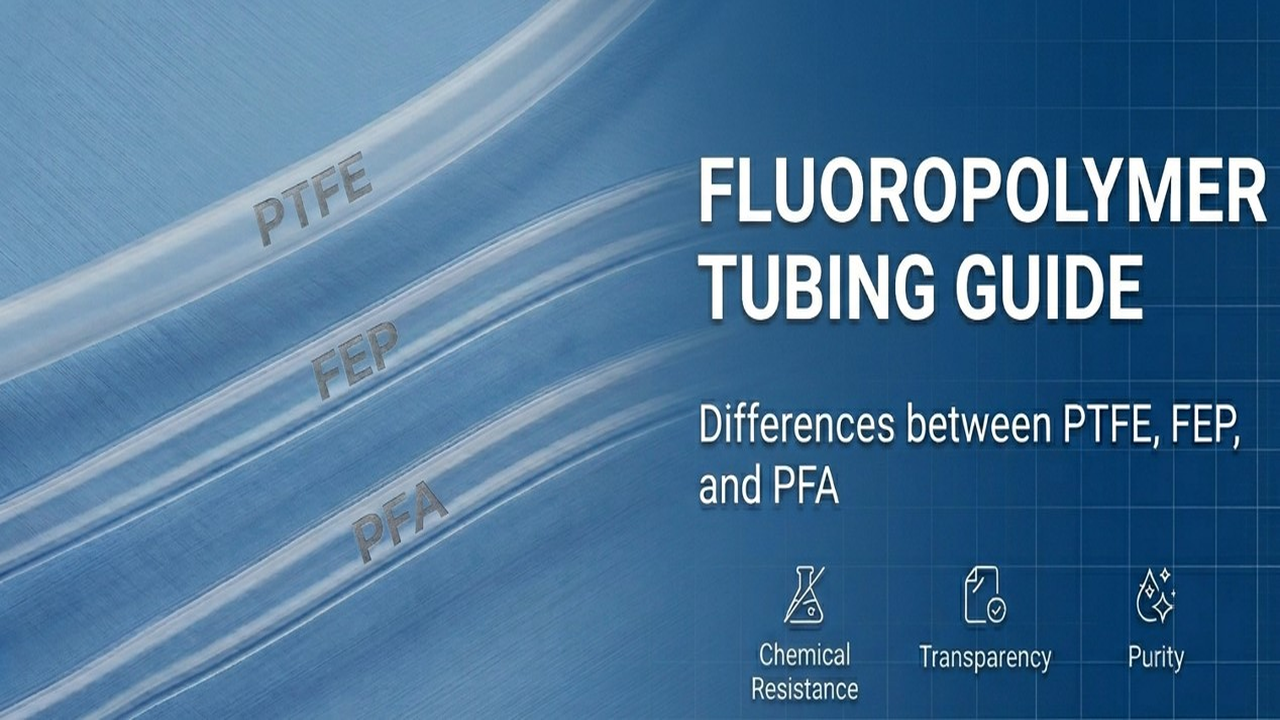
In fluid transport systems for life sciences and In Vitro Diagnostics (IVD) automation, three main fluoropolymer tubing types—PTFE (Polytetrafluoroethylene), FEP (Fluorinated Ethylene Propylene), and PFA (Perfluoroalkoxy Alkane)—dominate the market. While all belong to the PFAS (per- and polyfluoroalkyl substances) family and share excellent chemical resistance, they each possess distinct physical properties such as transparency, surface smoothness, gas permeability, flexibility, and maximum operating temperature. This necessitates careful selection based on specific application requirements. This article provides a comprehensive comparative analysis of these materials, forming a fundamental resource for precise fluid handling system design.
Technical & Clinical Details
PTFE is renowned for its high heat resistance, superior chemical inertness, and low coefficient of friction. However, it is microporous, opaque, and has a relatively rough internal surface, leading to higher gas permeability and a risk of trace impurity adsorption. Its manufacturing typically involves extrusion and sintering.
FEP retains many of PTFE’s excellent properties but is optically clear and boasts a smoother internal surface. This results in lower gas permeability than PTFE and tends to inhibit microbial adhesion in fluids. FEP is melt-processable, allowing for easier thermoforming and welding. While its maximum operating temperature is lower than PTFE, it is sufficient for many life science applications.
PFA represents the newest technology among the three fluoropolymers, offering nearly all of PTFE’s heat and chemical resistance while also being melt-processable like FEP. The key distinguishing features of PFA are its exceptionally high purity and remarkably smooth internal surface finish. These attributes lead to the lowest gas permeability and minimal extractables, making it ideal for transporting high-purity reagents and sensitive biological samples. In IVD applications, where minimizing contamination risk is paramount, PFA is particularly recommended. Additionally, PFA surpasses FEP in heat resistance and offers greater flexibility.
Background & Context
In life science research, clinical diagnostics, and pharmaceutical processes, the precise and safe transport of reagents and samples is critically important. Even minute contamination or material extractables can directly compromise the reliability of experimental results and the accuracy of patient diagnoses. Consequently, tubing materials must meet stringent requirements for chemical inertness, purity, and long-term stability. While PFAS family materials have been used for years due to their ability to meet these demands, understanding the subtle differences in each material’s properties is crucial for designing optimal systems that balance cost, performance, and reliability.
Strategic Significance & Outlook
With advancing automation and miniaturization in the life sciences and IVD sectors, the demand for high-performance fluoropolymer tubing will continue to grow. Requirements for low extractables, low adsorption, and long-term stability in materials will become increasingly stringent. Melt-processable materials like FEP and PFA offer potential for greater design freedom and production efficiency in manufacturing more complex fluidic circuits and microfluidic devices. Furthermore, as environmental regulations concerning PFAS as a whole evolve, the development of alternatives and more environmentally friendly manufacturing processes for these materials will become significant research and development themes.








Comments