Key Findings
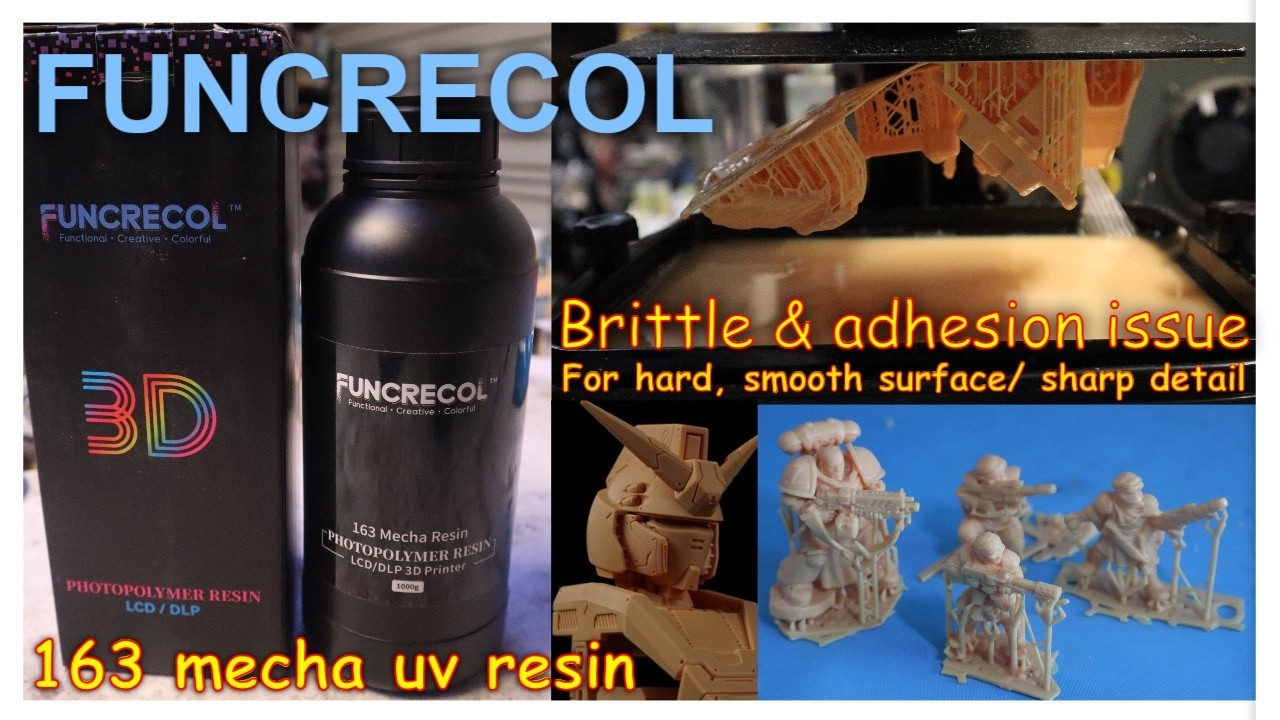
A recent review of Funcrecol 163 Mecha Photopolymer Resin for 3D printing highlighted its exceptional strength and impressively sharp detail, making it suitable for manufacturing small parts where visual fidelity or specific mechanical properties are critical. However, the review also underscored operational challenges, including poor adhesion to the build plate and difficulties in removing support structures, indicating room for improvement in user-friendliness for a broader audience.
Technical & Clinical Details
Funcrecol 163 Mecha Photopolymer Resin is a UV-curable resin used in DLP (Digital Light Processing) and SLA (Stereolithography) 3D printers. The review suggested that its high viscosity contributes to printing stability and enables high-precision detail reproduction. However, this high viscosity can complicate resin drainage from the vat and cleaning processes, potentially leading to reduced flowability, especially in colder environments. The strong chemical odor emitted during cleaning necessitates working in a well-ventilated area. In terms of strength, while the cured resin offers high rigidity and can withstand certain impacts, the review reported a tendency for brittleness upon ‘over-exposure.’ This implies that precise calibration of printing parameters is crucial. The difficulty in removing supports is attributed to the material’s hardness and excessively strong adhesion between the model and supports during curing, increasing post-processing labor.
Background & Context
In the 3D printing market, there’s a constant demand for both improved performance and ease of use. Mechanical properties and printing accuracy are paramount, especially in industrial applications and precision parts manufacturing. However, many high-performance resins often come with processing difficulties or specific drawbacks. Funcrecol 163 Mecha Photopolymer Resin exemplifies this, requiring developers to balance the needs for high strength and precision with an enhanced user experience. Such product reviews are invaluable for prospective users to understand the pros and cons of a product and determine its suitability for their specific applications.
Strategic Significance & Outlook
High-strength, high-precision materials like Funcrecol 163 Mecha Photopolymer Resin will maintain strong demand in niche markets such as precision engineering, medical models, and figurine production. Future developments will likely focus on optimizing viscosity, improving the balance between build plate adhesion and support removal, and reducing chemical odor. Material scientists and 3D printer manufacturers are expected to collaborate to optimize resins and printers, maximizing the potential of high-performance resins and delivering products more accessible to a wider range of users. This will further expand the application scope of high-performance 3D printing.







Comments