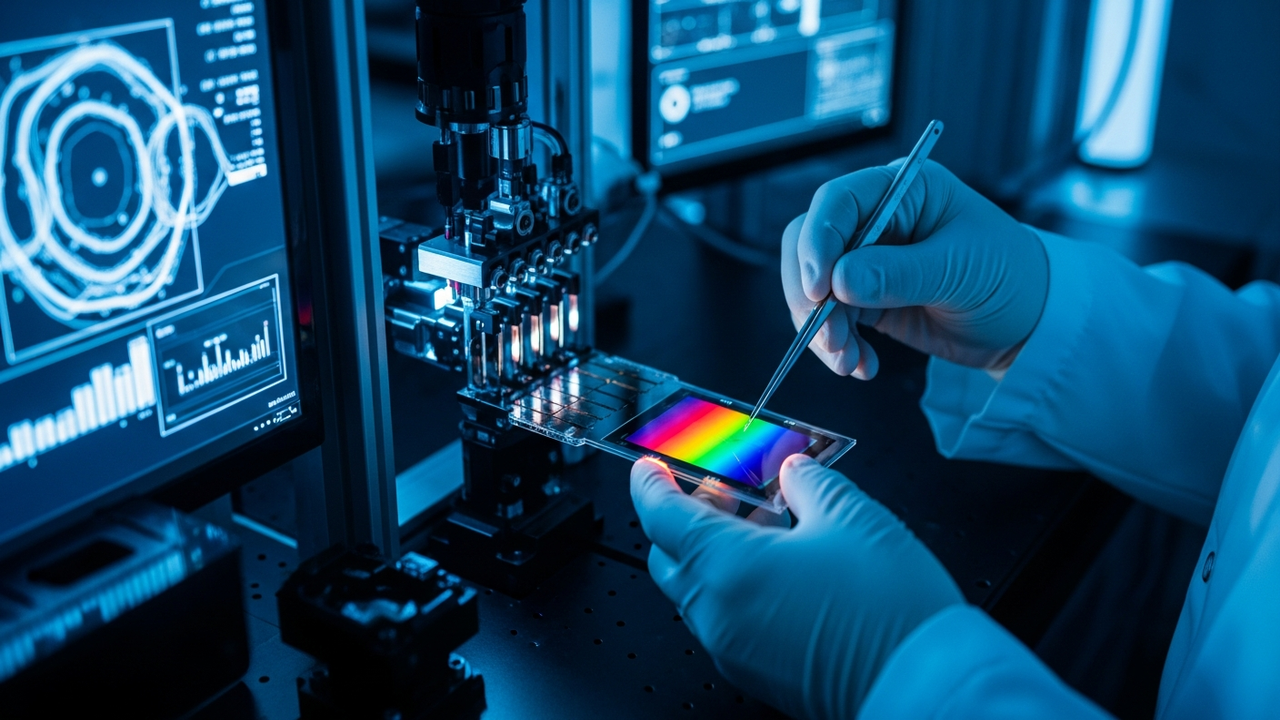
Key Findings
According to a report from Photonics.com, there is a marked increase in market demand for spectral biosensing technology within healthcare diagnostics, specifically for point-of-care (POCT) instruments, clinical laboratory equipment, and portable diagnostic devices. To meet this demand, the optimization of spectral responsivity in wafer-level optics is gaining significant importance. This optimization allows sensors to achieve more accurate detection across a broader range of wavelengths while simultaneously preserving the compact form factor critical for portable applications. This advancement is expected to bring substantial benefits to fields such as real-time pathogen detection, biomarker identification, and drug monitoring.
Technical and Clinical Details
Spectral biosensing is a technology that detects and quantifies specific substances by analyzing the interaction of light with biomolecules (e.g., absorption, reflection, emission). Wafer-level optics refers to a manufacturing approach that applies semiconductor fabrication techniques to produce optical components, enabling the mass production of extremely small and uniform optical elements. Optimizing spectral responsivity means designing biosensors to maximize their sensitivity and efficiency within the specific wavelength range relevant to the target analyte. For example, to capture the fluorescent signal emitted by a particular biomarker, the characteristics of filters and detectors are optimized to match its emission spectrum. This allows for clear identification of even trace amounts of target molecules, minimizing the impact of background noise—a crucial aspect for achieving rapid and reliable results in POCT devices.
Background and Industry Context
In modern medicine, there is an accelerating shift towards POCT devices that can provide rapid diagnostic results near the patient, reducing reliance on central laboratories. This need is evident in diverse scenarios, including emergency medicine, infectious disease outbreaks, remote healthcare, and home-based self-monitoring. Spectral biosensing, with its non-contact nature and high analytical capabilities, is a strong candidate for POCT, but miniaturization and cost-effectiveness have been challenges. Advances in wafer-level optics overcome these hurdles, making it possible to integrate high-performance spectral biosensors into compact portable devices. This will enable more people to access high-quality diagnostic services quickly, contributing to the reduction of healthcare disparities.
Strategic Significance and Outlook
The optimization of wafer-level optics in spectral biosensing is predicted to have a significant impact on the diagnostic market. Future developments will likely involve the creation of multiplex sensors capable of simultaneously detecting multiple pathogens and biomarkers in real-time within a single device. Furthermore, integration with AI will enable advanced analysis of spectral data, leading to enhanced automation and accuracy in diagnostics. This will accelerate widespread applications in non-medical fields, such as environmental pathogen detection systems, food safety inspections, and personalized drug treatment monitoring, contributing to a safer and healthier society.