Key Findings
A preprint published on Preprints.org provides a detailed review of recent progress in NKG2D CAR-NK cells for cancer immunotherapy, emphasizing their favorable safety profile characterized by a low risk of inducing graft-versus-host disease (GVHD) or immune rejection. The paper highlights CAR-NK cells’ excellent clinical accessibility and scalable manufacturing potential, concluding that iPSC (induced pluripotent stem cell)-derived NK cells represent the most innovative platform for universal “off-the-shelf” therapies, owing to their unlimited self-renewal capacity and potential for highly standardized production.
Technical / Clinical Details
- NKG2D CAR-NK Cells: NKG2D is an activating receptor on NK cells that recognizes stress ligands expressed on cancer and infected cells. By engineering NK cells to express NKG2D as a Chimeric Antigen Receptor (CAR), they are designed to exert more specific and potent anti-tumor effects. Compared to CAR-T cells, CAR-NK cells tend to exhibit fewer severe side effects such as cytokine release syndrome (CRS) and neurotoxicity, positioning them as a potentially safer therapeutic option.
- Low GVHD and Immune Rejection Risk: CAR-NK cells exert major histocompatibility complex (MHC)-independent anti-tumor effects compared to T cells, resulting in an extremely low risk of GVHD even when allogeneic (donor-derived) cells are transplanted. This eliminates the need for patient-specific, HLA-matched manufacturing, enabling broader application as an “off-the-shelf” therapeutic for a wide range of patients.
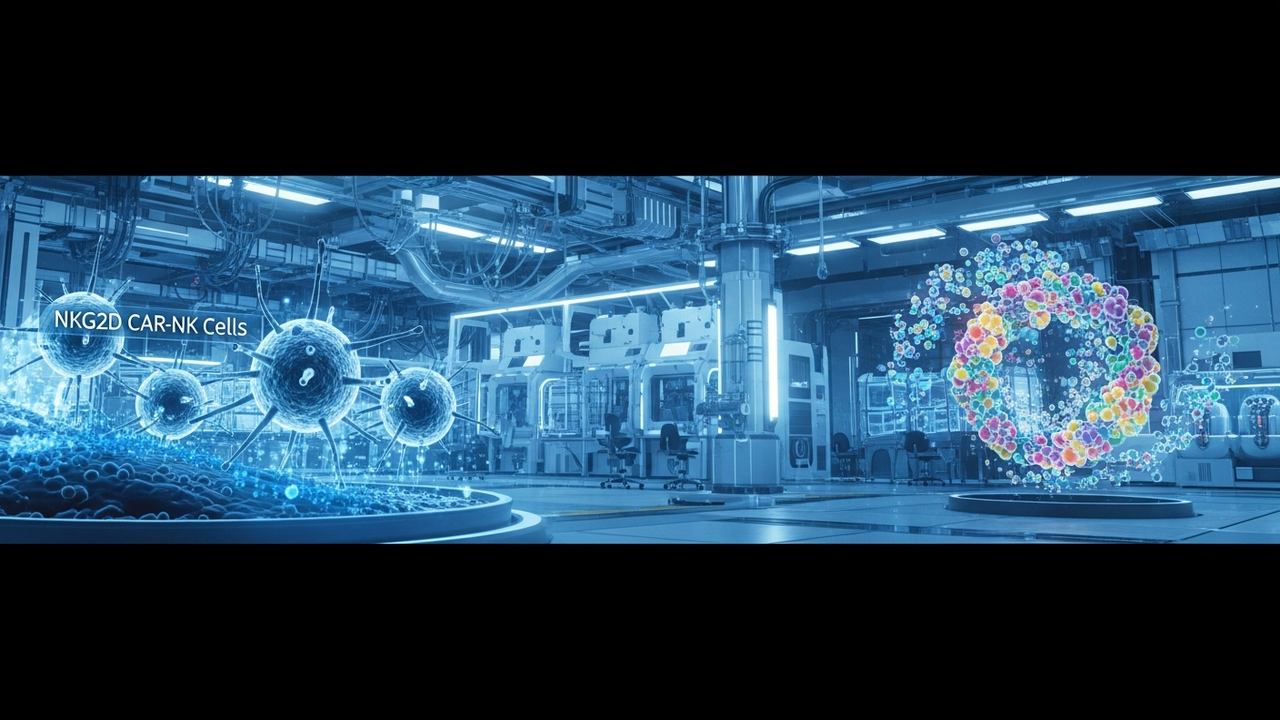
- Excellent Clinical Accessibility and Scalable Manufacturing Potential: The low GVHD risk significantly enhances the clinical accessibility of CAR-NK cell therapy, as pre-manufactured and cryopreserved allogeneic CAR-NK cells can be rapidly supplied to numerous patients. Furthermore, advances in in vitro NK cell expansion technologies are paving the way for large-scale, cost-effective manufacturing.
- Advantages of iPSC-Derived NK Cells: iPSCs possess unlimited self-renewal capacity, allowing for the stable and large-scale supply of homogeneous NK cells from a single iPSC master cell bank. This is highly advantageous for ensuring quality consistency and reducing manufacturing costs. iPSC-derived NK cells can also be readily subjected to gene editing technologies to enhance anti-tumor activity, prolong in vivo persistence, and confer immune evasion properties.
Background & Context
Cancer immunotherapy has revolutionized cancer treatment over the past decade, but existing cell therapies like CAR-T cell therapy still face challenges such as manufacturing complexity, high costs, and limited efficacy against some solid tumors. CAR-NK cells, particularly those derived from iPSCs, are emerging as a next-generation cell therapy poised to overcome these challenges, offering safer, more universal, and accessible cancer treatments.
Strategic Significance & Outlook
NKG2D CAR-NK cells, especially iPSC-derived off-the-shelf products, are set to play a pivotal role in shaping the future of cancer immunotherapy. This review suggests that their potent anti-tumor activity, favorable safety profile, and manufacturing scalability will provide new therapeutic options for diverse cancer types, especially solid tumors. If future clinical trial data further substantiate these benefits, iPSC-derived NKG2D CAR-NK cells hold the potential to become a groundbreaking “off-the-shelf” treatment for cancer patients worldwide.
Source: https://www.preprints.org/frontend/manuscript/82031b6c0696befd75cd86867e200d56/download_pub