Yan’an University Elevates Carbon-Based Perovskite Solar Cell Efficiency to 18.35% and Enhances Stability with Fluorinated Polymer Interface Technology
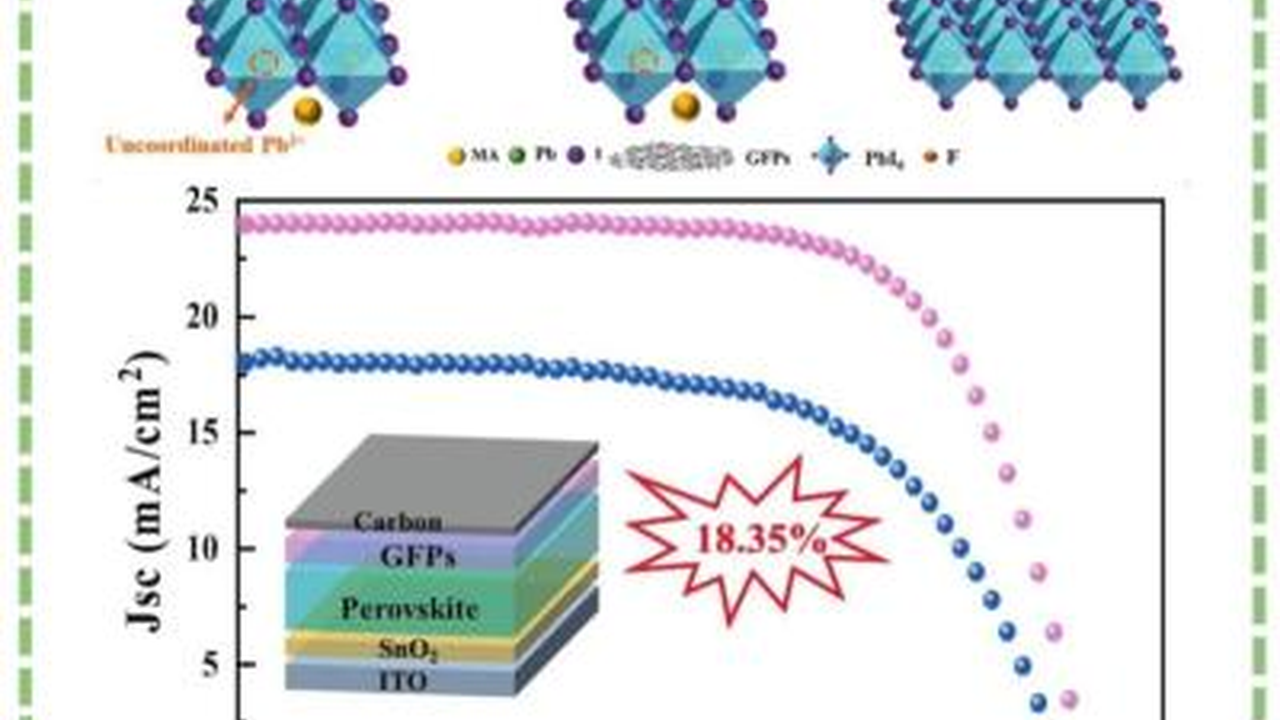
Researchers at Yan’an University in China have unveiled a new interface engineering strategy that dramatically improves the performance of carbon-based perovskite solar cells (C-PSCs). By incorporating fluorinated graphite polymers (GFPs), they successfully boosted the power conversion efficiency (PCE) of C-PSCs to 18.35%. This represents a significant advancement, paving the way for the commercialization of C-PSCs.
Technical and Clinical Details
- Multifunctionality of GFPs: The introduced GFPs act as a functional layer on the methylammonium lead iodide (MAPbI3) perovskite thin film. This GFP layer enhances device performance through several mechanisms:
- Defect Passivation: It effectively passivates trap states at the perovskite crystal surface and grain boundaries, thereby suppressing non-radiative recombination.
- Energy Level Modulation: The GFPs optimize the band alignment of the device, enhancing the efficiency of charge carrier extraction.
- Crystallization Control: They promote secondary grain growth within the perovskite film, leading to improved film quality and uniformity.
- Formation of Hydrophobic Barrier: The GFP layer also forms a hydrophobic dipole layer on the perovskite film. This significantly boosts the device’s resistance to external environmental factors such as moisture and oxygen, thereby enhancing long-term stability.
- Performance Enhancement: These improvements collectively lead to enhanced charge extraction efficiency and reduced non-radiative recombination losses, ultimately achieving a high efficiency of 18.35% and excellent environmental stability.
Background and Industry Context
Conventional hole-transport layer (HTL)-free carbon-based perovskite solar cells, which eliminate the need for precious metal electrodes and can be manufactured at low cost, hold great promise as a future low-cost photovoltaic technology. However, their performance, especially long-term stability, has been a major challenge for commercialization. This research demonstrates the potential to overcome these challenges through a simple surface modification, expanding the applicability of C-PSCs.
Future Outlook
Yan’an University’s research unequivocally demonstrates that interface engineering using fluorinated polymers is a powerful strategy for simultaneously enhancing both the efficiency and stability of C-PSCs. This technology offers a new pathway to realize high-performance, reliable perovskite solar cells while keeping manufacturing costs low. In the future, the integration of this approach into large-scale production processes is expected to significantly increase the adoption of C-PSCs in broader markets.