Background
The global push towards the commercial production of perovskite solar cells is gaining significant momentum, with substantial investments and technological advancements observed particularly in Asia and Europe. Perovskite solar cells represent a next-generation technology with numerous advantages over traditional silicon cells, including lower manufacturing costs, high power conversion efficiencies, and applicability to flexible substrates. These characteristics position them for diverse markets, ranging from utility-scale ground-mounted power plants and Building-Integrated Photovoltaics (BIPV) to portable electronics and even advanced space applications. While significant challenges to mass production remain, robust government support and inter-company collaborations are actively accelerating their commercialization.
Key Findings
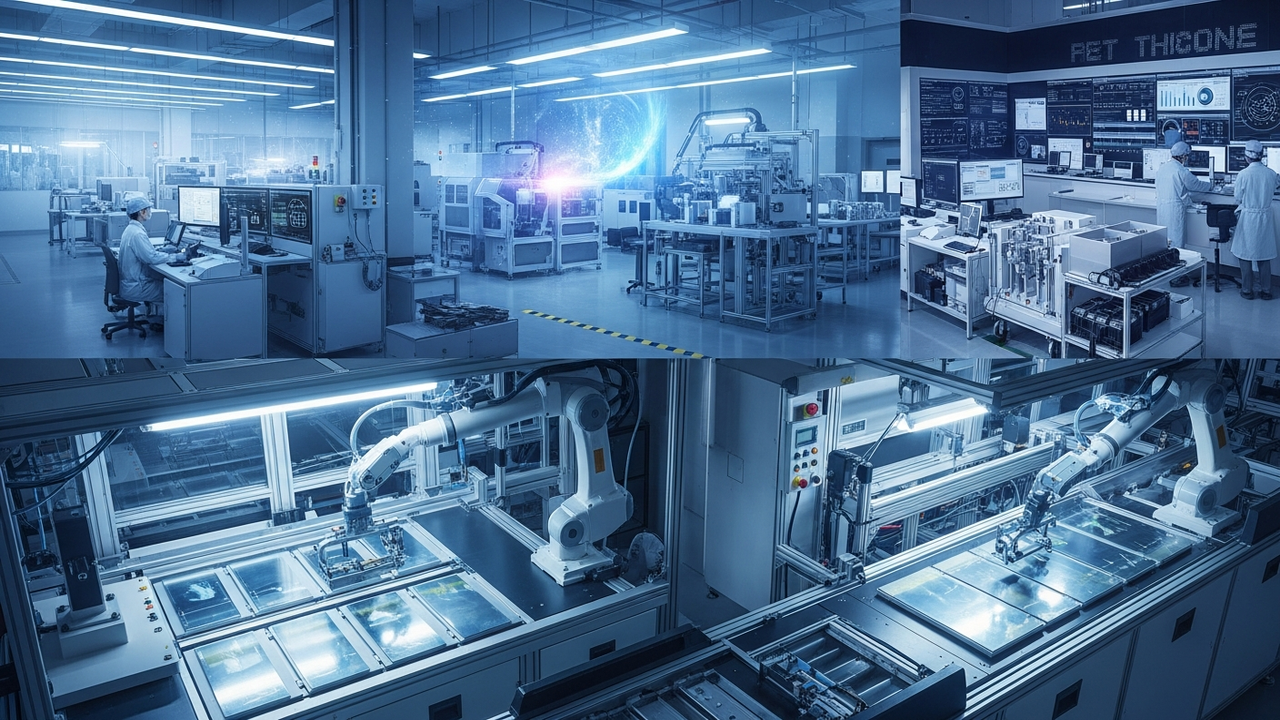
China Construction Second Engineering Bureau is making rapid progress on a 3-gigawatt (GW) perovskite solar cell module manufacturing base in southwestern China. The installation of its metal roof structure is complete, with the facility slated for full completion and handover by October 2026. This project marks a critical milestone for the large-scale deployment of perovskite solar technology.
- Flexell Space (Korea) Targets Space Applications: South Korean company Flexell Space has inaugurated a pilot manufacturing facility in Uiwang for perovskite/CIGS tandem solar cells, specifically engineered for demanding space applications. This facility aims to produce 20 high-efficiency, lightweight tandem cells (each 20cm x 20cm) per day, strategically targeting high-value niche markets where their unique properties offer distinct advantages.
- Italy’s New Time Collaborates on Production Roadmap: Italy’s New Time has partnered with China’s Huasun to outline a detailed four-phase roadmap for perovskite panel production within Italy. This comprehensive roadmap encompasses refining material formulations for improved performance and durability, ensuring robust device stabilization, obtaining crucial international certifications, and ultimately establishing full-scale industrial manufacturing capabilities.
- INFICON’s Precision Deposition Technology Enhances Scalability: A pivotal factor in achieving scalable perovskite production is precise control over manufacturing processes. INFICON’s innovative approach combines thermal evaporation with real-time quartz crystal microbalance (QCM) monitoring to achieve extremely high accuracy in perovskite solar cell deposition. QCM plays an indispensable role by providing real-time measurement of layer thickness and composition during the evaporation process. This meticulous control ensures stable device characteristics and high production yields, as even minor variations in layer thickness and composition can significantly accelerate device degradation. This precision control technology is thus crucial for achieving the long-term stability required for broad market adoption.
The establishment of these new manufacturing bases and pilot lines provides clear evidence that perovskite solar cell technology is transitioning from the research and development phase into mass production. The integration of such precision manufacturing process control technologies is vital for enhancing product reliability and market competitiveness, significantly broadening the potential for perovskite solar cells to become a major player in the global energy market. Furthermore, initial applications in high-value niche markets, such as space, will offer critical opportunities to rigorously demonstrate the technology’s reliability and superior performance.
Source: https://www.perovskite-info.com/tags/perovskite-solar-production