Key Findings
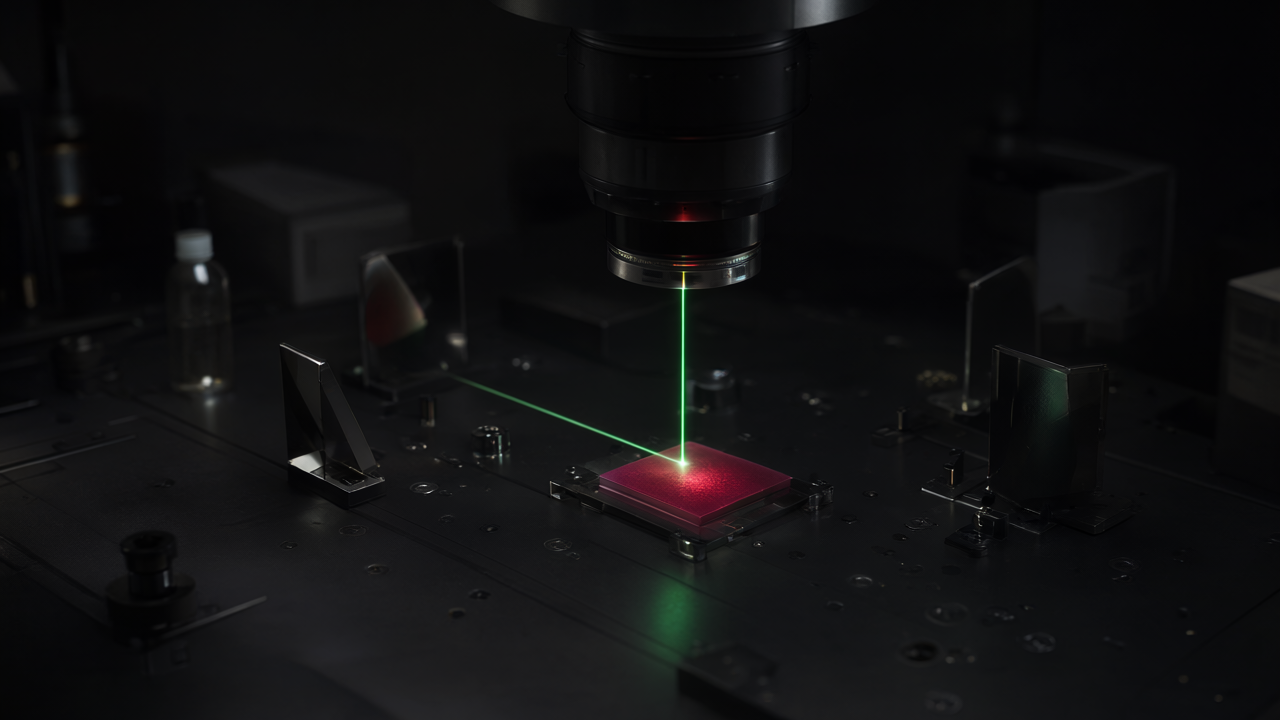
According to a research preprint released on arXiv, a groundbreaking nondestructive technique, wavelength-dependent photoluminescence (PL) mapping, has been developed and successfully applied to detailed, depth-resolved evaluation of degradation mechanisms in phenethylammonium tetrafluoroborate (PATFB)-treated perovskite solar cells under thermal stress. This method enables clear differentiation between interfacial and bulk degradation, significantly contributing to further enhancing the stability and refining the lifetime prediction of high-efficiency devices, including single-junction perovskite solar cells at 26.9% and silicon-perovskite tandem cells exceeding 34%.
Technical / Clinical Details
- Wavelength-Dependent PL Mapping: This technique collects PL signals from different depths within the perovskite layer by using varying excitation wavelengths. This allows for nondestructive, depth-resolved analysis of how photogenerated carrier behavior and defect distribution change across the film. It is particularly effective for understanding and distinguishing interfacial versus bulk degradation mechanisms that critically affect perovskite solar cell performance.
- Stability Enhancement via PATFB Treatment: The research also suggests that PATFB surface treatment improves the quality and stability of the perovskite film. PATFB is believed to play a role in passivating surface defects and inhibiting ion migration, thereby enhancing the thermal and operational stability of the device.
- Application to High-Efficiency Devices: This depth-dependent degradation evaluation technique provides essential information for materials design and device structure optimization in the development of high-efficiency perovskite solar cells (26.9% for single-junction, >34% for tandem cells). This feedback loop is crucial for achieving further performance improvements and ensuring long-term reliability.
Background & Context
Perovskite solar cells are considered promising for next-generation photovoltaics due to their excellent power conversion efficiency, but long-term stability remains a challenge for practical implementation. Elucidating degradation mechanisms caused by external environmental factors such as heat and humidity is essential for extending device lifetime. Conventional evaluation methods have struggled to clearly distinguish whether degradation occurs at the interface or within the bulk layer. The nondestructive, depth-resolving evaluation technique developed in this study addresses this challenge and provides design guidelines for improving stability.
Strategic Significance & Outlook
This wavelength-dependent PL mapping technique has potential applications not only in fundamental research on perovskite solar cells but also in quality control for manufacturing processes and product lifetime prediction. This is expected to accelerate the rapid development of more robust and reliable perovskite solar cells. Furthermore, widespread adoption of these high-efficiency and stable perovskites would accelerate the deployment of renewable energy, significantly contributing to global carbon emission reduction. Diversified applications, particularly in flexible devices and Building-Integrated Photovoltaics (BIPV), are anticipated.
Source: https://arxiv.org/abs/2610.04714
Get our weekly technology intelligence — free
Receive an infographic that lets you judge at a glance whether each field’s analysis report is worth reading.
Subscribe Free — Weekly Tech Intelligence
By subscribing, you’ll receive Troy-Technical’s weekly technology intelligence newsletter.
- Your email and selected fields are used only to deliver the newsletter.
- We never share your information with third parties.
- You can unsubscribe anytime via the link in each email.
See our Privacy Policy for details.
Takes about a minute · Unsubscribe anytime