Key Findings
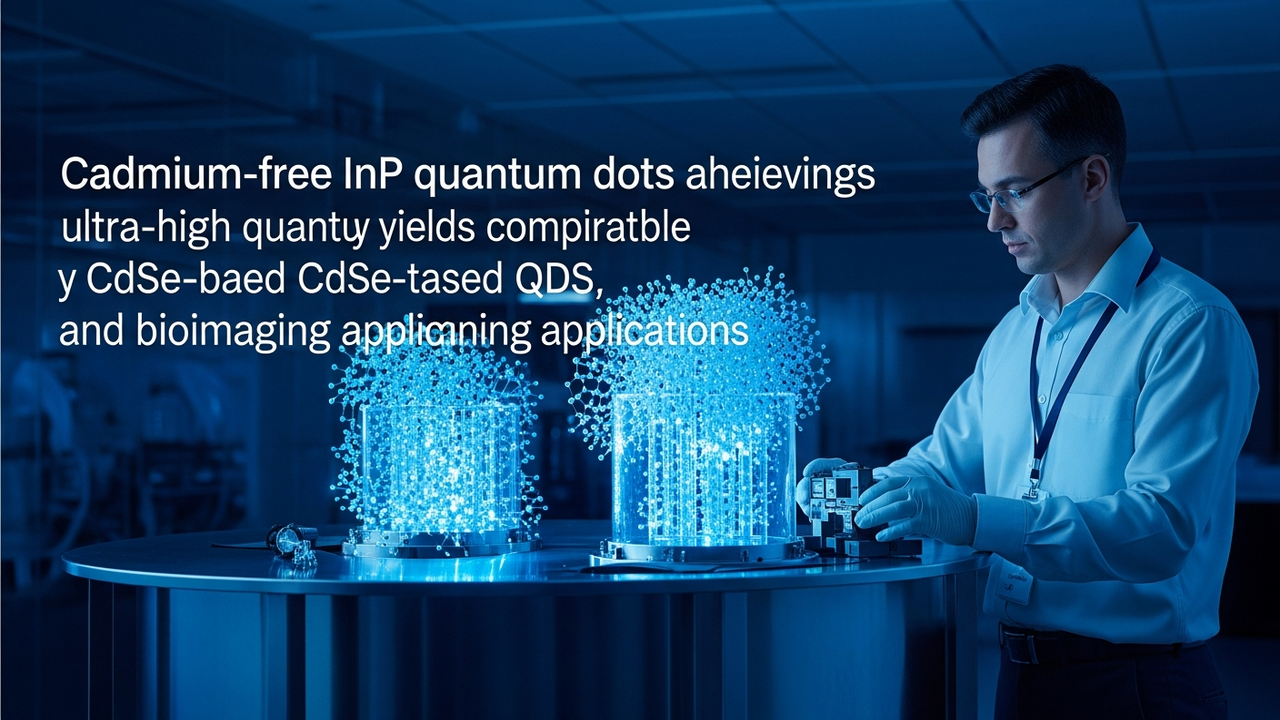
Significant advancements in the synthesis and optical properties of indium phosphide (InP)-based multinary quantum dots (QDs) have been reported, showcasing their remarkable performance without the toxic heavy metals like cadmium and lead. Crucially, these InP QDs have now achieved photoluminescence quantum yields (PLQY) exceeding 95%, making them competitive with, and in some aspects superior to, traditional CdSe-based QDs. This breakthrough positions InP QDs as a viable and safer alternative for applications in solid-state lighting, lasers, and bioimaging.
Technical / Clinical Details
The enhanced optical performance of InP QDs stems from sophisticated shell growth techniques and advanced surface passivation strategies. By uniformly coating the InP core with wide-bandgap materials, such as ZnS, surface defects are effectively suppressed, and non-radiative recombination pathways are minimized. This ensures that absorbed photons are efficiently re-emitted as light, dramatically increasing the quantum yield. Furthermore, the incorporation of multinary components allows for precise tuning of the emission spectrum, enabling specific wavelength emission tailored for various applications. These advancements provide a safer alternative that rivals or even surpasses the performance of conventional QDs containing toxic heavy metals.
Background & Context
Quantum dots are highly anticipated for their superior optical properties, promising revolutionary advancements in next-generation displays, lighting, and biomedical diagnostics. However, the most efficient QDs, historically based on CdSe or CdTe, have always carried significant environmental and biological safety concerns due to their cadmium content. This has created an urgent demand within both industry and academia for cadmium-free QDs that can deliver comparable high performance. The enhanced performance of InP QDs directly addresses this critical challenge, broadening the options for safer and more sustainable nanotechnology materials.
Strategic Significance & Outlook
With quantum yields exceeding 95%, cadmium-free InP QDs are poised to enable the development of products with more vibrant color reproduction and higher energy efficiency, particularly in the display industry. In the medical field, their enhanced biocompatibility as fluorescent probes will accelerate the development of safer bioimaging and diagnostic tools. Their high emission efficiency and stability also make them highly promising for next-generation laser light sources. These developments suggest that InP QDs will establish a significant competitive advantage in the market, especially with increasing environmental regulations, and will become a key material driving innovation across a wide range of industrial sectors.
Get our weekly technology intelligence — free
Receive an infographic that lets you judge at a glance whether each field’s analysis report is worth reading.
Subscribe Free — Weekly Tech Intelligence
By subscribing, you’ll receive Troy-Technical’s weekly technology intelligence newsletter.
- Your email and selected fields are used only to deliver the newsletter.
- We never share your information with third parties.
- You can unsubscribe anytime via the link in each email.
See our Privacy Policy for details.
Takes about a minute · Unsubscribe anytime