Background
Quantum computing, with its immense computational power, promises to revolutionize fields from drug discovery and materials science to cryptography. However, developing robust and scalable quantum hardware critically depends on ultra-precise optical components for manipulating and measuring qubits. Designing these nanoscale light-controlling components is exceptionally complex, requiring significant expertise, time, and computational resources. Traditional design methods, often relying on trial-and-error or intensive simulations, have historically created a bottleneck for innovation. Physics-informed AI emerges as a powerful solution to this challenge, enabling faster and more efficient development of high-performance quantum optical components.
Key Findings
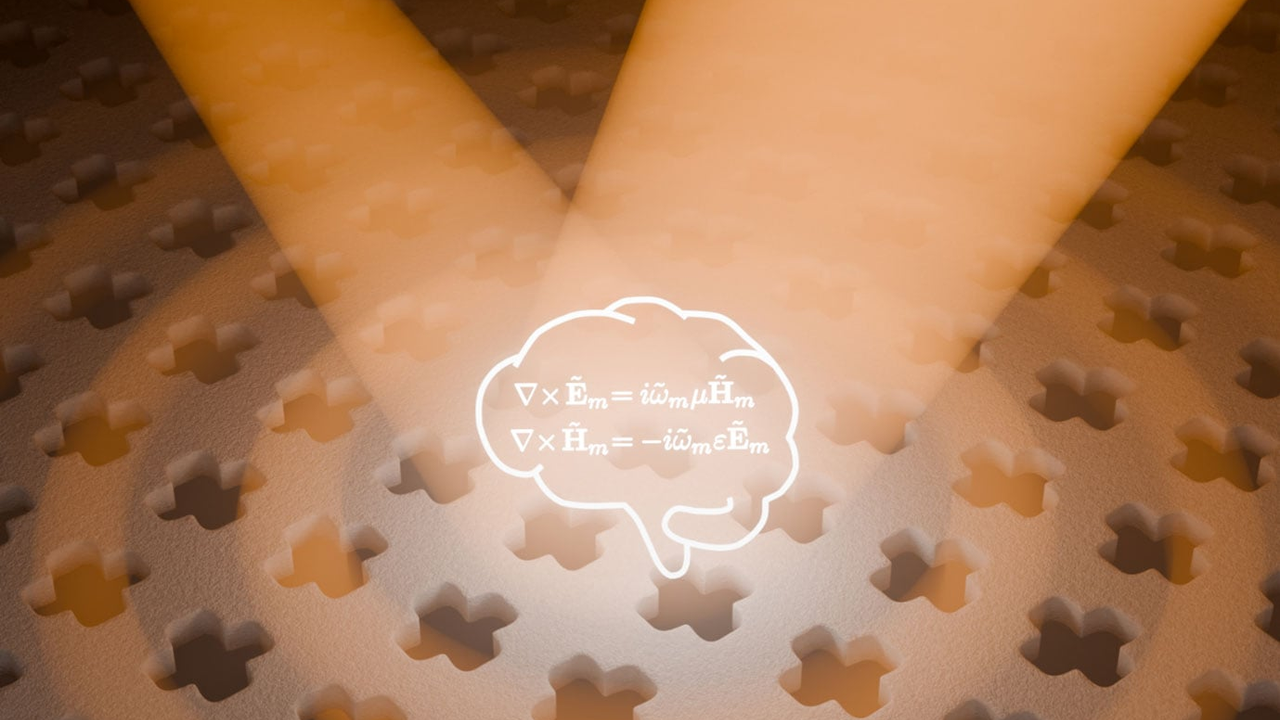
Researchers at Chalmers University of Technology in Sweden have pioneered an innovative machine learning approach that directly embeds fundamental laws of physics into neural networks. This ‘physics-informed AI’ dramatically boosts the development efficiency of advanced optical components and holds significant potential to accelerate discovery processes in quantum computing technologies and novel material design.
Unlike conventional purely data-driven neural networks, this new approach directly integrates fundamental physical laws, such as electromagnetism and quantum mechanics, into the model’s architecture and training. This intrinsic physical consistency enables the AI to generate more robust solutions and drastically reduces the data volume required for training. For instance, in designing complex optical components like photonic crystals and metamaterials, the AI can perform ‘inverse design’: taking desired optical properties (e.g., specific wavelength transmission or reflection) as input and outputting the optimal microstructure. By enforcing physical laws, the AI efficiently filters out unphysical or unfeasible designs, accelerating the exploration of promising candidates. This method compresses design iteration cycles from weeks or months down to hours or days, directly accelerating the development of optical devices essential for manipulating quantum states in quantum computing.
The physics-informed AI demonstrated by Chalmers University’s research heralds a new era for scientific and technological innovation. Its applications are expected to extend far beyond quantum computing, encompassing general material design, energy material development, and medical sensors. Future developments will likely involve models addressing more complex physical phenomena and multi-scale systems, moving towards ‘AI-driven science’ where AI autonomously generates hypotheses, designs experiments, and interprets results. This paradigm shift promises to accelerate technological solutions for humanity’s most pressing challenges—such as climate change and new drug development—and generate profound economic and technological impacts globally, ushering in an era of unprecedented, AI-accelerated innovation.
Get our weekly technology intelligence — free
Receive an infographic that lets you judge at a glance whether each field’s analysis report is worth reading.
Subscribe Free — Weekly Tech Intelligence
By subscribing, you’ll receive Troy-Technical’s weekly technology intelligence newsletter.
- Your email and selected fields are used only to deliver the newsletter.
- We never share your information with third parties.
- You can unsubscribe anytime via the link in each email.
See our Privacy Policy for details.
Takes about a minute · Unsubscribe anytime