Key Findings
Leading Chinese solar power companies are aggressively entering the space-based solar power (SSPP) market, investing heavily in perovskite technology to realize cost-effective and scalable space energy systems. GCL Optoelectronic Material and Ziwei Network Technology have announced plans to launch their self-developed “computing satellite” within the year, which will be equipped with GCL’s perovskite solar cell array. GCL has already achieved a high certified conversion efficiency of 30.2% for its 2,042 square centimeter perovskite-silicon tandem module, demonstrating its potential to revolutionize power supply in space.
Technical and Space Application Details
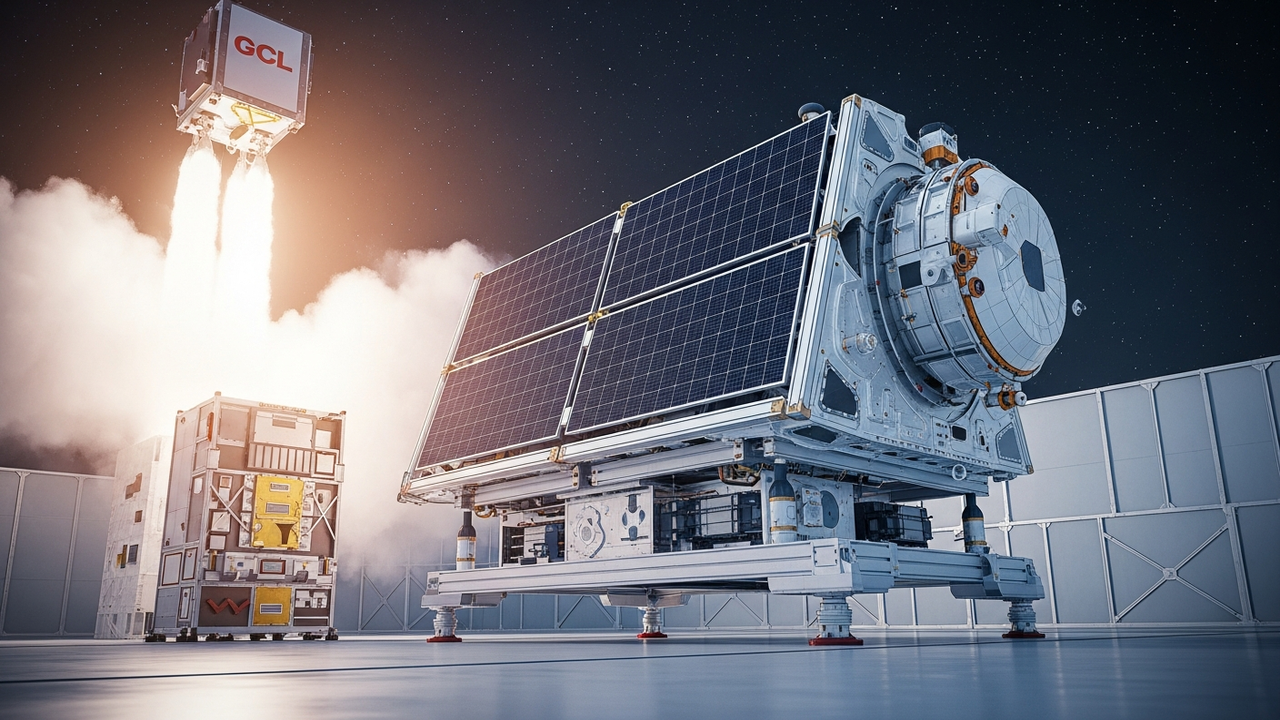
Chinese solar giants are making a strategic foray into the space-based solar power (SSPP) market, driven by the potential of perovskite technology to offer lower costs and enhanced scalability for extraterrestrial energy systems. GCL Optoelectronic Material, in collaboration with Ziwei Network Technology, plans to launch its proprietary “computing satellite” before the end of the year. This satellite will feature a perovskite solar cell array developed by GCL. Critically, GCL has already demonstrated a robust certified conversion efficiency of 30.2% for its perovskite-silicon tandem module, sized at a practical 2,042 square centimeters. Perovskite solar cells are exceptionally well-suited for space applications due to several key advantages over traditional silicon cells, including their lighter weight, greater flexibility, and potential for higher radiation tolerance. The impressive 30.2% efficiency is crucial for maximizing power generation from the limited surface area available on satellites, enabling more ambitious missions and extended operational lifetimes in orbit.
Background & Context
Space-based solar power has long been envisioned as one of the ultimate solutions to Earth’s energy crises. However, its realization has been hampered by significant challenges: the need for ultralight and highly efficient solar cells, and substantial cost reductions for deployment. China has made rapid advancements in space exploration and is increasingly interested in SSPP to secure energy independence and technological leadership. Perovskite solar cells are uniquely positioned to address these challenges. Beyond their excellent power conversion efficiency, their thin-film, lightweight nature, and ability to be deposited on various flexible substrates offer significant design freedom for satellite and spacecraft solar arrays. Furthermore, their relatively lower manufacturing cost is a crucial advantage for the large-scale deployment required by SSPP projects, differentiating them from traditional, more expensive space-grade solar cells.
Strategic Significance & Outlook
The launch of GCL’s “computing satellite” will mark one of the first instances where perovskite solar cell technology demonstrates its performance under the extremely harsh conditions of space. The 30.2% efficient 2,042 cm² tandem module has the potential to dramatically enhance satellite power capabilities, enabling larger payloads and longer mission durations. This will open new opportunities in areas such as space communications, Earth observation, and even deep-space exploration. This move by Chinese solar giants signals the dawn of new competition in the space energy market and represents a critical step in expanding the commercial application scope of perovskite technology beyond Earth. Investors should closely monitor the long-term growth opportunities presented by this nascent “space energy revolution,” as it promises to be a transformative force in both energy and aerospace sectors.
Get our weekly technology intelligence — free
Receive an infographic that lets you judge at a glance whether each field’s analysis report is worth reading.
Subscribe Free — Weekly Tech Intelligence
By subscribing, you’ll receive Troy-Technical’s weekly technology intelligence newsletter.
- Your email and selected fields are used only to deliver the newsletter.
- We never share your information with third parties.
- You can unsubscribe anytime via the link in each email.
See our Privacy Policy for details.
Takes about a minute · Unsubscribe anytime