Key Findings
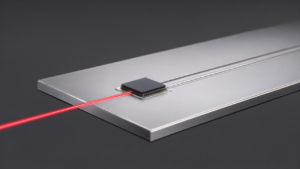
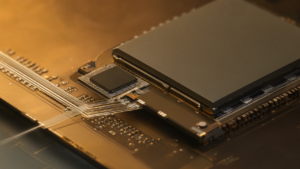
An international collaborative research team, spearheaded by the University of Oxford, has developed a world-class ultrafast and low-power chip-scale modulator using self-assembled plasmonic-organic hybrid nanocavities (POHN). This groundbreaking device enables modulation in the terahertz band with only picojoule-order energy, significantly outperforming conventional electro-optic modulators.
Technical / Clinical Details
- The developed modulator maximizes the interaction efficiency between light and electrical signals by combining plasmonic effects with the excellent electro-optical properties of organic materials.
- Through a self-assembly process, nanoscale resonant cavity structures are precisely formed, allowing for efficient concentration of optical signals. This dramatically reduces the driving voltage and energy required for modulation.
- Experiments have demonstrated that this POHN modulator operates over an ultra-wide bandwidth, achieving extremely low energy consumption per bit (pJ/bit) at gigabit to terabit-scale data rates.
- Its chip-scale integration capability makes it promising for applications in optical interconnects and on-chip optical networks, potentially revolutionizing internal communication within AI accelerators and high-performance processors.
- Compared to conventional modulators, significant improvements in size, power consumption, and speed have been observed, contributing to solutions for thermal management and operational costs in data centers.
Background & Context
With the advancement of AI and HPC, data processing speed and efficiency have dramatically increased, but power consumption, particularly for data movement and optoelectronic conversion, remains a major bottleneck. Existing optical modulators face a trade-off where power consumption increases with higher speeds, necessitating new fundamental approaches. The fusion of plasmonics and organic materials has emerged as a promising avenue to overcome this challenge.
Strategic Significance & Outlook
The development of this ultrafast, low-power chip-scale modulator has the potential to profoundly impact the future of optical communication, optical computing, and AI infrastructure. The research team aims to further scale up this technology, paving the way for commercial applications. Particularly in next-generation architectures such as Co-Packaged Optics (CPO) and on-chip optical interconnects, POHN modulators are poised to play a central role, accelerating the sustainable and high-performance evolution of data centers.
Source: https://academic.oup.com/nsr/advance-article-abstract/doi/10.1093/nsr/nwag335/8707690
Get our weekly technology intelligence — free
Receive an infographic that lets you judge at a glance whether each field’s analysis report is worth reading.
Subscribe Free — Weekly Tech Intelligence
By subscribing, you’ll receive Troy-Technical’s weekly technology intelligence newsletter.
- Your email and selected fields are used only to deliver the newsletter.
- We never share your information with third parties.
- You can unsubscribe anytime via the link in each email.
See our Privacy Policy for details.
Takes about a minute · Unsubscribe anytime