Key Findings
Marvell has published a blog post highlighting the critical role that plasmonics technology plays in shaping the future of high-bandwidth optical communication for the AI era. Plasmonics leverages hybrid light-electron interactions to push the boundaries of current optical communication technologies, addressing the unprecedented data rate and power efficiency challenges demanded by AI/ML workloads.
Technical / Clinical Details
- What is Plasmonics: This technology utilizes surface plasmon polaritons (SPPs), which are collective oscillations of electrons at the interface between noble metals and dielectrics, to confine light to the nanoscale. This enables the creation of smaller, faster, and lower-power optical components compared to conventional optical devices.
- Achieving High Bandwidth: Plasmonics-based modulators, due to their ultra-compact size, can operate in the gigahertz to terahertz frequency range, achieving extremely high modulation speeds. This is crucial for next-generation optical interconnects of 1.6T and beyond, required in AI data centers.
- Improving Power Efficiency: The short propagation distance of SPPs significantly reduces the power required for modulation. This alleviates power consumption and thermal management challenges for AI accelerators and GPU clusters.
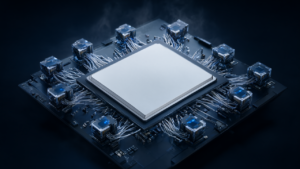
- Marvell states that integrating plasmonics with silicon photonics can achieve both high scalability and cost efficiency, paving the way for advanced packaging technologies like Co-Packaged Optics (CPO) and Near-Packaged Optics (NPO).
Background & Context
The increasing complexity of AI models and the explosion of data volumes are placing new demands on data center interconnect technologies. Traditional copper wiring and standard optical fibers are facing bottlenecks in terms of bandwidth, latency, and power consumption, necessitating fundamental new technological innovations. Plasmonics has emerged as one of the promising candidates to overcome these challenges.
Strategic Significance & Outlook
Marvell anticipates that plasmonics technology will play a central role in the future of AI infrastructure and is focusing on its development and commercialization. The evolution of this technology will further push the performance limits of AI data centers, enabling the deployment of larger and more complex AI workloads. Plasmonics has the potential to establish the next-generation standard for optical interconnects and accelerate the realization of an AI-driven society.
Source: https://www.marvell.com/blogs/plasmonics-higher-bandwidth-optics-ai-era.html
Get our weekly technology intelligence — free
Receive an infographic that lets you judge at a glance whether each field’s analysis report is worth reading.
Subscribe Free — Weekly Tech Intelligence
By subscribing, you’ll receive Troy-Technical’s weekly technology intelligence newsletter.
- Your email and selected fields are used only to deliver the newsletter.
- We never share your information with third parties.
- You can unsubscribe anytime via the link in each email.
See our Privacy Policy for details.
Takes about a minute · Unsubscribe anytime