Key Findings
Oxford PV and Fraunhofer ISE have collaboratively unveiled a new prototype design for a perovskite-silicon tandem solar module, demonstrating a high conversion efficiency of 25.6% across the entire module area. This achievement was demonstrated with two types of large-format modules: a 1.92m², 491W rooftop module and a 2.13m², 546W bifacial module. Critically, this design incorporates Fraunhofer’s innovative Matrix Shingle interconnection technology, marking a significant step toward the commercialization of perovskite solar technology.
Technical Details
The core of this breakthrough lies in the synergy between Oxford PV’s leading perovskite-silicon tandem cells and Fraunhofer ISE’s advanced Matrix Shingle interconnection technology. The module achieved a verified 25.6% efficiency over its full aperture area, showcasing a remarkable translation of cell-level performance to a practical module scale. The Matrix Shingle approach facilitates wider cell cutting due to lower current density, promising substantial improvements in manufacturing throughput compared to conventional busbar-connected cells. This innovation directly addresses production scalability, a key hurdle for advanced PV technologies. The prototypes, including a 1.92m², 491W rooftop variant and a 2.13m², 546W bifacial module, combine high power output with practical dimensions suitable for industrial adoption. The technology was prominently featured at Intersolar Europe, drawing considerable industry attention to its commercial viability and performance.
Background & Context
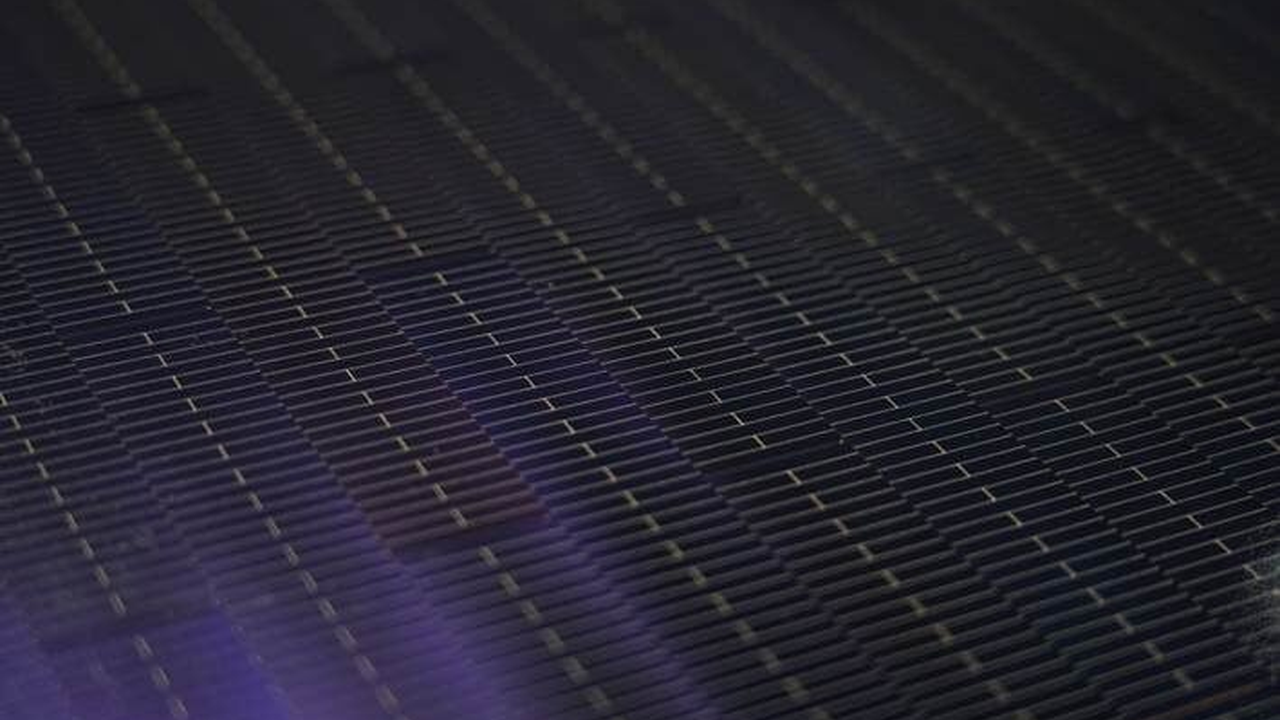
Perovskite-silicon tandem solar cells are globally recognized as a leading pathway to surpass the theoretical efficiency limits of single-junction silicon solar cells, which hover around 26-27%. Oxford PV has been a pioneer in this field, focusing on developing highly efficient perovskite top layers that can harvest higher-energy photons, while silicon bottom cells capture lower-energy light. Fraunhofer ISE, with its extensive legacy in PV research and development, particularly excels in module interconnection and packaging technologies. This collaboration effectively marries Oxford PV’s material science prowess with Fraunhofer’s engineering and manufacturing expertise. Traditional solar module production processes often face challenges with complex cell interconnections and module-level losses. The Matrix Shingle interconnection technology mitigates these issues by allowing for overlapping cell arrangements, which leads to denser cell packing and more efficient current collection across the module, reducing inactive areas and resistive losses.
Strategic Significance & Outlook
The unveiling of this prototype represents a critical milestone in the journey towards large-scale commercialization of perovskite tandem technology. By simultaneously advancing both efficiency and manufacturability, these modules are expected to drive down the levelized cost of electricity (LCOE) for solar power, thereby accelerating the global adoption of renewable energy. The superior performance and versatility, especially in large-area rooftop installations and bifacial applications, position these new modules with a significant competitive advantage. This advancement suggests that perovskite-silicon tandems are moving rapidly from scientific curiosity to tangible, market-ready products, potentially reshaping the future of the photovoltaic industry.
Get our weekly technology intelligence — free
Receive an infographic that lets you judge at a glance whether each field’s analysis report is worth reading.
Subscribe Free — Weekly Tech Intelligence
By subscribing, you’ll receive Troy-Technical’s weekly technology intelligence newsletter.
- Your email and selected fields are used only to deliver the newsletter.
- We never share your information with third parties.
- You can unsubscribe anytime via the link in each email.
See our Privacy Policy for details.
Takes about a minute · Unsubscribe anytime