Key Findings
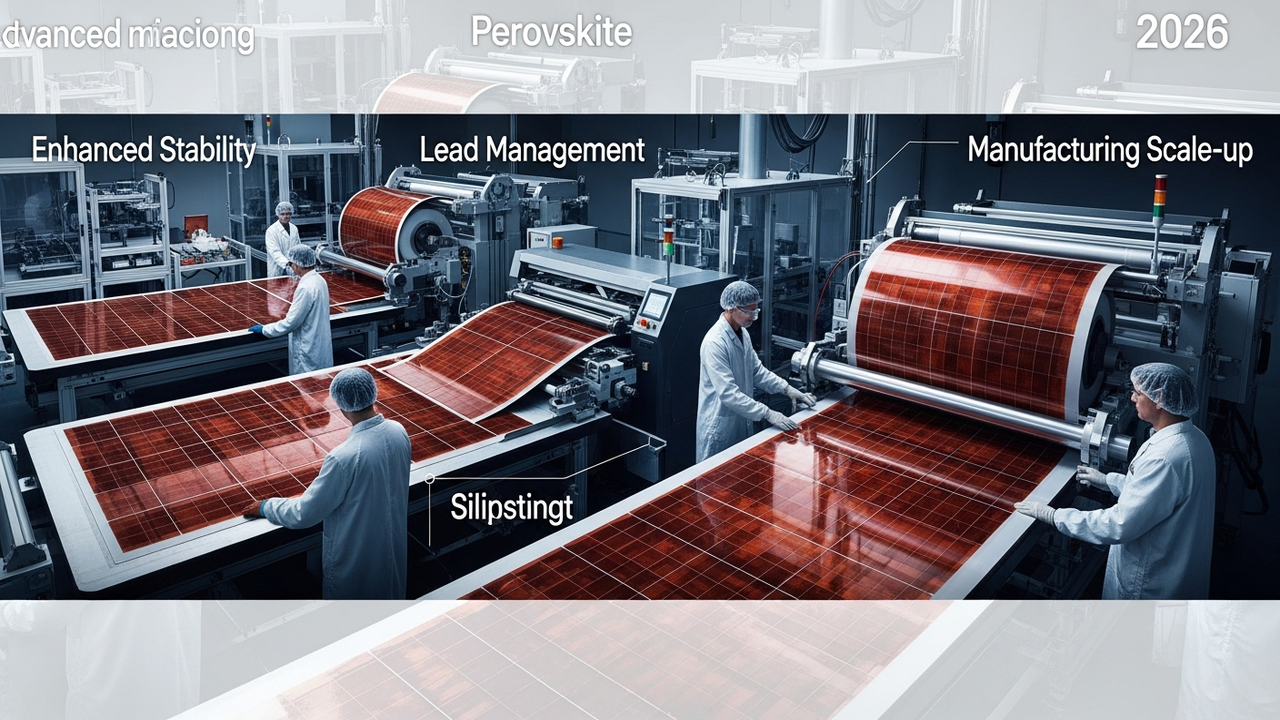
A video from TaiyangNews provides a detailed analysis of the current status of perovskite solar cells in 2026, highlighting stability, toxicity (lead management), and manufacturing scale-up as primary areas of focus. The discussion emphasized significant progress in tandem cell technology, notable improvements in device stability, and innovations in manufacturing processes tailored for large-scale production. These advancements conclude that perovskite solar cells are capable of high-efficiency, low-cost manufacturing, and possess the potential to surpass the theoretical limits of conventional silicon-based solar cells.
Technical Challenges and Progress
Historically, maintaining performance under long-term environmental exposure has been a major challenge for perovskite solar cells. However, significant progress has been made through novel encapsulation techniques and material refinements, substantially enhancing their stability, particularly against moisture and heat. Regarding toxicity, concerns over the environmental impact of lead, commonly used in perovskite solar cells, are being addressed. This includes developing technologies for reducing lead content, implementing robust encapsulation strategies to prevent lead leakage, and actively researching lead-free perovskite materials. Scaling up from small-area laboratory cells to commercially viable large-area modules has also been a significant hurdle. Now, efficient and low-cost large-scale manufacturing techniques, such as slot-die coating and roll-to-roll processes, are maturing. Furthermore, perovskite-silicon tandem cells, which combine perovskite with silicon solar cells, have already achieved efficiencies exceeding 30%, breaking the limits of single-junction cells by utilizing a broader spectrum of solar energy. These collective technical advancements clearly indicate that perovskite solar cells are steadily progressing towards practical application and commercial viability.
Background & Industry Context
Since their first report in 2009, perovskite solar cells have garnered attention as a “game-changer” in the photovoltaic industry due to their rapid efficiency improvements. However, despite their high efficiency, commercialization has been hindered by issues of durability, environmental safety (especially lead content), and the establishment of mass production technologies. The global photovoltaic industry constantly seeks new technologies that offer higher efficiency and lower Levelized Cost of Electricity (LCOE) to accelerate the worldwide shift towards renewable energy. By 2026, numerous concrete solutions to these challenges have been proposed and are entering the demonstration phase. The video illustrates that major companies and research institutions are actively focusing on developing technologies to manufacture stable, high-efficiency modules while mitigating environmental impact.
Strategic Significance & Outlook
Breakthroughs in stability, toxicity management, and manufacturing scale-up are poised to significantly accelerate the commercial adoption of perovskite solar cells. The combination of high efficiency and low-cost manufacturing capabilities will dramatically enhance the cost-effectiveness of solar power, potentially complementing or partially replacing the existing silicon solar cell market. Given their lightweight and flexible nature, perovskites are expected to find diverse applications, including Building-Integrated Photovoltaics (BIPV), wearable devices, IoT sensors, and space applications. The evolution of this technology will further expand the role of solar power in the global energy mix, becoming indispensable for achieving a sustainable society. Investors, policymakers, and engineers must continue to pay close attention to the opportunities and challenges presented by this rapidly evolving field, as it promises to be a pivotal component of future energy infrastructures.
Source: https://www.youtube.com/watch?v=S3O_7eFz8S0
Get our weekly technology intelligence — free
Receive an infographic that lets you judge at a glance whether each field’s analysis report is worth reading.
Subscribe Free — Weekly Tech Intelligence
By subscribing, you’ll receive Troy-Technical’s weekly technology intelligence newsletter.
- Your email and selected fields are used only to deliver the newsletter.
- We never share your information with third parties.
- You can unsubscribe anytime via the link in each email.
See our Privacy Policy for details.
Takes about a minute · Unsubscribe anytime