Key Findings
Quantinuum, in collaboration with Sandia National Laboratories, has announced the publication of peer-reviewed data in Nature, validating the exceptional performance of Helios, their 98-qubit commercial trapped-ion quantum computer. The key breakthrough reported is an average two-qubit gate fidelity of 99.921%, alongside a single-qubit gate fidelity of 99.9975%. These high-fidelity metrics represent a significant advancement in controlling quantum states and reducing error rates, crucial for the development of practical and fault-tolerant quantum computing systems.
Technical / Clinical Details
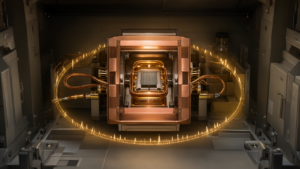
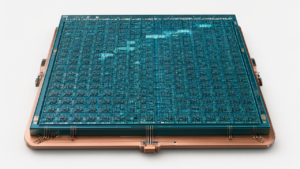
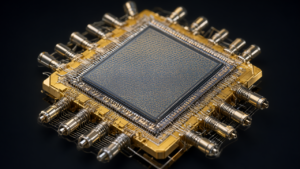
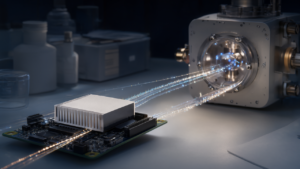
The Helios processor operates on Quantinuum’s Quantum Charge Coupled Device (QCCD) architecture, which enables the precise shuttling of ions across a microchip, facilitating targeted interactions between qubits. A distinguishing feature of Helios is its rotatable ion storage ring, which enhances the efficiency of qubit operations and the implementation of quantum error correction protocols. The Nature paper meticulously details the operational parameters of the device, including qubit layout, ion transport mechanisms, and the calibration processes employed to achieve the reported fidelities. High gate fidelity is paramount as it directly translates to the ability to execute longer and more complex quantum algorithms with reduced susceptibility to noise, thereby lowering the overhead required for quantum error correction. This brings the realization of fault-tolerant quantum computers, capable of sustained, accurate computation, significantly closer.
Background & Context
Trapped-ion quantum computers are widely regarded as one of the leading modalities in the race for scalable quantum computing, primarily due to their long coherence times and high gate fidelities. The validation of Helios’s performance represents a critical step towards achieving quantum advantage—the point at which quantum computers can perform tasks infeasible for even the most powerful classical supercomputers. This technology holds immense promise for applications in areas such such as drug discovery, advanced materials science, and complex financial modeling. The collaboration between a national laboratory like Sandia and a commercial entity such as Quantinuum exemplifies the synergistic approach needed to translate fundamental scientific breakthroughs into commercially viable quantum solutions, strengthening U.S. leadership in the burgeoning quantum technology sector.
Strategic Significance & Outlook
The successful demonstration of Helios’s capabilities provides a robust platform for further research and development in quantum computing. This 98-qubit system will serve as a vital testbed for developing and validating more sophisticated quantum algorithms, pushing the boundaries of what is computable. Quantinuum plans to leverage these advancements to scale their systems to even larger qubit counts and higher fidelities, accelerating the timeline for fault-tolerant quantum computing. For researchers and engineers, this opens new avenues for developing practical quantum applications. From an investment perspective, the progress in trapped-ion technology, as demonstrated by Helios, signals a maturing quantum computing landscape, indicating potential for significant returns in companies driving these fundamental hardware advancements. This breakthrough underscores the sector’s rapid evolution and the increasing viability of quantum solutions for real-world problems.
Get our weekly technology intelligence — free
Receive an infographic that lets you judge at a glance whether each field’s analysis report is worth reading.
Subscribe Free — Weekly Tech Intelligence
By subscribing, you’ll receive Troy-Technical’s weekly technology intelligence newsletter.
- Your email and selected fields are used only to deliver the newsletter.
- We never share your information with third parties.
- You can unsubscribe anytime via the link in each email.
See our Privacy Policy for details.
Takes about a minute · Unsubscribe anytime