Background
Polymer materials are indispensable across virtually every industry, from automotive and aerospace to healthcare, electronics, and packaging. However, developing new polymers with enhanced functionality or improved sustainability has historically been an extremely challenging and time-consuming endeavor. This difficulty stems from the vast chemical space polymers occupy and the intricate synthesis pathways involved. Recent advancements in AI and automation technologies are now emerging as powerful tools to overcome this ‘exploration bottleneck’ in polymer science. The Schubert Group’s presentation vividly illustrates the transformative potential of materials informatics within the polymer field, setting high expectations for the rapid creation of higher-performance and more environmentally friendly macromaterials.
Key Findings
The Schubert Group presented its latest groundbreaking advancements in AI-driven polymer research at the AI4X Conference 2026 in Singapore. Their research demonstrates that combining automated high-throughput experimentation with machine learning dramatically accelerates the discovery process for new functional polymer materials. This approach enables the efficient generation and analysis of large polymer datasets, providing deep insights into the complex relationships between polymer structure and properties.
Technical Details
The Schubert Group’s research integrates the following key elements:
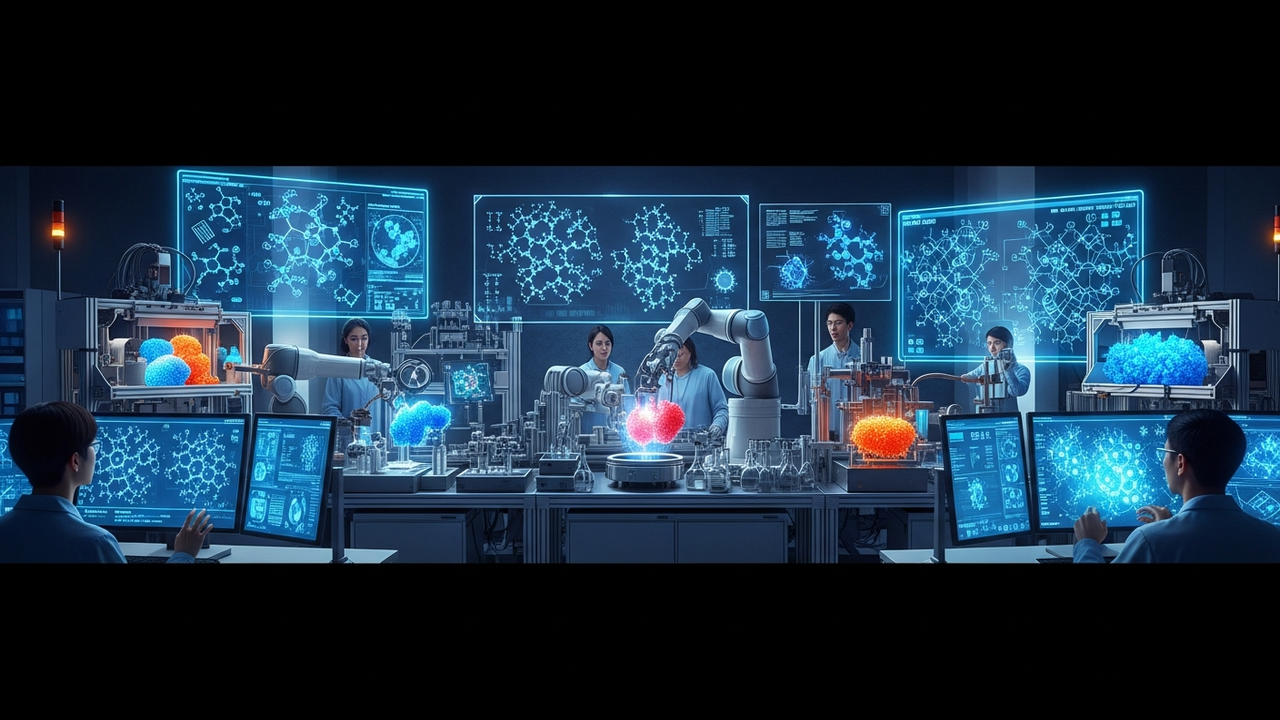
- High-Throughput Automated Synthesis: Robotic automated synthesis platforms are employed to rapidly synthesize polymers spanning a wide range of compositions and structures. This enables the simultaneous generation of thousands of polymer candidates, a scale previously unattainable with conventional laboratory methods.
- Automated Characterization: Synthesized polymers undergo rapid evaluation using automated instruments for a diverse array of physical and chemical properties, including thermal analysis, viscosity measurements, mechanical strength tests, and optical property assessments. All measurement data is immediately digitized and archived in a central database.
- Machine Learning Models: The extensive structure-property datasets collected are leveraged to train various machine learning models (e.g., regression models, classification models, generative models). These models learn the intricate relationships between a polymer’s structure and its desired functionalities (e.g., electrical conductivity, biocompatibility, heat resistance), enabling accurate prediction of properties for new polymer candidates or the inverse design of polymers with specific target attributes. Graph Neural Networks (GNNs), which represent molecular structures as graphical data, have proven particularly effective for predicting complex macromolecular properties.
- Closed-Loop Learning: Predictions generated by the machine learning models are fed back into the experimental design pipeline, guiding the next iterative round of automated synthesis and characterization. This continuous, closed-loop learning cycle perpetually enhances the efficiency and effectiveness of the polymer discovery process.
This integrated, iterative approach drastically shortens the development timeline for novel polymer materials, reducing what traditionally took years or even decades to a matter of months.
Future Outlook
The Schubert Group’s research is poised to significantly shape the future of AI-driven polymer research. Moving forward, this integrated approach is anticipated to be applied to a broad spectrum of macromaterials, including more complex multi-functional polymers, self-healing polymers, and recyclable or biodegradable polymers. Furthermore, the group aims to continually enhance the predictive accuracy of their AI models and the reliability of their automated synthesis and characterization systems, ultimately working towards the realization of ‘self-driving labs’ with minimal human intervention. This technology is projected to rapidly deliver next-generation polymer materials crucial for achieving a sustainable society, enabling a transition to a circular economy, and fostering the development of innovative products across emerging technological sectors.
Get our weekly technology intelligence — free
Receive an infographic that lets you judge at a glance whether each field’s analysis report is worth reading.
Subscribe Free — Weekly Tech Intelligence
By subscribing, you’ll receive Troy-Technical’s weekly technology intelligence newsletter.
- Your email and selected fields are used only to deliver the newsletter.
- We never share your information with third parties.
- You can unsubscribe anytime via the link in each email.
See our Privacy Policy for details.
Takes about a minute · Unsubscribe anytime