Key Findings
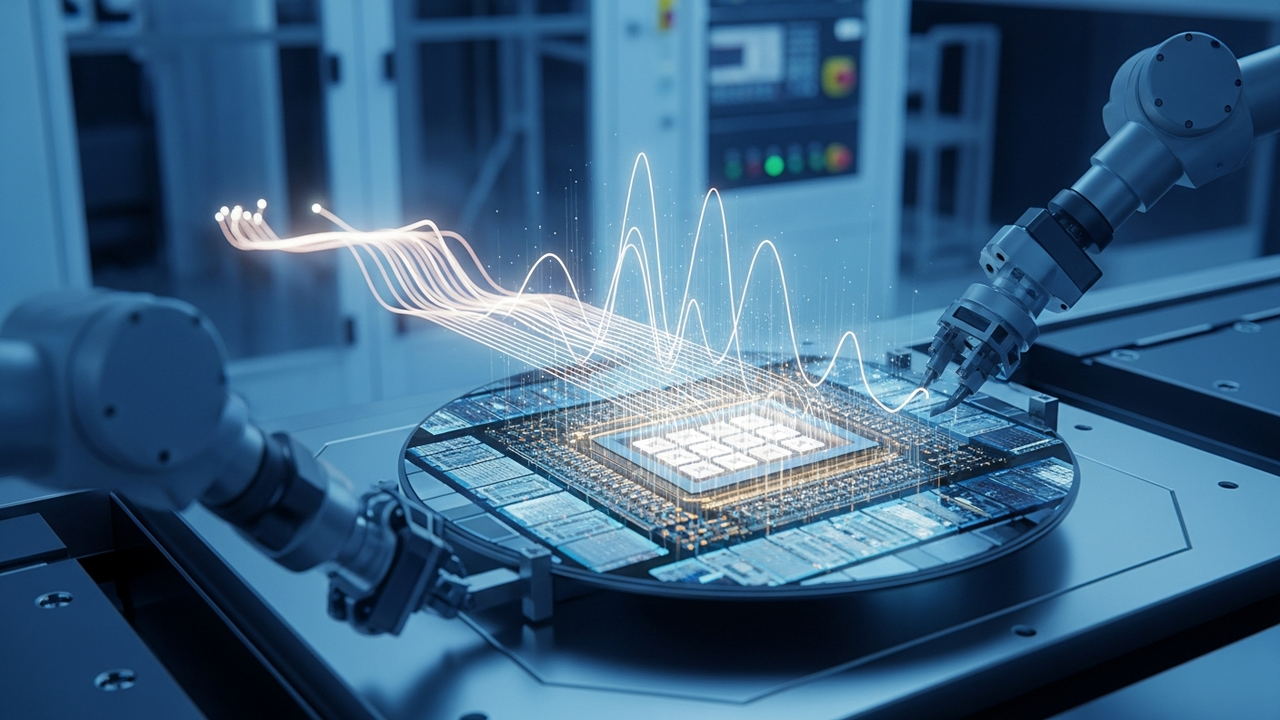
A June 2026 report from Semiconductor Engineering highlights that AI systems are catalyzing a profound integration of optical components with logic chips. This shift mandates a holistic co-evolution across fabrication processes, advanced packaging, thermal management, materials science, and testing methodologies to achieve scalable manufacturing. Central to this integration is hybrid bonding technology, which is lauded for enabling unprecedented connection density. Furthermore, Intel Foundry’s Lori Scott elaborated on the latest advancements in EMIB-T, co-packaged optics, and glass packaging at ECTC 2026, providing a clear trajectory for industry innovation.
Technical & Clinical Details
- AI-Driven Optical-Logic Integration: AI applications demand immense data processing capabilities, often bottlenecked by inter-chip data transfer speeds. Directly integrating optical components with logic chips allows for high-speed, low-power data communication that transcends the limitations of electrical signaling. This integration requires coordinated technological development across the entire semiconductor ecosystem, from design to manufacturing.
- Hybrid Bonding: This technique creates direct copper-to-copper bonds at the wafer or die level, achieving extremely high interconnect density and fine pitches impossible with traditional wire bonding or flip-chip methods. It is key to 3D stacking and chiplet technologies, contributing to increased bandwidth and reduced power consumption.
- EMIB-T (Embedded Multi-die Interconnect Bridge-Tile): Developed by Intel, this technology functions as a bridge to efficiently connect disparate chiplets. It enables high-density connectivity while offering cost advantages and process simplification compared to traditional interposers.
- Co-packaged Optics: This technology integrates optical transceivers directly within the semiconductor package. It dramatically boosts switching bandwidth and improves power efficiency in data centers by shortening signal pathways and minimizing electrical losses.
- Glass Packaging: Utilizing glass substrates, which offer high flatness, low dielectric loss, and thermal stability, for packaging. This provides superior signal integrity and thermal dissipation characteristics, especially for high-frequency applications and large interposers, enabling higher-performance modules.
Background & Context
The semiconductor industry is undergoing fundamental transformations driven by mega-trends such as AI, high-performance computing, 5G communication, and autonomous driving. As the industry grapples with the slowing pace of traditional process node miniaturization (the “end of Moore’s Law”), heterogeneous integration and advanced packaging have become primary strategies for delivering next-generation performance and cost efficiency. The integration of optics and logic, in particular, is a top industry priority, directly addressing power consumption issues in data centers and bottlenecks in AI workloads.
Strategic Significance & Outlook
This report clearly indicates that AI is a primary driving force across all facets of the semiconductor industry, especially in packaging and materials development. Technologies like hybrid bonding, EMIB-T, co-packaged optics, and glass packaging are poised to shape the innovation roadmap for semiconductor advancements in the coming years. These technologies will mature and scale to mass production, enabling faster, more power-efficient, and smaller electronic devices. Industry-wide collaboration and investment will be crucial for the successful realization of these technological breakthroughs.
Source: https://semiengineering.com/newsletter/manufacturing-packaging-materials-june-2026/
Get our weekly technology intelligence — free
Receive an infographic that lets you judge at a glance whether each field’s analysis report is worth reading.
Subscribe Free — Weekly Tech Intelligence
By subscribing, you’ll receive Troy-Technical’s weekly technology intelligence newsletter.
- Your email and selected fields are used only to deliver the newsletter.
- We never share your information with third parties.
- You can unsubscribe anytime via the link in each email.
See our Privacy Policy for details.
Takes about a minute · Unsubscribe anytime