Key Findings
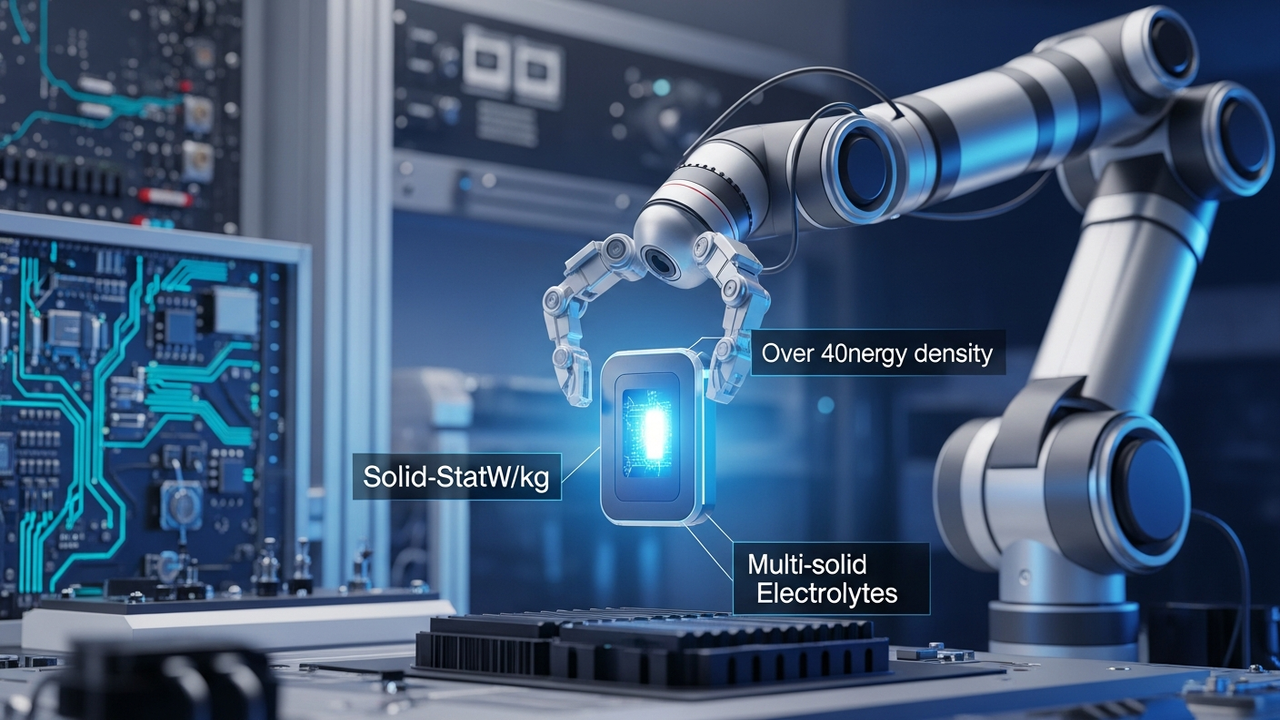
This academic paper thoroughly evaluates the transformative potential of solid-state batteries for robotics applications, particularly noting their capability to achieve energy densities exceeding 400 Wh/kg when paired with lithium metal anodes. This advancement could dramatically extend robot operating times and enable significant weight reductions, pushing the boundaries of autonomous systems.
Technical Details
The study highlights a diverse range of solid electrolytes, including oxides, sulfides, polymers, and halides, each offering distinct advantages over traditional liquid electrolytes. These advantages encompass inherent non-flammability for superior safety, higher energy density through the use of lithium metal anodes, extended cycle life, and enhanced design flexibility for various robotic forms. Specific ionic conductivities are impressive, with sulfide argyrodites reaching 10^-2 S cm^-1 and garnet-type LLZO oxides achieving 10^-4 to 10^-3 S cm^-1.
Furthermore, the paper discusses the potential of bipolar stacking architectures to increase volumetric energy density by 30% to 50%. This structural innovation is particularly critical for robotics, where maximizing energy storage within constrained volumes is paramount. Despite these promising developments, the persistent challenge of suppressing lithium dendrite formation in lithium metal anodes is identified as a key technical hurdle that must be overcome for widespread commercialization.
Background & Context
Robotics is an rapidly expanding field, encompassing industrial automation, service robots, drones, and humanoid systems. Power sources are fundamental to the performance and reliability of these diverse applications. While conventional lithium-ion batteries have provided a baseline, solid-state batteries are emerging as the next-generation solution, offering significant improvements in safety, energy density, and design freedom, essential for advanced robotic functionalities.
Strategic Significance & Outlook
The progression of solid-state battery technology is poised to revolutionize robot autonomy, mobility, and endurance. Higher capacity and safer power sources will enable robots to perform more complex tasks for longer durations, extending their utility beyond human assistance into hazardous environments and inaccessible locations. Future research will likely concentrate on improving the stability of solid electrolyte-electrode interfaces, achieving complete dendrite suppression, and reducing manufacturing costs. Success in these areas is expected to establish solid-state batteries as a foundational technology driving new frontiers in robotics.
Get our weekly technology intelligence — free
Receive an infographic that lets you judge at a glance whether each field’s analysis report is worth reading.
Subscribe Free — Weekly Tech Intelligence
By subscribing, you’ll receive Troy-Technical’s weekly technology intelligence newsletter.
- Your email and selected fields are used only to deliver the newsletter.
- We never share your information with third parties.
- You can unsubscribe anytime via the link in each email.
See our Privacy Policy for details.
Takes about a minute · Unsubscribe anytime