Key Findings
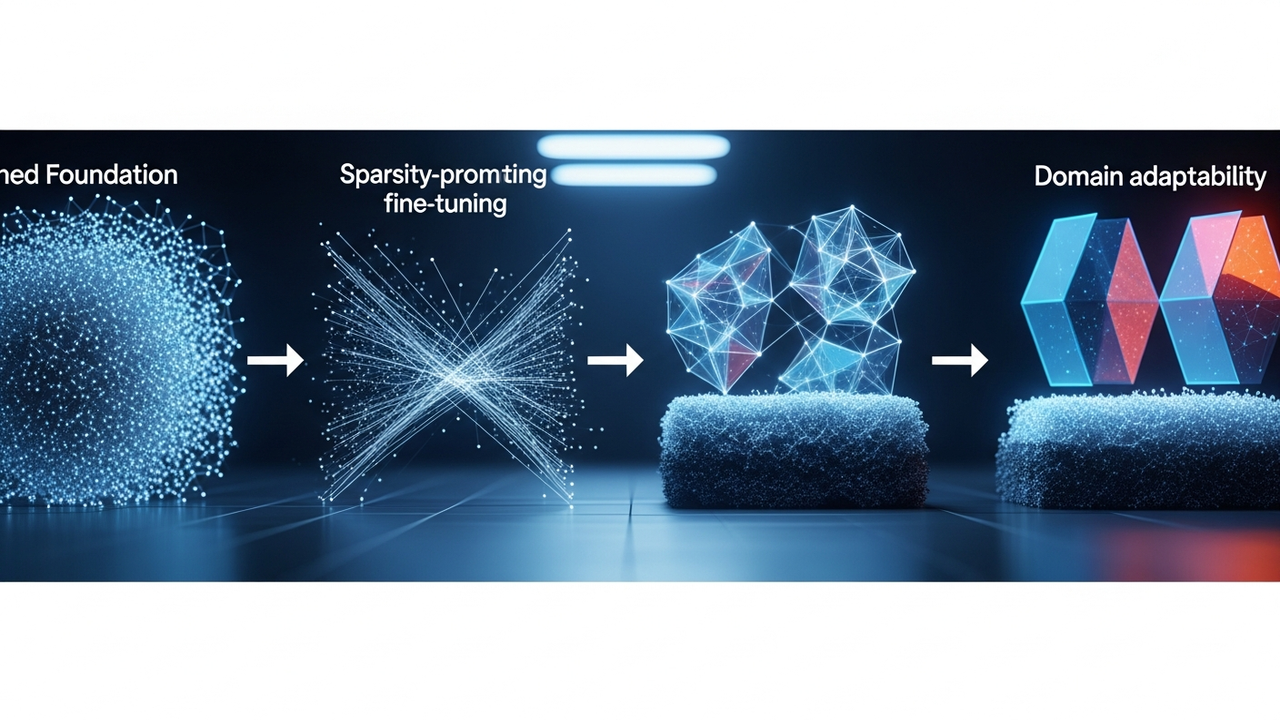
A novel sparsity-promoting fine-tuning method has been proposed for robust and interpretable adaptation of pre-trained Equivariant Materials Foundation Models (MLIPs) to domain-specific applications. This technique achieves high predictive performance, comparable to or even surpassing full fine-tuning, with significantly fewer updated parameters, by selectively adjusting only a subset of the model’s parameters. Its effectiveness has been confirmed particularly in complex physical property predictions, such as magnetic moment prediction.
Technical / Clinical Details
The proposed sparsity-promoting fine-tuning is a type of Parameter-Efficient Fine-Tuning (PEFT), where only a portion of the model’s weights are subject to updates, while the majority remain fixed. Specifically, by introducing sparsity constraints, such as L1 regularization, into the fine-tuning process, only the most crucial parameters are encouraged to learn from domain-specific data. This prevents the model from learning unnecessary information, thereby reducing the risk of overfitting. Equivariant materials foundation models, which preserve symmetry based on physical laws, exhibit the property that their predictions change appropriately under transformations like atomic translation, rotation, and inversion. This characteristic is maintained through sparsity-promoting fine-tuning, ensuring the fine-tuned model provides physically consistent predictions. This method is highly effective for efficiently customizing existing foundation models in domains where only limited data is available, such as specific alloy systems, catalyst surfaces, or classes of magnetic materials.
Background & Context
Recent advancements in AI within materials science have been accelerated by the emergence of large pre-trained foundation models (Materials Foundation Models). These models, trained on vast first-principles computational data, can capture universal physical laws and chemical interactions across various material systems. However, for specific applications (e.g., simulating materials with specific defect structures or predicting behavior under certain temperature and pressure conditions), ‘fine-tuning’ these general-purpose models is necessary. Traditional full fine-tuning has presented challenges due to the requirement for large amounts of domain-specific data and high computational costs. Sparsity-promoting fine-tuning addresses this issue, offering an efficient means to specialize foundation models with less data and fewer computational resources, thereby significantly advancing the practical application of AI-driven materials design.
Strategic Significance & Outlook
This sparsity-promoting fine-tuning method holds the potential to dramatically enhance the efficiency and accessibility of AI-driven materials discovery. Moving forward, this approach is expected to be applied to domain adaptation for a wide range of material property predictions, including thermodynamic, electronic, mechanical, and dynamic properties. Furthermore, research will progress to further enhance model interpretability, allowing for clearer understanding of which physical aspects are emphasized by fine-tuning. This will enable researchers to develop high-performance AI models with limited resources, accelerating technological innovations aimed at solving society’s most critical challenges, such as new catalysts, high-performance batteries, spintronic devices, and quantum materials. It represents a crucial step for AI foundation models to become truly ‘universal’ tools.
Source: https://arxiv.org/abs/2606.18691
Get our weekly technology intelligence — free
Receive an infographic that lets you judge at a glance whether each field’s analysis report is worth reading.
Subscribe Free — Weekly Tech Intelligence
By subscribing, you’ll receive Troy-Technical’s weekly technology intelligence newsletter.
- Your email and selected fields are used only to deliver the newsletter.
- We never share your information with third parties.
- You can unsubscribe anytime via the link in each email.
See our Privacy Policy for details.
Takes about a minute · Unsubscribe anytime