Key Findings
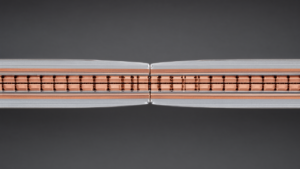
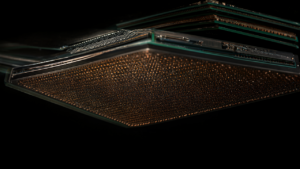
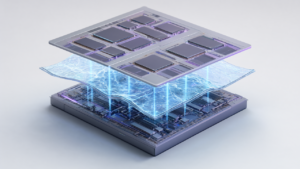
TSMC, a world-leading research and innovation hub in nanoelectronics and digital technologies, has announced a breakthrough in system-level III-V chiplet integration on a 300mm RF silicon interposer platform. This achievement significantly boosts capacitance density by 10 to 100 times compared to previous technologies and demonstrates an exceptionally high alignment precision of less than 600nm. This milestone unlocks new integration possibilities for RF and power applications within heterogeneous chiplet architectures, promising profound impacts on next-generation electronics systems.
Technical / Clinical Details
The RF silicon interposer platform developed by imec enables the co-integration of high-Q integrated passives with III-V semiconductor chiplets on a silicon-based platform. III-V semiconductors offer high-frequency performance and superior power efficiency that are challenging to achieve with SiGe (silicon-germanium) based technologies, but direct integration with silicon has presented significant technical hurdles. This success was achieved by optimizing high-density wiring layers and micro-bump technologies, realizing an alignment precision of less than 600nm. This precision maximizes electrical and thermal coupling between III-V chiplets and the silicon interposer. The 10-100x increase in capacitance density means the realization of smaller, higher-performance modules for circuits like RF transceivers and power amplifiers. Furthermore, imec has expanded its Automotive Chiplet Program into the Autonomous Edge Chiplet Program, pushing the application of this technology towards edge AI applications that demand high reliability and real-time processing, such as robotics, industrial automation, security, and intelligent infrastructure.
Background & Context
Demand for high-performance RF systems is exploding, driven by the proliferation of 5G/6G communications, radar systems, satellite communications, and edge AI devices. These systems require operation at high frequencies, wide bandwidths, low power consumption, and miniaturization. However, traditional monolithic (single-chip) design methods have difficulty optimizing RF components with different material properties and digital logic. The chiplet architecture addresses this challenge by integrating specialized chips manufactured through different processes. Imec’s success, particularly in the RF domain, paves the way for combining the cost benefits of silicon platforms with the high performance of III-V semiconductors, marking a critical step toward accelerating the widespread adoption of heterogeneous integration technology.
Strategic Significance & Outlook
The successful III-V chiplet integration on imec’s RF silicon interposer platform holds the potential to revolutionize the design of next-generation wireless communication systems and edge AI devices. Improvements in capacitance density and alignment precision will enable higher-performance, smaller, and more power-efficient RF modules, opening new possibilities for 5G Advanced and 6G communication infrastructure, high-precision radar for autonomous vehicles, and real-time sensing for industrial robots. The expansion into the Autonomous Edge Chiplet Program indicates that this technology is not merely a research outcome but is being pursued for practical applications across diverse industries, acting as a catalyst for innovation across the entire semiconductor industry.
Get our weekly technology intelligence — free
Receive an infographic that lets you judge at a glance whether each field’s analysis report is worth reading.
Subscribe Free — Weekly Tech Intelligence
By subscribing, you’ll receive Troy-Technical’s weekly technology intelligence newsletter.
- Your email and selected fields are used only to deliver the newsletter.
- We never share your information with third parties.
- You can unsubscribe anytime via the link in each email.
See our Privacy Policy for details.
Takes about a minute · Unsubscribe anytime