Key Findings
The design and modeling of Organic Electrochemical Energy Materials (OEEMs) can be dramatically accelerated through the application of Artificial Intelligence (AI), potentially enabling breakthroughs in the performance limits of next-generation energy storage technologies such as rechargeable batteries, redox-flow batteries (RFBs), and supercapacitors. This preprint details the innovative approach leveraging AI in this critical field.
Technical Details
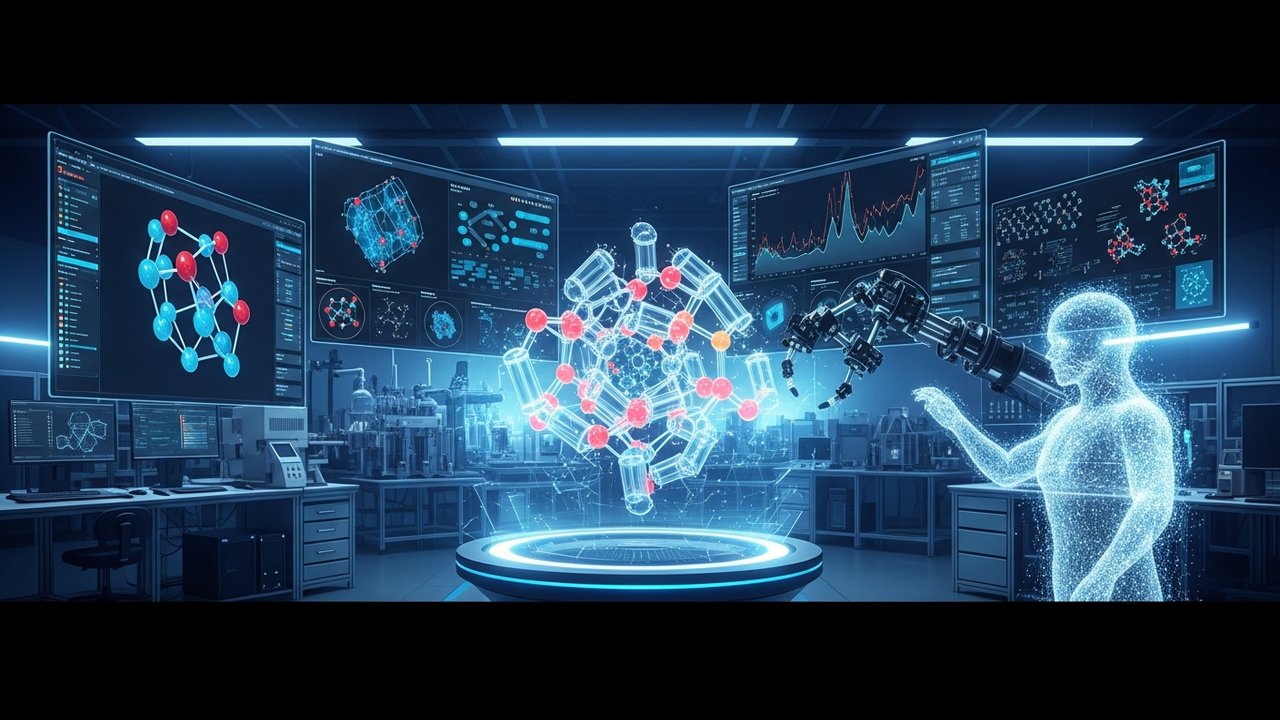
OEEMs, due to their vast molecular diversity, hold immense potential for customized properties across a wide range of electrochemical storage systems. However, their expansive design space has historically been challenging to explore using traditional trial-and-error methods. This research employs an AI-driven approach, combining machine learning algorithms with computational chemistry simulations, to predict and optimize the complex interplay of thermal properties, redox behavior (oxidation-reduction reactions), and ion/electron transport characteristics that govern OEEM performance. This is achieved with unprecedented speed and accuracy. Specifically, AI models learn the relationships between molecular structures and these properties, rapidly generating and evaluating candidates for novel materials with desired performance, significantly shortening the material development process. This methodology enables faster attainment of goals like higher efficiency, extended lifespan, and enhanced safety that are difficult to achieve with existing materials.
Background & Industry Context
The transition to a sustainable society necessitates highly efficient, low-cost, and environmentally benign energy storage technologies. Organic material-based batteries, particularly those not relying on scarce metals like lithium and cobalt, are expected to contribute significantly to addressing resource constraints and supply chain challenges. However, organic materials often face challenges in stability and conductivity compared to inorganic materials, demanding deep understanding in materials science and chemical engineering, as well as innovative approaches for their advancement. AI has rapidly gained traction in materials science, recognized as a powerful tool for analyzing vast experimental and computational data to derive new material design principles. This research represents a cutting-edge effort to directly apply AI capabilities to the development of energy storage materials.
Strategic Significance & Outlook
The AI-accelerated design and modeling of OEEMs hold the potential to revolutionize the energy storage sector. For redox-flow batteries, this can facilitate the development of higher-performance active materials, electrolytes, and separators, contributing to reduced long-duration storage costs and improved efficiency at grid scale. In supercapacitors, it may lead to materials that simultaneously offer higher energy and power densities, expanding their application in rapid charge-discharge scenarios such as EV regenerative braking and instantaneous grid stabilization. Looking ahead, the establishment of a “Materials-by-Design” approach, where AI assists from material discovery through optimization to final product design, is anticipated to dramatically shorten the innovation cycle for energy storage technologies.
Source: https://chemrxiv.org/toc/chemrxiv/2026/0618
Get our weekly technology intelligence — free
Receive an infographic that lets you judge at a glance whether each field’s analysis report is worth reading.
Subscribe Free — Weekly Tech Intelligence
By subscribing, you’ll receive Troy-Technical’s weekly technology intelligence newsletter.
- Your email and selected fields are used only to deliver the newsletter.
- We never share your information with third parties.
- You can unsubscribe anytime via the link in each email.
See our Privacy Policy for details.
Takes about a minute · Unsubscribe anytime