Key Findings
The global optical chip industry is experiencing a massive wave of capacity expansion, driven by the explosive demand from AI data centers. Leading chip manufacturers are making aggressive capital investments and pushing technological innovations to supply the ultra-high-speed and energy-efficient optical interconnects required by next-generation AI infrastructure.
Technical and Market Details
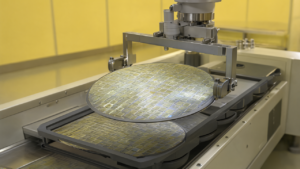
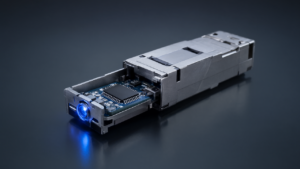
This capacity expansion is spearheaded by companies like STMicroelectronics and Source Photonics. STMicroelectronics has announced ambitious plans to quadruple its 300mm silicon photonics production capacity by 2027. Their PIC100, built on a 300mm wafer platform, integrates optical modulators, photodetectors, and waveguides to create highly efficient and low-power optical transceivers. This strategic move aims to stabilize the supply of 800G and 1.6T optical transceivers, which are becoming indispensable in AI data centers.
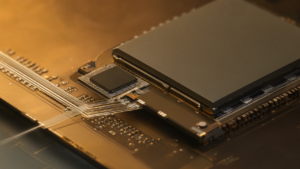
Meanwhile, Source Photonics, a major Chinese supplier, is investing a significant $1.2 billion in expanding its production of optical chips and high-speed optical modules, including 800G and 1.6T products for AI servers. This investment will play a crucial role in supporting the build-out of AI infrastructure, particularly within China. These large-scale investments are accelerating the adoption of technologies like Co-Packaged Optics (CPO) and Near-Package Optics (NPO), which bring optical engines even closer to electrical chips, dramatically improving data transmission efficiency.
Background and Industry Context
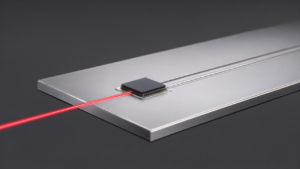
The rapid development of generative AI has led to a dramatic increase in data center traffic and power consumption, creating ‘data bottlenecks’ that traditional electrical interconnects and slower optical modules can no longer handle. AI workloads require vast amounts of data to be moved at high speeds with low latency within GPU clusters. Consequently, optical interconnects have become an indispensable technology for resolving computing power bottlenecks in the AI era. Silicon photonics, due to its compatibility with CMOS manufacturing processes, is considered a core technology in this paradigm shift, enabling cost-effective, large-scale integration of optical circuits onto semiconductor chips.
Strategic Significance and Outlook
The aggressive expansion of global optical chip manufacturing capacity is critical for sustaining the continuous growth of AI data centers. This will ensure a stable supply of next-generation optical modules, including 800G, 1.6T, and soon 3.2T, thereby accelerating further advancements in AI technology and its application across various industrial sectors. Large-scale investments will create new business opportunities throughout the optical communication supply chain and drive technological innovation. The optical chip industry is poised to stand at the forefront of the AI revolution, playing a central role in building the foundation of future digital infrastructure.
Source: https://www.htx.com/news/optical-chips-collective-capacity-expansion-MTJAcD3B/
Get our weekly technology intelligence — free
Receive an infographic that lets you judge at a glance whether each field’s analysis report is worth reading.
Subscribe Free — Weekly Tech Intelligence
By subscribing, you’ll receive Troy-Technical’s weekly technology intelligence newsletter.
- Your email and selected fields are used only to deliver the newsletter.
- We never share your information with third parties.
- You can unsubscribe anytime via the link in each email.
See our Privacy Policy for details.
Takes about a minute · Unsubscribe anytime