Key Findings
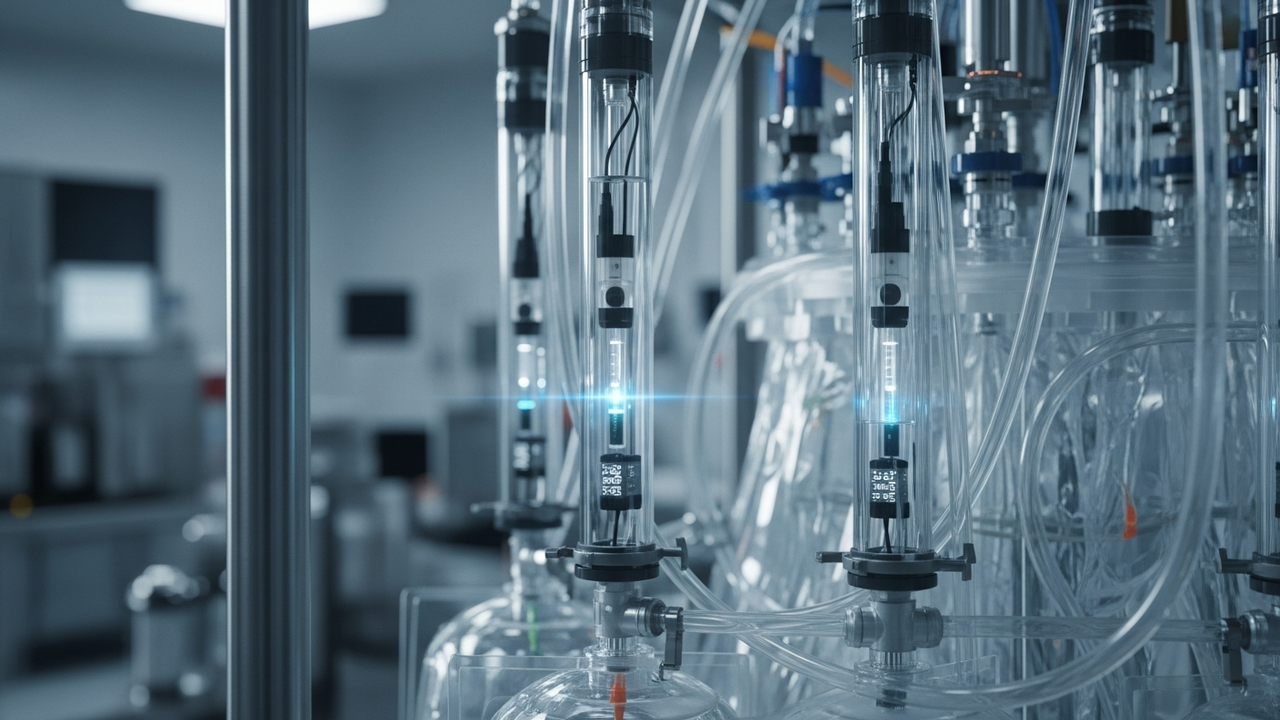
With the rise of single-use biomanufacturing, in-line sensors have become an indispensable component for enhancing process efficiency, robustness, and quality assurance. Directly integrated into single-use bioreactor bags, these sensors enable continuous, real-time measurement of Critical Process Parameters (CPPs) such as pH, dissolved oxygen (DO), and biomass, all without compromising the sterile barrier. This capability lays the foundation for the widespread adoption of Process Analytical Technology (PAT) and facilitates advanced process control in biopharmaceutical manufacturing.
Technical / Clinical Details
- Integration of In-line Sensors: Traditional reusable stainless-steel bioreactors faced challenges with probe sterilization and installation, often involving contamination risks. Factory-pre-integrated in-line sensors in single-use bioreactor bags overcome these issues, offering a plug-and-play solution. These sensors are constructed from gamma-irradiation tolerant materials, ensuring sterility.
- Advantages of Real-time Monitoring: Continuous, real-time monitoring of parameters like pH, dissolved oxygen, temperature, and biomass (cell concentration) allows for the prediction of Critical Quality Attributes (CQAs) and immediate detection of process deviations. This reduces the frequency of manual sampling, shortens analysis times, and enables faster process adjustments.
- Advancing Process Analytical Technology (PAT): The vast amount of data generated by in-line sensors forms the cornerstone of PAT strategies. PAT is a system that assures product quality through process design, analysis, and control. Combining real-time data with advanced data analytics (e.g., multivariate data analysis) provides deep process understanding and enables predictive control.
- Enhancing Single-Use Manufacturing: Single-use systems are rapidly gaining traction, particularly in the manufacturing of cell and gene therapy (CGT) products, due to their flexibility, rapid changeover capabilities, and reduced cleaning/sterilization costs. In-line sensors maximize the benefits of these systems, boosting manufacturing reliability and scalability.
Background & Context
Biopharmaceutical manufacturing continuously seeks improvements in efficiency and quality control, driven by increasing product complexity, demands for shorter development timelines, and cost reduction pressures. Single-use technologies emerged as a primary solution to address these challenges. However, even with single-use systems, robust monitoring and control are essential to ensure process health and product quality. In-line sensors are a crucial technology meeting this need.
Strategic Significance & Outlook
The evolution of in-line sensor technology in single-use biomanufacturing is critical for further enhancing the quality and efficiency of biopharmaceuticals. In the future, these sensors are expected to integrate with AI and machine learning algorithms, leading to ‘smart biomanufacturing’ systems that automatically optimize processes based on real-time data. This will strengthen decision-making across the entire lifecycle, from development to commercial production, allowing for faster and more cost-effective delivery of safer, higher-quality therapeutics to patients.
Get our weekly technology intelligence — free
Receive an infographic that lets you judge at a glance whether each field’s analysis report is worth reading.
Subscribe Free — Weekly Tech Intelligence
By subscribing, you’ll receive Troy-Technical’s weekly technology intelligence newsletter.
- Your email and selected fields are used only to deliver the newsletter.
- We never share your information with third parties.
- You can unsubscribe anytime via the link in each email.
See our Privacy Policy for details.
Takes about a minute · Unsubscribe anytime