Key Findings
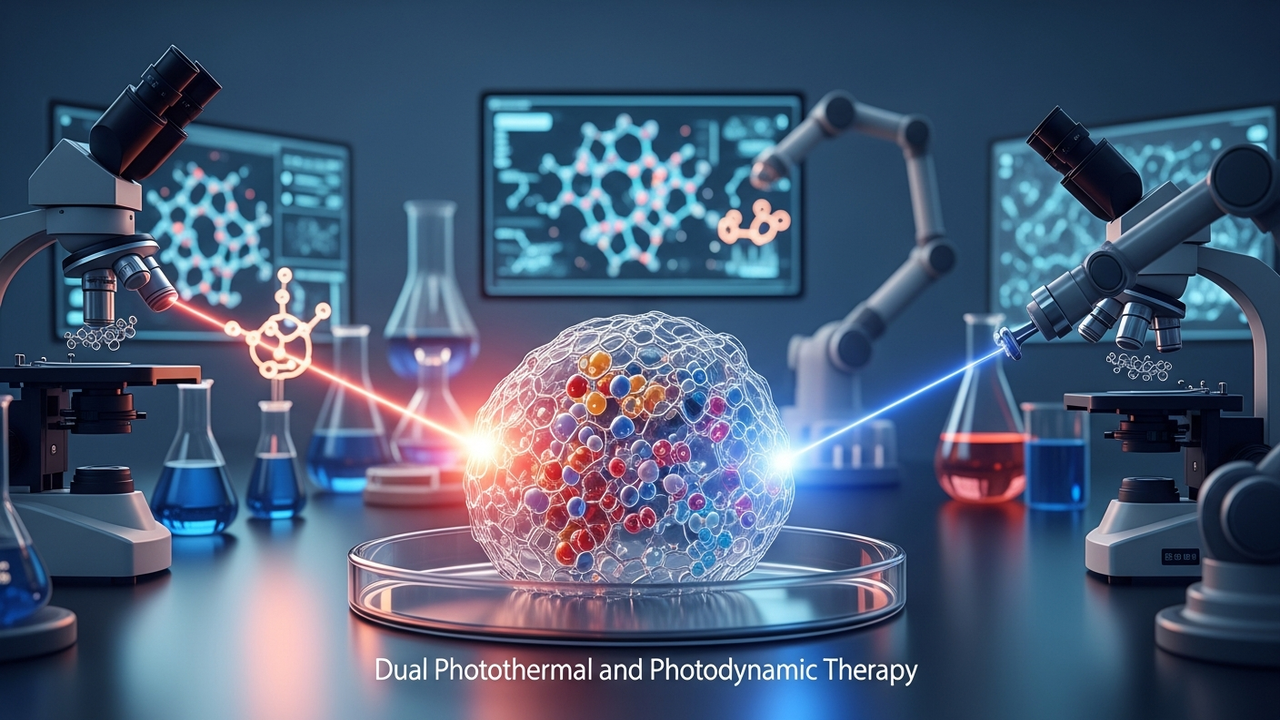
To address the critical challenges of increasing antibiotic resistance and delayed wound healing in infected wounds, a groundbreaking composite hydrogel, HGJD, has been developed. This hydrogel integrates dual phototherapy functions—photothermal (PTT) and photodynamic (PDT)—by combining three types of semiconductor conjugated polymer (SCP) nanomaterials (DFPE, DTBA, DTID), a natural sodium alginate/chitosan (SA/CS) hydrogel matrix, and the therapeutic agent curcumin. Specifically, encapsulating DTID and curcumin within the SA/CS hydrogel achieved a highly effective therapeutic approach for infected wounds.
Technical Details
The SCP nanomaterials developed in this study simultaneously exhibit a photothermal effect (PTT), generating heat upon absorbing specific wavelengths of light, and a photodynamic effect (PDT), producing reactive oxygen species to kill bacteria. By introducing different electron-donor groups, the three SCPs—DFPE, DTBA, and DTID—were engineered to possess distinct light absorption properties and quantum efficiencies, optimized for dual phototherapy. The selected DTID demonstrated high photothermal conversion efficiency in the near-infrared (NIR) region and effective reactive oxygen species generation for PDT. Encapsulating this DTID along with curcumin (a natural antibacterial and anti-inflammatory agent) within the SA/CS hydrogel resulted in the HGJD composite hydrogel, which is highly biocompatible and provides sustained release, suitable for direct application to wound sites. The hydrogel also maintains a moist wound environment and serves as a scaffold to promote cell proliferation. Upon light irradiation, the SCP nanomaterials activate, leading to localized heating and reactive oxygen species generation that efficiently eliminates bacteria, suppresses inflammation, and accelerates wound healing.
Background & Context
Bacterial infection is a primary impediment to chronic wound healing, a significant issue in various types of wounds, including diabetic ulcers, pressure sores, and burns. Conventional antibiotic therapies are becoming increasingly limited due to the emergence of drug-resistant bacteria, necessitating novel antimicrobial treatment strategies. Phototherapy is gaining attention as a non-invasive treatment with fewer side effects. Combining PTT and PDT, in particular, holds potential for addressing a broader spectrum of bacteria and reducing the risk of resistance development. This research integrates biomaterials and nanotechnology to deliver a next-generation wound care solution.
Strategic Significance & Outlook
The clinical application of this composite hydrogel, HGJD, has the potential to profoundly transform the landscape of infected wound treatment. As an antibiotic-independent therapy, it offers new hope to patients struggling with drug resistance. Future research is expected to involve further efficacy and safety evaluations in animal models, leading to human clinical trials. Progressively, this technology could evolve into smart wound dressings, forming integrated systems that simultaneously detect and treat infections. This technology is poised to significantly impact regenerative medicine, infectious disease treatment, and biomedical engineering fields, greatly contributing to improving patients’ quality of life.
Source: https://pubs.acs.org/doi/10.1021/acsami.6c06419
Get our weekly technology intelligence — free
Receive an infographic that lets you judge at a glance whether each field’s analysis report is worth reading.
Subscribe Free — Weekly Tech Intelligence
By subscribing, you’ll receive Troy-Technical’s weekly technology intelligence newsletter.
- Your email and selected fields are used only to deliver the newsletter.
- We never share your information with third parties.
- You can unsubscribe anytime via the link in each email.
See our Privacy Policy for details.
Takes about a minute · Unsubscribe anytime