Background
MOMs, including MOFs and MPNs, are highly versatile materials with applications spanning gas storage and separation, catalysis, sensing, and drug delivery. However, their vast compositional and structural diversity presents a significant challenge for traditional discovery methods. The integration of AI into materials design addresses this bottleneck by enabling a more systematic and efficient exploration of the design space, moving beyond serendipitous discoveries.
Key Findings
This prospective paper proposes extending the design of metal–organic materials (MOMs) using AI from crystalline metal–organic frameworks (MOFs) to dynamic coordination networks, such as metal–polyphenol networks (MPNs). This shift emphasizes the need for process-aware, interface-sensitive, and function-oriented AI approaches to optimize dynamic networks by integrating machine learning, multimodal characterization, active learning, and closed-loop experimentation.
Technical Details
The proposed AI-driven design framework for MOMs aims to leverage advanced computational techniques to navigate the vast design space of these materials. The core technical approach involves three synergistic AI strategies:
- Process-aware AI: This component focuses on understanding how synthesis conditions and pathways influence the final material properties, allowing for more precise control over the fabrication process.
- Interface-sensitive AI: Designed to analyze and predict the interactions between the material and its environment, crucial for applications involving sensing, catalysis, or separation.
- Function-oriented AI: This directs the design process towards achieving specific performance targets by identifying structural motifs and compositions that yield desired functionalities.
The methodology integrates several advanced computational tools:
- Machine Learning (ML): Utilized to identify complex relationships between material composition, structure, and properties from vast datasets of experimental and computational results.
- Multimodal Characterization: Combines data from various experimental techniques (e.g., optical, electrical, mechanical, chemical analyses) to provide a comprehensive understanding of material behavior, enhancing the accuracy and reliability of AI models.
- Active Learning: An iterative process where the AI model intelligently suggests the next most informative experiment to perform, reducing the number of trials and errors.
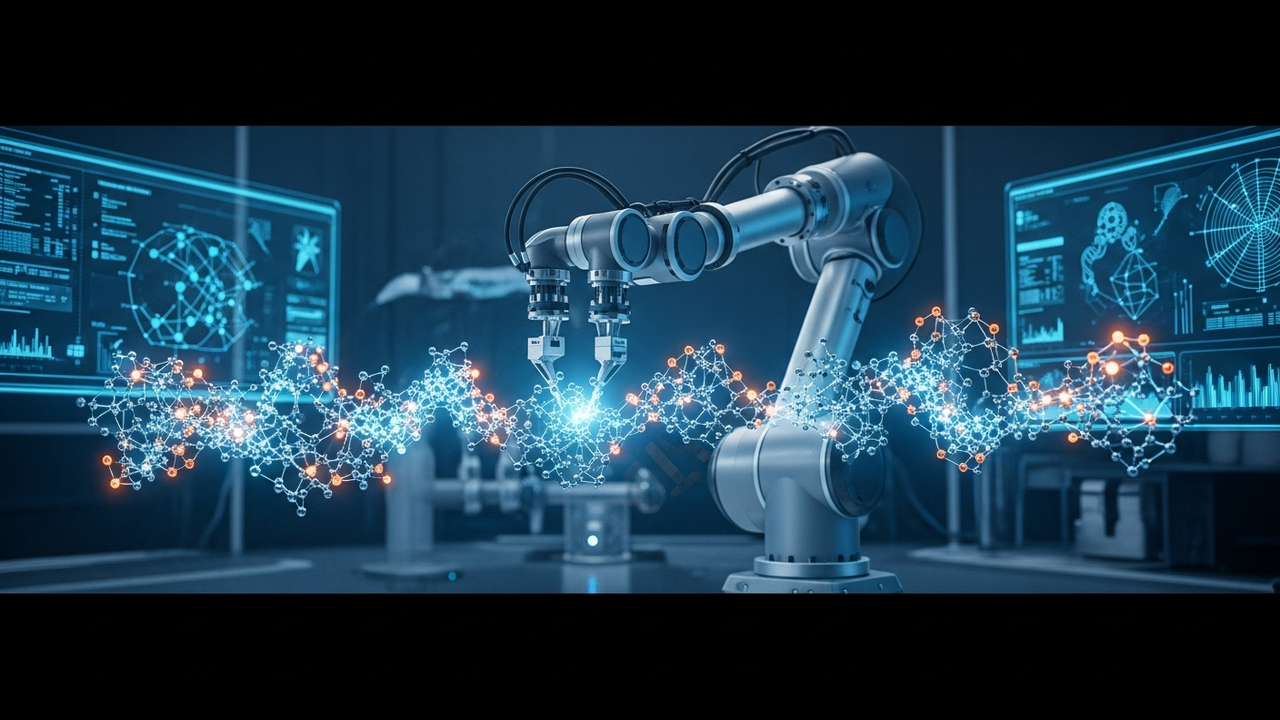
- Closed-Loop Experimentation: Automates the entire discovery cycle, from prediction and synthesis to characterization and data analysis, with the AI continuously learning and refining its predictions.
The paper also highlights the potential of self-driving labs to accelerate the synthesis and screening of both MOFs and MPNs. These autonomous laboratories can perform experiments, collect data, and adapt synthesis recipes in real-time, drastically speeding up the discovery process from months or years to days or weeks.
Strategic Significance & Outlook
This AI-guided expansion of MOM design holds immense strategic significance for the future of materials science. By enabling the discovery of new dynamic networks with tailored properties, it can unlock advancements in areas such as high-efficiency catalysts, selective gas adsorbents, and responsive biomaterials. The development of self-driving labs, coupled with these advanced AI algorithms, promises a future where novel materials can be discovered and optimized at an unprecedented pace, driving innovation across energy, environmental, and biomedical sectors globally. This shift represents a fundamental transformation in how materials research is conducted, emphasizing intelligent automation and data-driven insights.
Source: https://www.mdpi.com/3042-6723/1/3/10
Get our weekly technology intelligence — free
Receive an infographic that lets you judge at a glance whether each field’s analysis report is worth reading.
Subscribe Free — Weekly Tech Intelligence
By subscribing, you’ll receive Troy-Technical’s weekly technology intelligence newsletter.
- Your email and selected fields are used only to deliver the newsletter.
- We never share your information with third parties.
- You can unsubscribe anytime via the link in each email.
See our Privacy Policy for details.
Takes about a minute · Unsubscribe anytime