Background
As AI capabilities rapidly advance, the demand for increased memory bandwidth and power efficiency in AI chips has become paramount. With traditional 2D chip designs nearing their physical limits, advanced packaging technologies such as High Bandwidth Memory (HBM), 3D stacking, and chiplet architectures are crucial for overcoming these constraints, directly addressing the ‘memory wall’ challenge. Applied Materials’ strategy focuses on bringing wafer-fab-level precision process control to memory manufacturing to meet these evolving technological demands, ensuring that physical design can keep pace with computational advancements.
Key Findings
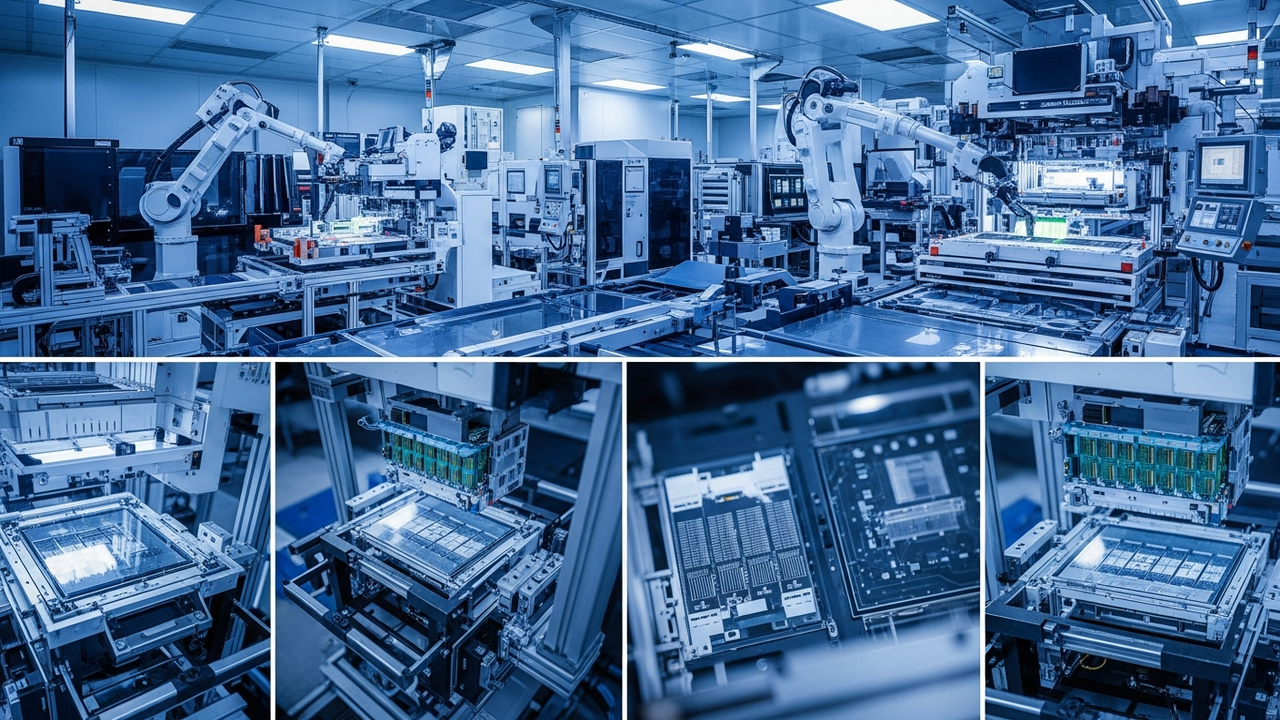
In response to these escalating demands, Applied Materials has launched six innovative new systems aimed at enhancing performance and manufacturing efficiency for next-generation AI chips, specifically targeting DRAM and advanced packaging. These systems are engineered to resolve manufacturing hurdles in advanced chip architectures like HBM and 3D stacking.
- Enhanced Centura Prime Epi System: Delivers logic-class fabrication precision for next-generation DRAM perimeter transistors.
- Opta Quad CMP System: Addresses uniformity and yield challenges in thick, non-uniform packaging structures critical for HBM and 3D stacking. This system is engineered for superior planarization.
- Nokota VMax 2 ECD and Producer Avila 2 PECVD Systems: These deposition technologies enable high-yield chip stacking for 3D stacking and HBM architectures, ensuring robust interconnections.
- VeritySEM 7AP CD Metrology System: An eBeam-based metrology system that enhances process control in advanced packaging, providing critical dimension measurements with high accuracy.
- SEMVision G7AP Defect Analysis System: This eBeam system detects microscopic defects in 3D packaging with sub-10 nanometer sensitivity, revolutionizing defect review. It allows for early identification and resolution of issues, significantly improving overall manufacturing yield in increasingly complex processes.
These new systems are poised to expand AI chip production capacity and potentially reduce manufacturing costs. The high-precision defect detection, particularly from the eBeam systems, is expected to dramatically improve yields in complex packaging processes, contributing to a more stable supply of next-generation AI accelerators. This technological leap is critical for accelerating the broader adoption and further development of AI applications, strengthening the entire AI hardware ecosystem. The ability to precisely control and verify advanced packaging processes sets a new industry benchmark, enabling more robust and higher-performing AI solutions.
Source: https://ir.appliedmaterials.com/static-files/97be2049-edfd-4399-b6ca-ffa0e8ea464f
Get our weekly technology intelligence — free
Receive an infographic that lets you judge at a glance whether each field’s analysis report is worth reading.
Subscribe Free — Weekly Tech Intelligence
By subscribing, you’ll receive Troy-Technical’s weekly technology intelligence newsletter.
- Your email and selected fields are used only to deliver the newsletter.
- We never share your information with third parties.
- You can unsubscribe anytime via the link in each email.
See our Privacy Policy for details.
Takes about a minute · Unsubscribe anytime