Key Findings
A recent investigative report by eWeek details the current state of major bottlenecks impeding the performance enhancement and market deployment of artificial intelligence (AI) chips, strongly emphasizing that advanced packaging technologies are paramount to their resolution. The report highlights that a severe shortage in the supply capacity of high-density integration technologies, such as TSMC’s CoWoS, represents a critical challenge within the current AI chip supply chain.
Technical / Clinical Details
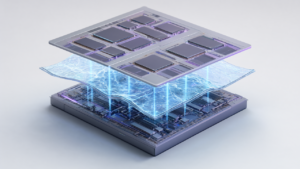
AI chip bottlenecks primarily arise from three aspects. First, limitations in data bandwidth between AI processors and connected High Bandwidth Memory (HBM). Conventional packaging struggles to achieve sufficient data transfer speeds, preventing AI’s full computational power from being utilized. Second, the thermal management challenges of highly integrated AI chips. Efficiently dissipating heat generated from stacking numerous dies in advanced packaging is extremely difficult. Third, the manufacturing yield and cost of advanced packaging. Complex 3D structures and fine-pitch interconnections complicate manufacturing processes, leading to high costs and supply shortages. CoWoS (Chip-on-Wafer-on-Substrate) is a cutting-edge technology addressing these challenges, but limitations in manufacturing equipment and lengthy process times contribute to its bottleneck status. Alternative technologies like wafer-level packaging and panel-level packaging are being developed to improve scalability and cost efficiency.
Background & Context
The rapid advancement of large language models (LLMs) and generative AI has explosively increased demand for AI accelerators in data centers. However, while AI chip design and front-end manufacturing have made tremendous strides, advanced packaging capabilities have failed to keep pace. This has resulted in chronic AI chip shortages, with leading AI chip vendors like NVIDIA and AMD struggling to bring products to market. The eWeek report clearly frames this issue not merely as a silicon fabrication problem, but as a back-end challenge of efficiently and reliably integrating chips. The entire semiconductor industry is dedicating significant resources to resolving these bottlenecks.
Strategic Significance & Outlook
Resolving AI chip bottlenecks is indispensable for the sustained growth of the AI industry. Continued investment and innovation in advanced packaging technologies are key to overcoming these challenges. Specifically, the development of hybrid bonding, panel-level packaging, and novel thermal management solutions will accelerate. This will lead to expanded AI chip supply capacity, reduced costs, and broader adoption across diverse AI applications. In the long term, packaging technology is expected to play a central role in driving AI evolution, with the semiconductor industry’s innovation focus shifting towards more integrated, system-level solutions.
Source: https://www.eweek.com/news/ai-chip-bottlenecks/
Get our weekly technology intelligence — free
Receive an infographic that lets you judge at a glance whether each field’s analysis report is worth reading.
Subscribe Free — Weekly Tech Intelligence
By subscribing, you’ll receive Troy-Technical’s weekly technology intelligence newsletter.
- Your email and selected fields are used only to deliver the newsletter.
- We never share your information with third parties.
- You can unsubscribe anytime via the link in each email.
See our Privacy Policy for details.
Takes about a minute · Unsubscribe anytime