Key Findings
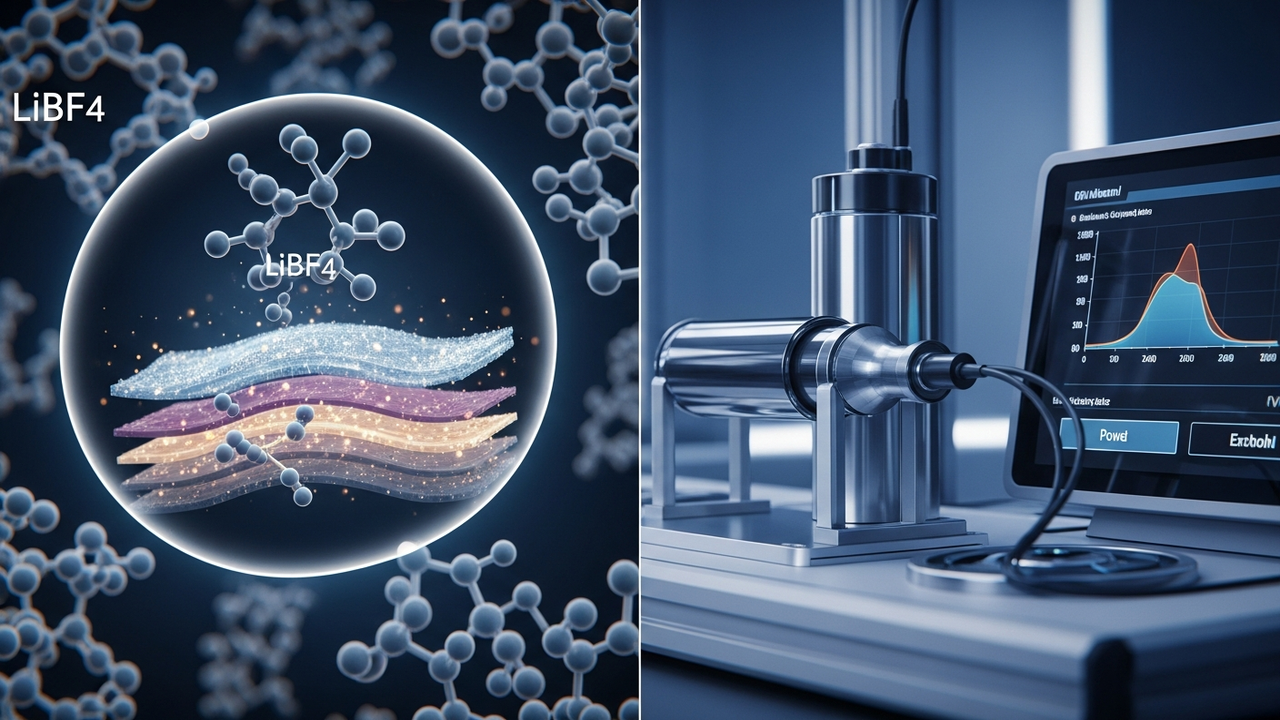
A novel technology has been developed to significantly enhance the stability of the electrolyte/lithium metal anode interface for high-energy-density lithium metal batteries. This was achieved by incorporating lithium tetrafluoroborate (LiBF₄) into the framework of a sulfohalide (Li₃SCl) solid electrolyte. The new LSC@BF solid electrolyte maintained a high ionic conductivity of 4.32 × 10⁻⁴ S cm⁻¹ at room temperature while enabling stable lithium plating and stripping for over 800 hours.
Technical Details
Lithium metal anodes theoretically offer the highest energy density compared to current lithium-ion batteries, but they face a major challenge: the formation of lithium dendrites during charge-discharge cycles, which can lead to internal short circuits and premature battery degradation. In this study, by compounding LiBF₄ with the Li₃SCl solid electrolyte, a mechanism was established to form a LiF-rich solid electrolyte interphase (SEI) layer in-situ at the anode interface. This LiF-rich SEI layer effectively suppresses lithium dendrite growth by providing uniform diffusion pathways for lithium ions. Furthermore, improved chemical and electrochemical stability at the interface reduces interfacial resistance and extends battery cycle life. The high ionic conductivity at room temperature ensures high performance in practical operating temperature ranges.
Background & Context
High-energy-density batteries are essential for improving the performance of electric vehicles (EVs) and portable electronic devices. Lithium metal anodes are a primary target for next-generation batteries because they offer significantly higher energy density than graphite anodes. However, safety and lifespan issues due to dendrite formation have long hindered their practical application. Sulfohalide solid electrolytes are promising candidates for solid electrolytes in all-solid-state batteries due to their high ionic conductivity and stability. This research represents a significant contribution to solving one of the biggest barriers to their practical use: the interfacial stability issue with lithium metal anodes.
Strategic Significance & Outlook
The development of LiBF₄-incorporated sulfohalide solid electrolytes is a crucial step towards the commercialization of high-energy-density lithium metal batteries. Over 800 hours of stable lithium plating/stripping cycles demonstrate the potential to meet the long-term reliability requirements for EV applications. Future research will focus on further optimizing this technology, validating its manufacturing scalability, and reducing costs. If this breakthrough is successfully commercialized, it is expected to dramatically extend EV range, improve safety and lifespan, and thus significantly accelerate the transition to sustainable mobility.
Source: https://www.mdpi.com/1420-3049/31/13/2313
Get our weekly technology intelligence — free
Receive an infographic that lets you judge at a glance whether each field’s analysis report is worth reading.
Subscribe Free — Weekly Tech Intelligence
By subscribing, you’ll receive Troy-Technical’s weekly technology intelligence newsletter.
- Your email and selected fields are used only to deliver the newsletter.
- We never share your information with third parties.
- You can unsubscribe anytime via the link in each email.
See our Privacy Policy for details.
Takes about a minute · Unsubscribe anytime







Comments