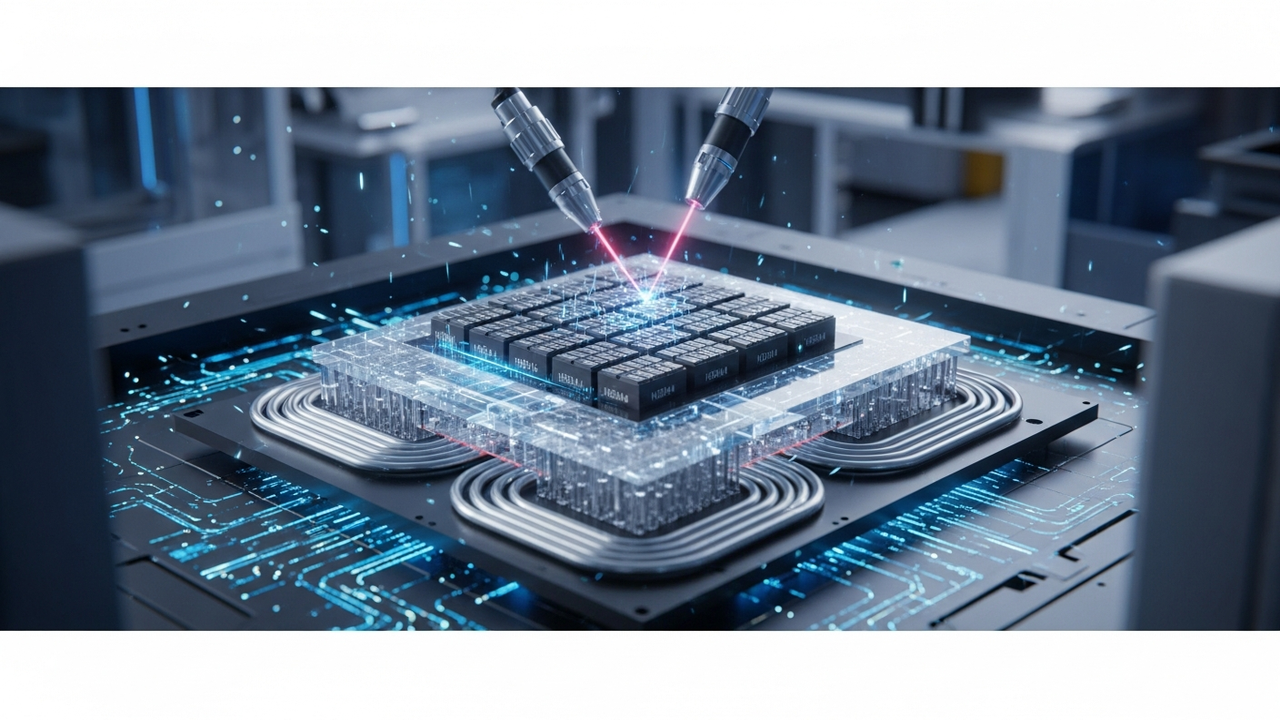
Key Findings: SK Hynix’s Advanced MR-MUF Achieves 17% Reduction in HBM4 Thermal Resistance
According to a report by Kynix, SK Hynix has successfully reduced the thermal resistance of HBM4 (High Bandwidth Memory 4) by 17% compared to conventional HBM4 technology, through its newly developed Advanced MR-MUF (Mass Reflow Molded Underfill) packaging process. This significant reduction in thermal resistance is key to dramatically improving the performance and reliability of AI accelerator chips.
Technical & Product Details
- Advanced MR-MUF Process: MR-MUF is a process that involves filling the gaps between multiple memory dies in an HBM stack with a thermally conductive underfill material. SK Hynix’s Advanced MR-MUF maximizes thermal conduction efficiency and suppresses hot spot formation through optimized material formulations and process parameters.
- 17% Thermal Resistance Reduction: A 17% improvement in thermal resistance compared to traditional HBM4 packaging processes offers a significant advantage for controlling the overall temperature rise of the chip and ensuring stable operation of the processor, especially under high loads. This reduces the risk of performance degradation due to thermal throttling.
- Stability of High-Density 3D Packaging: HBM is a 3D packaging technology that vertically stacks multiple memory dies. Thermal management is the biggest challenge associated with increasing density. The improved thermal resistance achieved by Advanced MR-MUF is essential for maintaining the mechanical and thermal stability of such high-density stacks, ensuring long-term reliability.
- Contribution to AI Accelerator Chips: AI accelerator chips process vast amounts of data at high speeds, generating significant heat concurrently with data supply from HBM. This technology optimizes HBM thermal management, thereby maximizing the computational power of AI processors and improving the efficiency of AI workloads.
Background & Industry Context
With the surge in demand for AI and High-Performance Computing (HPC), the performance of HBM integrated into GPUs and AI-specific processors has dramatically improved. However, the accompanying increase in heat generation has become a bottleneck for further performance enhancements. SK Hynix’s Advanced MR-MUF addresses this pressing issue from the perspective of packaging technology.
Strategic Significance & Outlook
The introduction of Advanced MR-MUF technology will enable further HBM stacking and speed increases, accelerating the development of next-generation HBM (e.g., HBM5, HBM6). The improved thermal resistance is also expected to enhance the power efficiency of AI chips and contribute to reduced operating costs for data centers. This technology is poised to play a crucial role as a foundational technology supporting the computing infrastructure of the AI era.
Source: https://www.kynix.com/Blog/what-ai-accelerator-chip-work.html
Get our weekly technology intelligence — free
Receive an infographic that lets you judge at a glance whether each field’s analysis report is worth reading.
Subscribe Free — Weekly Tech Intelligence
By subscribing, you’ll receive Troy-Technical’s weekly technology intelligence newsletter.
- Your email and selected fields are used only to deliver the newsletter.
- We never share your information with third parties.
- You can unsubscribe anytime via the link in each email.
See our Privacy Policy for details.
Takes about a minute · Unsubscribe anytime