Background
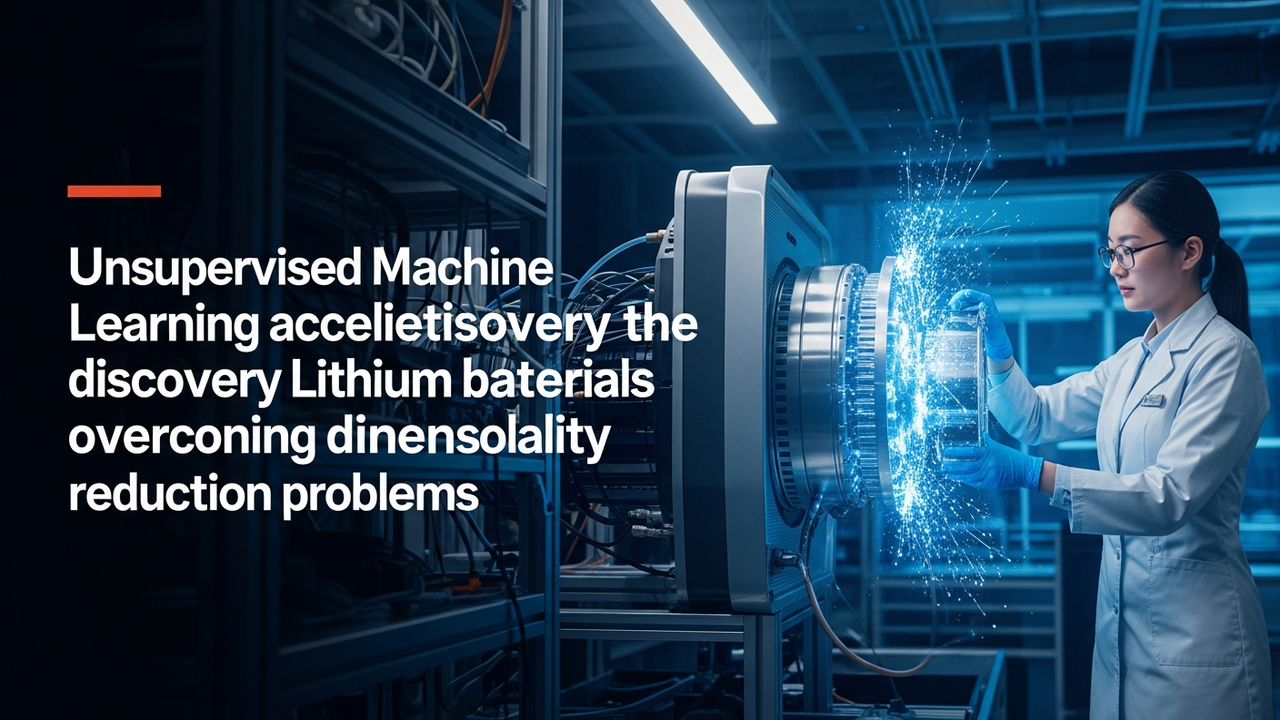
Lithium-ion batteries are indispensable for electric vehicles and grid-scale renewable energy storage, yet their continued performance and cost enhancements hinge on the discovery of novel materials. Conventional materials science relies on arduous, costly, and often trial-and-error experimental methods. Materials informatics, particularly the integration of machine learning (ML), has emerged as a critical pathway to overcome these bottlenecks. This research is particularly notable for its utilization of unsupervised learning, which enables the exploration of genuinely innovative material spaces, free from the constraints of human intuition or existing knowledge, thereby forging a new frontier for AI applications in battery material science.
Key Findings
This groundbreaking research introduces an unsupervised machine learning (ML) framework that dramatically accelerates the discovery of novel lithium-based battery materials. A key innovation is its ability to directly convert crystallographic information files (CIFs) into numerical descriptors suitable for ML models. Unlike conventional methods that rely on predetermined, fixed low-dimensional embeddings, this framework intelligently ascertains the optimal intrinsic embedding dimensionality of the high-dimensional material data. This dynamic approach critically minimizes information loss, allowing the model to accurately capture intricate material properties and explore entirely new material candidates, rather than being confined to known chemistries or existing database entries.
By effectively circumventing the inherent data loss associated with dimensionality reduction, this robust statistical methodology offers a significant leap in the efficiency and precision of material exploration. The framework’s adaptability extends beyond lithium batteries, showing promise for a broad spectrum of inorganic materials, including functional materials, alloys, and catalysts. Looking ahead, this technology is poised for integration with autonomous experimental systems – ‘self-driving laboratories’ – to establish closed-loop material design, synthesis, and characterization platforms. Such advancements are anticipated to drastically shorten R&D cycles, driving transformative innovations across vital sectors like energy storage, electronics, and aerospace.
Source: #
Get our weekly technology intelligence — free
Receive an infographic that lets you judge at a glance whether each field’s analysis report is worth reading.
Subscribe Free — Weekly Tech Intelligence
By subscribing, you’ll receive Troy-Technical’s weekly technology intelligence newsletter.
- Your email and selected fields are used only to deliver the newsletter.
- We never share your information with third parties.
- You can unsubscribe anytime via the link in each email.
See our Privacy Policy for details.
Takes about a minute · Unsubscribe anytime