Key Findings
Lumentum CEO Michael Hurlston made a significant prediction that copper Ethernet cables within server racks in AI data centers will begin to be replaced by optical interconnects within the next 12 months, driven by physical limitations. This transition is underscored by Lumentum’s current Indium Phosphide (InP) manufacturing capacity struggling to meet the surging AI-related demand, suggesting that optical components are becoming a structural growth bottleneck for AI infrastructure.
Technical Challenges and Indium Phosphide’s Importance
- Limits of Copper: The immense data transfer rates and low latency demanded by AI workloads pose significant challenges for traditional copper cables. Issues such as signal attenuation, power consumption, and physical cabling constraints hinder performance improvements for intra-rack connectivity. CEO Hurlston’s prediction indicates that these limits are now widely recognized, prompting the industry to seek new solutions.
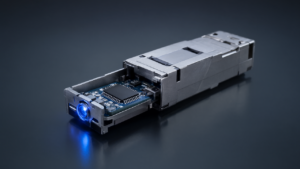
- Shift to Optical Interconnects: Optical fibers vastly outperform copper in terms of high bandwidth, low loss, and long-distance transmission capabilities. High-speed communication between GPUs is critical in AI data centers, making optical interconnects an indispensable element for enhancing AI cluster scalability and efficiency.
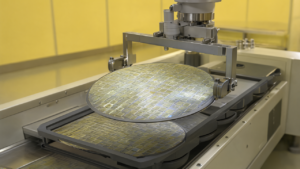
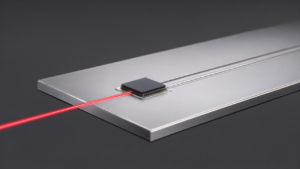
- Indium Phosphide (InP) Bottleneck: Lumentum is a leading manufacturer of Indium Phosphide (InP) substrates and devices, which are crucial for producing high-performance optical components. InP serves as the foundational material for advanced optical devices such as high-speed lasers and modulators used in data centers. However, the current manufacturing capacity’s inability to keep pace with the explosion in AI demand represents a critical bottleneck determining the speed of this technological transition.
Background and Industry Context
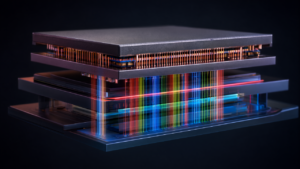
The evolution of generative AI models and the expansion of hyperscale data centers are revolutionizing data center infrastructure. AI clusters, connecting hundreds to thousands of GPUs, require terabit-scale data exchange in real-time between them, often making network bandwidth and efficiency a bottleneck. The industry is accelerating the adoption of co-packaged optics (CPO) and optical interconnects to resolve this challenge, but stable supply and expanded manufacturing capacity of foundational materials like InP are essential for their realization.
Strategic Significance and Outlook
This prediction presents both a significant business opportunity and an urgent challenge for the optical communications industry—the need for increased manufacturing capacity. Leading optical component suppliers like Lumentum will likely be compelled to make substantial investments in production capacity to meet AI demand. This will further accelerate innovation and adoption of optical technology, solidifying its status as an indispensable component in shaping the future of AI computing. Investors should pay close attention to companies with InP manufacturing capabilities and those offering optical interconnect solutions.
Get our weekly technology intelligence — free
Receive an infographic that lets you judge at a glance whether each field’s analysis report is worth reading.
Subscribe Free — Weekly Tech Intelligence
By subscribing, you’ll receive Troy-Technical’s weekly technology intelligence newsletter.
- Your email and selected fields are used only to deliver the newsletter.
- We never share your information with third parties.
- You can unsubscribe anytime via the link in each email.
See our Privacy Policy for details.
Takes about a minute · Unsubscribe anytime