Key Findings
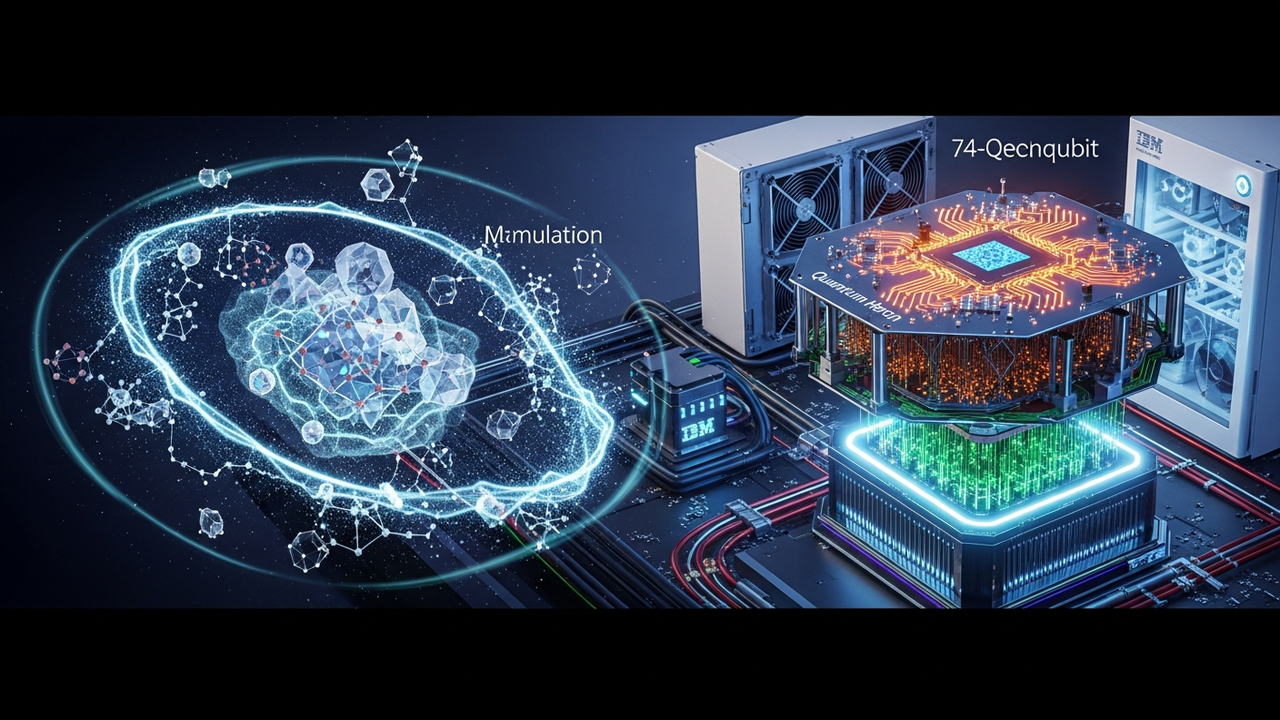
IBM and Qedma Quantum Computing have announced a significant milestone: achieving quantum advantage in simulating quantum materials utilizing IBM’s Quantum Heron processor combined with Qedma’s advanced error mitigation software. This collaboration has successfully enabled the study of quantum dynamics in systems of up to 74 qubits, a scale that definitively surpasses the capabilities of current classical supercomputers.
Technical / Clinical Details
The research leveraged IBM’s state-of-the-art Quantum Heron processor, a commercial quantum computer, in conjunction with Qedma’s specialized error mitigation techniques. These techniques are crucial for suppressing noise in quantum computations, allowing researchers to observe and analyze complex quantum behaviors in materials relevant to industrial applications, such as heterogeneous quantum materials for catalysts and battery electrolytes. The ability to model these systems at 74 qubits provides unprecedented insight into their fundamental properties and potential functionalities, laying groundwork for future material design.
Background & Context
Quantum computing has long been anticipated to revolutionize fields requiring intensive computational power, including materials science, drug discovery, and financial modeling. Simulating quantum materials accurately is essential for designing and optimizing new functional materials, yet the computational demands have posed a formidable barrier for classical computers. The demonstration of quantum advantage by IBM and Qedma represents a critical step in overcoming this barrier, paving the way for reliable quantum simulations even in scenarios where classical verification is infeasible.
Strategic Significance & Outlook
This achievement signals a pivotal moment for practical quantum materials science, opening new avenues for the accelerated development of advanced materials. In the future, this capability is expected to expedite the creation of more energy-efficient batteries, environmentally friendly catalysts, and innovative electronic components. IBM and Qedma are poised to build upon this foundation, pushing the boundaries of quantum computation to explore even larger and more complex quantum systems, thereby driving significant societal and industrial transformations.
Get our weekly technology intelligence — free
Receive an infographic that lets you judge at a glance whether each field’s analysis report is worth reading.
Subscribe Free — Weekly Tech Intelligence
By subscribing, you’ll receive Troy-Technical’s weekly technology intelligence newsletter.
- Your email and selected fields are used only to deliver the newsletter.
- We never share your information with third parties.
- You can unsubscribe anytime via the link in each email.
See our Privacy Policy for details.
Takes about a minute · Unsubscribe anytime









Comments