Key Findings
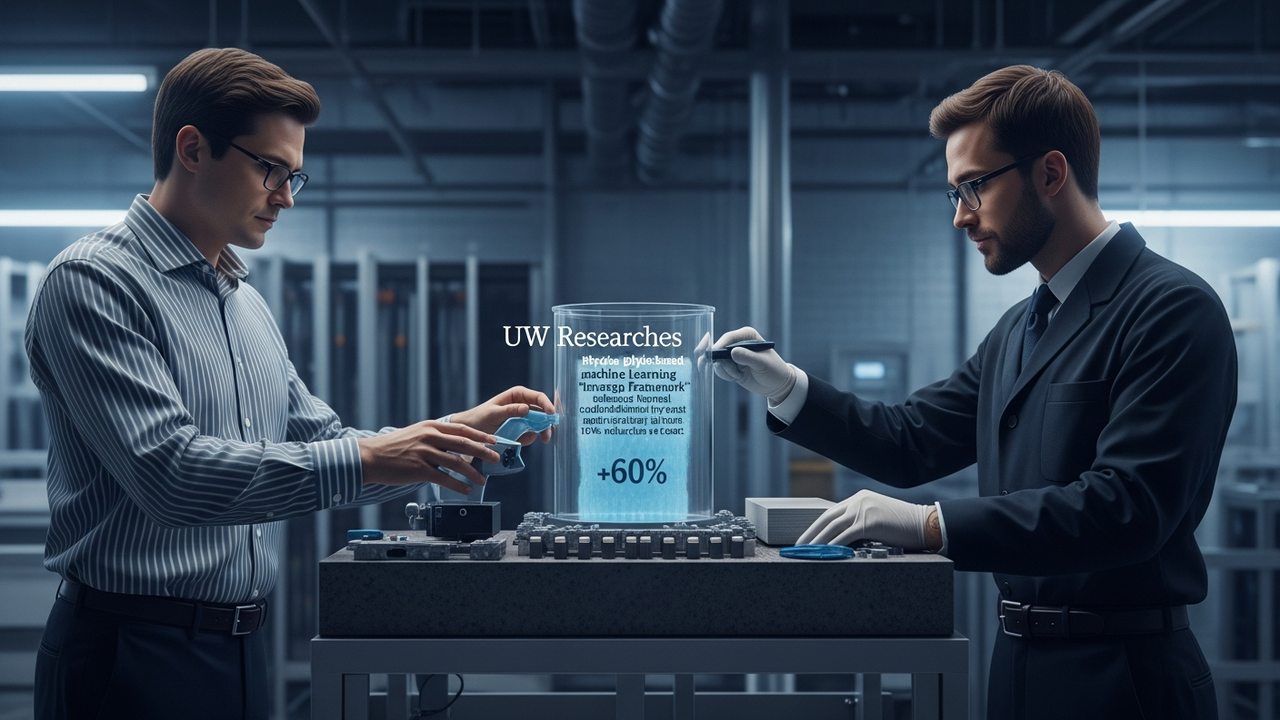
A research team at the University of Washington (UW) has developed a revolutionary ‘inverse design framework’ that significantly accelerates the discovery of multifunctional materials. This framework, which integrates physics-based modeling with machine learning, efficiently identifies optimal compositions for flexible materials that possess both mechanical flexibility and high thermal or electrical conductivity—properties crucial for advanced wearable devices and soft robotics. Experiments confirmed that materials identified using this approach achieved a 60% improvement in thermal conductivity and a 10% reduction in manufacturing costs compared to conventional materials, marking a substantial leap in materials engineering.
Technical / Clinical Details
Traditional materials design predominantly follows a ‘forward’ approach, where materials are first synthesized and then their properties are evaluated. In contrast, the inverse design framework developed by the UW team begins by defining desired material properties (e.g., specific thermal conductivity, flexibility, electrical conductivity) and then ‘back-calculates’ to identify optimal material compositions and structures. In this process, physics-informed simulation models accurately predict the behavior of candidate materials, while machine learning algorithms efficiently explore vast possibilities to find optimal combinations. This combinatorial optimization allows for the discovery of new material design spaces previously overlooked by conventional methods. The framework proved particularly effective for polymer composites, where achieving high flexibility and high conductivity simultaneously has been challenging. The identified materials demonstrate a balanced combination of superior thermal management capabilities and mechanical durability, holding direct application potential in wearable sensors and actuators, as well as circuit boards for soft robots.
Background & Context
Modern technology increasingly demands higher-performance and more multifunctional materials. For instance, soft robotics, designed for human-like interaction, and wearable devices, intended for continuous health monitoring, necessitate materials that are flexible yet efficiently conductive of heat and electricity. A common challenge has been the low thermal conductivity of most flexible materials, leading to heat accumulation. Therefore, a breakthrough that addresses these issues while balancing material performance and cost has been highly sought after. UW’s research, by fusing materials science with AI, presents a powerful solution to this long-standing challenge, advancing capabilities for next-generation devices.
Strategic Significance & Outlook
This inverse design framework is expected to dramatically accelerate the development of multifunctional materials, facilitating the market introduction of innovative products. Materials that can deliver a 60% improvement in thermal conductivity alongside a 10% cost reduction will provide a significant competitive advantage across a wide range of sectors, including high-performance electronics, advanced cooling systems, next-generation sensors, and biocompatible medical devices. Moving forward, this framework is anticipated to be applied to other material systems, such as structural materials and catalysts, forming a foundation for designing and developing customized materials at unprecedented speeds to meet diverse industrial needs. This represents a critical step towards realizing ‘design-on-demand’ capabilities in materials science globally, transforming how new products are conceived and deployed.
Get our weekly technology intelligence — free
Receive an infographic that lets you judge at a glance whether each field’s analysis report is worth reading.
Subscribe Free — Weekly Tech Intelligence
By subscribing, you’ll receive Troy-Technical’s weekly technology intelligence newsletter.
- Your email and selected fields are used only to deliver the newsletter.
- We never share your information with third parties.
- You can unsubscribe anytime via the link in each email.
See our Privacy Policy for details.
Takes about a minute · Unsubscribe anytime