Key Findings
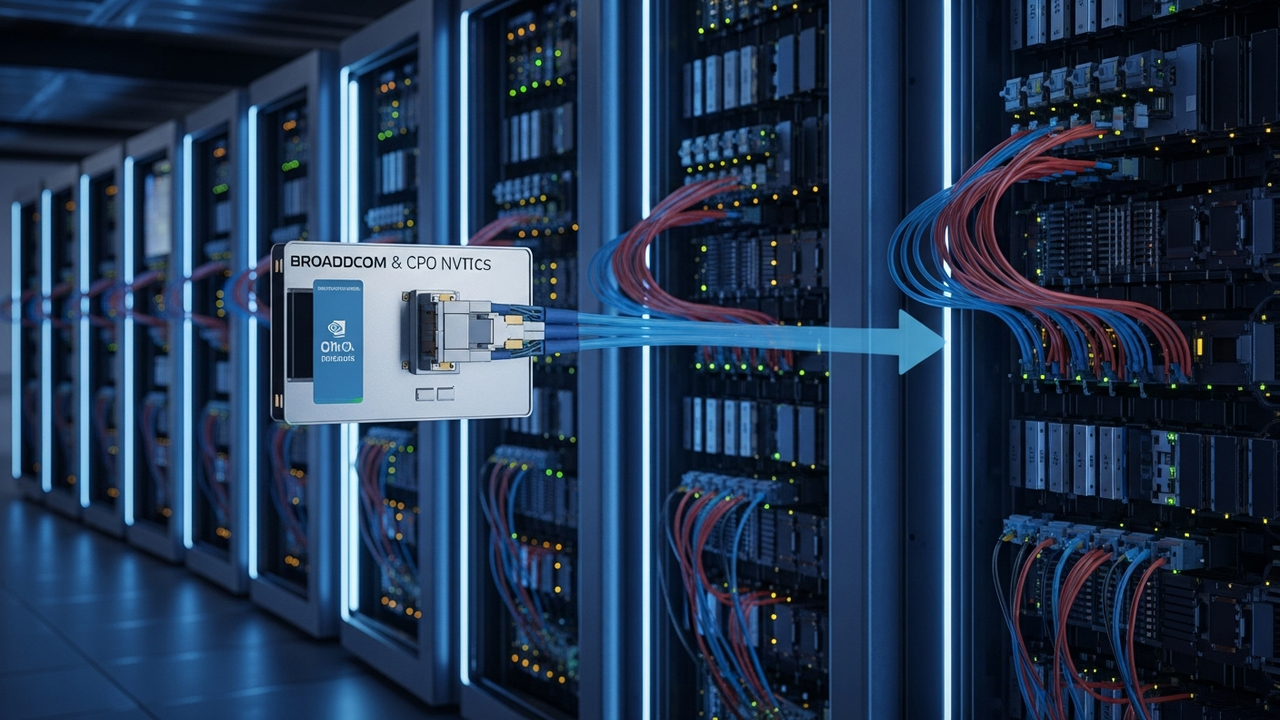
AI data centers are now decisively transitioning from traditional copper-based interconnects to advanced optical solutions, a shift driven by the performance bottlenecks encountered with electrical I/O. Pioneering technologies such as Co-Packaged Optics (CPO) and Near-Packaged Optics (NPO) are being widely adopted, with Broadcom already deploying its Davisson CPO products and Lightmatter introducing its innovative L20 optical engine. This fundamental change is setting the stage for a new era of high-performance AI infrastructure.
Technical / Clinical Details
The relentless demand for higher bandwidth and lower latency in AI workloads has pushed electrical I/O to its physical limits, manifesting in increased power consumption, signal integrity issues, and restricted routing density. Optical interconnects offer a compelling alternative, delivering significantly greater bandwidth over longer distances with reduced power footprints. CPO integrates optical engines directly into the same package as the processor, drastically shortening the electrical path between the chip and the optical module. This proximity minimizes signal degradation and latency, leading to substantial gains in system efficiency. Lightmatter’s L20 optical engine, specifically designed for AI/HPC, leverages photonic computing principles to achieve superior power efficiency and performance. Furthermore, Nvidia and Cisco are poised to deploy 1.6T optical transceivers in the latter half of 2026, promising a radical improvement in network throughput for AI clusters. The recent announcement of the Optical Compute Interconnect (OCI) Multi-Source Agreement also signals a concerted industry effort to establish interoperability standards, fostering wider adoption and accelerating innovation.
Background & Context
As AI models scale in complexity and data volumes explode, the interconnects within data centers have become a critical bottleneck. Modern GPU clusters and AI accelerators, requiring several terabytes per second of bandwidth, can no longer be efficiently linked using conventional copper. This challenge has fueled intense investment and development in optical technologies, particularly CPO and silicon photonics. Major semiconductor manufacturers, hyperscale cloud providers, and system integrators are now heavily investing in in-package optics and optical I/O solutions to meet the insatiable demands of AI workloads. This trend underscores the essential role of photonics in the future of high-performance computing.
Strategic Significance & Outlook
The evolution of optical interconnect technology is poised to revolutionize AI data center architectures. With the commercialization of CPO gaining momentum and industry leaders like Nvidia and Cisco deploying next-generation optical transceivers, the training speeds and inference capabilities of AI models are set for exponential growth. This transition will not only enhance chip-to-chip communication but also extend to intra-rack and inter-data center connectivity, maximizing the overall efficiency and scalability of AI infrastructure. Consequently, the development of even larger and more sophisticated AI models will become feasible, accelerating AI’s impact across diverse fields such as autonomous driving, drug discovery, and climate modeling, marking a profound shift in how we build and deploy AI systems globally.
Source: https://mlq.ai/news/inside-the-copper-to-optics-shift-in-ai-data-centers/
Get our weekly technology intelligence — free
Receive an infographic that lets you judge at a glance whether each field’s analysis report is worth reading.
Subscribe Free — Weekly Tech Intelligence
By subscribing, you’ll receive Troy-Technical’s weekly technology intelligence newsletter.
- Your email and selected fields are used only to deliver the newsletter.
- We never share your information with third parties.
- You can unsubscribe anytime via the link in each email.
See our Privacy Policy for details.
Takes about a minute · Unsubscribe anytime







Comments