Key Findings
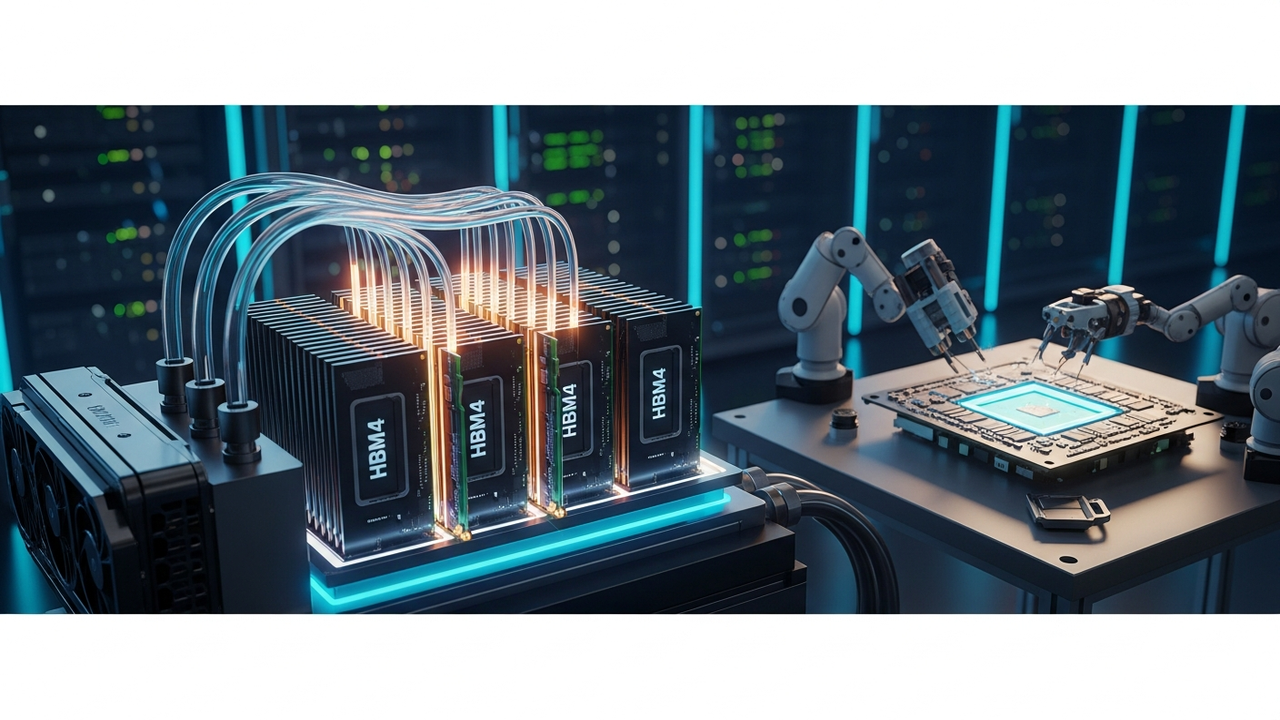
Industry observers indicate that the competitive landscape for 6th-generation High-Bandwidth Memory (HBM4) is shifting, with cooling technology becoming a primary focus. This redirection is occurring against the backdrop of delays in the widespread adoption of hybrid bonding technology. HBM4 shipments, particularly in conjunction with Nvidia’s next-generation ‘Vera Rubin’ GPU, are projected to continue their upward trajectory in late 2026.
Technical & Market Details
HBM4’s architecture is characterized by higher chip stacks, even denser integration, and more intricate packaging structures compared to its predecessors. While these advancements dramatically boost data bandwidth and processing capabilities, they simultaneously lead to increased heat generation within the chip and the overall package. As traditional cooling solutions prove inadequate for these intensified thermal challenges, efficient and advanced cooling technologies are becoming indispensable for the stable operation and sustained performance of HBM4.
Conversely, hybrid bonding technology, which enables micro-bump-less connections in HBM manufacturing, is experiencing delays in its planned deployment. These delays are attributed to the complex challenges associated with technological transitions, including substantial investments in equipment, material innovation, rigorous testing, and fundamental changes in production processes. Although hybrid bonding is ultimately expected to enhance HBM performance, its postponed widespread adoption means that immediate HBM4 competition will center on optimizing conventional bonding technologies paired with advanced cooling solutions.
The three leading HBM manufacturers—Samsung, SK Hynix, and Micron—are engaged in fierce competition for stable mass production capabilities and reliable supply to customers. Nvidia maintains a dominant position in the AI accelerator market, making the secure supply of optimized HBM4 for its next-generation ‘Vera Rubin’ GPU the biggest business opportunity for each memory manufacturer.
- **Shift to Cooling:** High-performance cooling solutions become critical due to increased HBM4 heat generation.
- **Hybrid Bonding Delays:** Complex technological transition leads to postponed mass adoption of hybrid bonding in HBM manufacturing.
- **Nvidia Vera Rubin Synergy:** HBM4 shipments expected to increase in late 2026, driven by integration with Nvidia’s next-gen GPU.
Background & Context
The exponential growth in the scale and complexity of AI models places unprecedented demands on the computational power and efficiency of semiconductor chips. HBM is an indispensable component for maximizing the performance of GPUs and AI accelerators, and its evolution is closely intertwined with the AI technology roadmap. Thermal design has always been a critical factor determining semiconductor chip performance, but its importance has intensified with the advent of high-density stacked memory like HBM. While advanced packaging technologies such as hybrid bonding are highly anticipated, the reality of their practical implementation taking time dictates the immediate direction of technological development.
Strategic Significance & Outlook
The centrality of cooling technology in HBM4 competition underscores the necessity of an integrated approach to AI-era semiconductor design and manufacturing. This will further strengthen collaboration among memory manufacturers, packaging providers, cooling solution vendors, and system integrators. Although hybrid bonding delays pose short-term challenges, HBM4 demand is expected to remain strongly driven by Nvidia’s next-generation platforms. In the long term, the maturation and widespread adoption of hybrid bonding technology are inevitable, and in synergy with advanced cooling solutions, AI chip performance is expected to reach new heights. This competition will serve as a driving force to push the performance limits of AI infrastructure and foster new innovations.
Source: https://www.digitimes.com/news/a20260717PD226/hbm4-hbm-cooling-shipments-nvidia.html
Get our weekly technology intelligence — free
Receive an infographic that lets you judge at a glance whether each field’s analysis report is worth reading.
Subscribe Free — Weekly Tech Intelligence
By subscribing, you’ll receive Troy-Technical’s weekly technology intelligence newsletter.
- Your email and selected fields are used only to deliver the newsletter.
- We never share your information with third parties.
- You can unsubscribe anytime via the link in each email.
See our Privacy Policy for details.
Takes about a minute · Unsubscribe anytime









Comments